Can You Remove NMP with a Rotary Evaporator? Vacuum Limits, Pump Requirements & When to Switch Methods
NMP can be removed under vacuum, but it is a demanding high-boiling solvent. The correct decision depends on target temperature, pressure capability, leak tightness, pump chemistry, condenser performance, and whether rotary evaporation remains the right unit operation near the endpoint.
Share this article
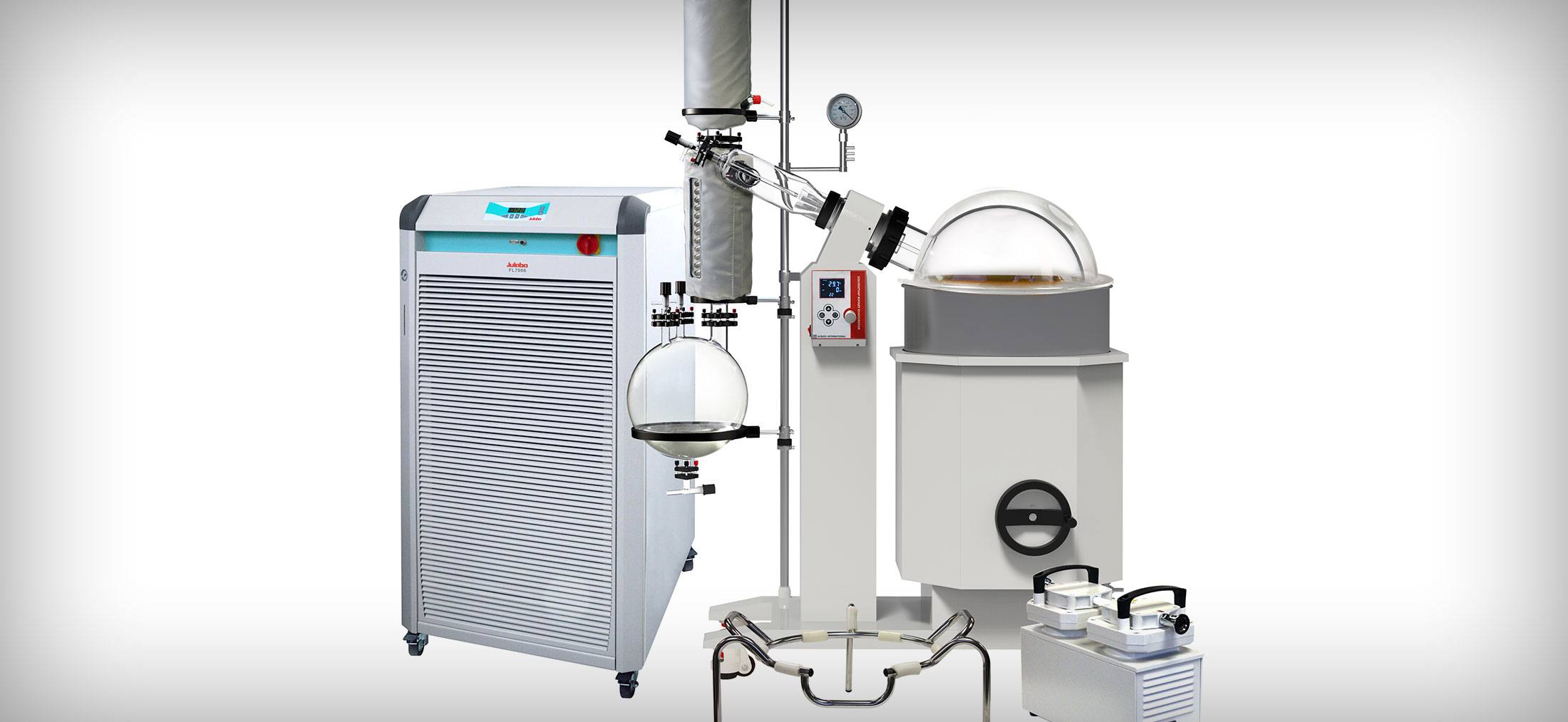
Yes — N-methyl-2-pyrrolidone (NMP) can be removed under vacuum.
But that does not mean every rotary evaporator setup is well suited to it.
NMP is a high-boiling, low-vapor-pressure solvent. A system that removes ethanol, acetone or dichloromethane quickly may slow dramatically once NMP becomes the dominant liquid.
The practical problem is not simply:
Can the rotavap reach vacuum?
It is:
Can the complete system reach and hold the pressure required for NMP at an acceptable product temperature, while still maintaining useful pumping speed and solvent recovery?
For some processes, the answer is yes.
For others, the rotary evaporator is useful for bulk removal of more volatile co-solvents, but NMP is better handled in a later vacuum-distillation or specialized evaporation step.
That distinction makes NMP an unusually useful equipment-selection case.
Decision Summary
NMP should be treated as a high-boiling-solvent application, not as a routine rotavap solvent. Start from the allowable product temperature, then define the required NMP vapor pressure. If the target approaches the pump's ultimate-vacuum specification, the system has insufficient practical headroom. Also evaluate whether the final NMP-rich stage should remain on the rotavap at all.
Affiliate disclosure: Some links in this guide are affiliate links. If you use them to contact a supplier or place an eligible order, Equipvia may earn a commission at no additional cost to you. Affiliate status does not determine which products or suppliers we include.
Why NMP Is a Difficult Rotary-Evaporation Solvent
NIST lists NMP under the chemical name 2-pyrrolidinone, 1-methyl-, CAS 872-50-4.
Its normal boiling point is about 202°C.
That immediately places it in a very different equipment class from common low-boiling laboratory solvents.
A scientific review of common aprotic solvents reports NMP vapor pressure around:
0.29 mmHg at 20°C
which is approximately:
0.39 mbar absolute
NIST phase-change data also report a boiling point around:
90°C at 15 mmHg
which is approximately:
20 mbar absolute
These two reference points show the central problem.
At high temperature, NMP can be removed at a moderate deep vacuum.
At near-ambient temperature, the required equilibrium pressure moves into the sub-mbar regime.
That is why the question "what vacuum pump do I need?" cannot be answered without first defining the temperature.
NMP Pressure: Use Source-Supported Reference Points, Not a Fake Universal Table
For some solvents, authoritative Antoine parameters cover the exact 30–80°C range commonly used in rotary evaporation.
For NMP, the public data are less convenient.
NIST provides strong phase-change data, and NIST's ThermoML archive includes a 2015 study specifically designed to improve low-pressure NMP vapor-pressure data. But a single simple public NIST Antoine table covering every normal rotavap temperature is not available in the same way it is for some other solvents.
So this guide does not invent a smooth 30/40/50/60°C pressure table by uncontrolled extrapolation.
Instead, use well-supported anchors:
| NMP condition | Pressure reference | Source context |
|---|---|---|
| 20°C | ~0.29 mmHg ≈ 0.39 mbar | Published physical-property review |
| 25°C | ~0.345 mmHg ≈ 0.46 mbar | EPA physical-chemical property review |
| 90°C boiling point | 15 mmHg ≈ 20 mbar | NIST phase-change data |
| Normal boiling point | ~202°C at atmospheric pressure | NIST |
Why this matters
These values show that temperature changes the equipment problem by orders of magnitude.
If your product can tolerate an NMP boiling temperature near 90°C, a system capable of tens of mbar may be useful.
If you need NMP removal near room temperature, the theoretical vapor pressure is already below 1 mbar.
That is a very different vacuum system.
Do Not Select the Pump From the Normal Boiling Point
Seeing a 202°C atmospheric boiling point can lead to one of two bad conclusions:
"NMP cannot be removed with a rotavap."
or:
"We just need a very hot bath."
Neither is a good equipment decision.
Vacuum lowers the boiling temperature.
The useful sequence is:
acceptable product temperature → NMP vapor pressure → operating pressure → pump capability
not:
202°C boiling point → maximum bath temperature
If the product is temperature-sensitive, deeper vacuum can reduce thermal exposure.
If the product is robust, a warmer evaporation condition can reduce the burden on the pump.
The correct answer is process-specific.
Why a 10 mbar Pump Is Not Automatically an NMP Pump
A chemistry diaphragm pump rated to 10 mbar may work well for many routine rotary-evaporation solvents.
For NMP, its suitability depends strongly on the desired boiling temperature.
NIST reports NMP boiling around 90°C at about 20 mbar.
So a 10 mbar pump can theoretically reach below that pressure.
But that does not prove it can support a practical NMP process at substantially lower temperatures.
The important questions are:
- What operating temperature is acceptable?
- What pressure is required at that temperature?
- What pumping speed remains at that pressure?
- How much gas and vapor load is present?
- How much leakage does the assembled system have?
A 10 mbar headline specification is therefore not enough to qualify the system.
Why a 6 mbar Pump Still Needs Careful Evaluation
A 6 mbar ultimate-vacuum pump provides more capability than a 10 mbar pump.
But NMP's ambient-temperature vapor pressure is below 1 mbar.
If the laboratory is trying to keep the product very cool, 6 mbar can still be far from the required equilibrium pressure.
This is an important distinction from common buying language.
A listing may say:
"Suitable for rotary evaporator"
That statement tells you almost nothing about a low-temperature NMP process.
The pump must be evaluated against:
NMP + desired boiling temperature + real system pressure
not against the word "rotary evaporator."
Related guide: How Much Vacuum Does a Rotary Evaporator Need?
A ≤1 mbar Pump Is a More Relevant Starting Point — But Not a Guarantee
The DVP2H chemistry diaphragm pump already reviewed in Equipvia's high-boiling-solvent research is a useful specification example.
The current Alibaba listing states:
- Product ID:
1600792651611 - model: DVP2H
- pump type: diaphragm pump
- published ultimate vacuum: ≤1 mbar
- pumping speed: 2 m³/h
- motor power: 360 W
- speed: 1400 rpm
- PTFE inlet/outlet
- carbon-fiber-reinforced PTFE inlet plate
- dimensions: 270 × 280 × 170 mm
- weight: 15 kg
- warranty: 1 year
- MOQ: 1 set
Its affiliate URL has already been verified through Equipvia's Alibaba Affiliate backend.
Review current DVP2H listing →
Why it is more relevant to NMP
A ≤1 mbar pump has materially more vacuum capability than 6–10 mbar-class pumps.
That matters because NMP vapor pressure is only around 0.4–0.5 mbar near 20–25°C.
But the comparison also reveals an important limit:
A pump rated to ≤1 mbar is still not automatically a comfortable room-temperature NMP system.
If the equilibrium vapor pressure is already below 1 mbar, a 1 mbar ultimate-vacuum specification leaves little or no theoretical headroom for near-ambient boiling.
For low-temperature NMP work, a buyer needs more than the ultimate pressure number.
Ask for:
- a pumping-speed curve;
- performance around 0.5, 1, 2, 5, 10 and 20 mbar;
- full wetted-material specification;
- continuous-duty capability;
- vacuum-controller compatibility;
- inlet separator / trap options.
Related guide: Vacuum Pump Selection for Rotary Evaporation
Pump Curve Matters More Than Free-Air Flow
Marketplace listings often emphasize a number such as:
33 L/min
or:
2 m³/h
Those are useful, but they are not enough.
A pump's flow normally changes as inlet pressure falls.
For NMP, the relevant question is not necessarily:
How much air does the pump move near atmospheric pressure?
It is:
How much pumping speed is available near the actual NMP operating pressure?
This is especially important if the target is in the low-single-digit-mbar range.
Ask suppliers for the curve
The quotation should ideally show pumping speed against absolute inlet pressure.
If the supplier provides only:
- maximum flow;
- ultimate vacuum;
the information is incomplete for a demanding NMP application.
Leak Tightness Becomes a System Specification
At deep vacuum, a small leak is not a minor inconvenience.
It is an additional gas load the pump must continuously remove.
For NMP, this can determine whether the process reaches the required pressure at all.
Check:
- rotary seals;
- vapor duct;
- flask joints;
- condenser joints;
- receiver connections;
- vacuum-controller fittings;
- hose connections;
- pump fittings.
Diagnostic sequence
Before replacing the pump:
- isolate and test the pump;
- test the vacuum line;
- test the empty assembled rotavap;
- then test the system under process load.
If the pump performs correctly alone but the complete system does not, the bottleneck may be leakage rather than pump depth.
The Water/NMP Problem: Mixtures Are Not Pure-Solvent Setpoints
NMP is miscible with water.
Real processes may therefore contain:
- NMP + water;
- NMP + reaction solvent;
- NMP + dissolved polymer;
- NMP + salts;
- NMP + product.
A published ACS Omega study on water/NMP vapor-liquid equilibrium treats the mixture as nonideal and uses activity-coefficient models to represent the liquid phase.
That matters operationally.
A pure-NMP pressure value should not be treated as an exact operating recipe for an NMP/water mixture.
What often changes during the run
A more volatile component can dominate early evaporation.
As that component is removed:
- the liquid composition changes;
- NMP becomes a larger fraction;
- vapor pressure falls;
- the apparent evaporation rate slows.
The user can interpret this as:
"The pump stopped working."
But the equipment may be functioning normally while the process composition has moved into a harder separation regime.
Why NMP Can Be a "Last 10%" Problem
NMP removal is often most frustrating near the endpoint.
Early in the run, the flask may contain lower-boiling co-solvents or water.
Those components can evaporate relatively quickly.
Then the system becomes NMP-rich.
At that point:
- required absolute pressure becomes lower;
- residual volume is smaller;
- dissolved product concentration rises;
- viscosity may change;
- heat and mass transfer can change;
- sample thermal sensitivity may become more important.
This creates a common mismatch:
A rotavap is effective for the first 80–90% of solvent removal, but inefficient or undesirable for the final NMP-rich stage.
That is not necessarily a failure.
It may be a signal to use a different unit operation for the endpoint.
Published Procedure Example: Rotavap First, Vacuum Distillation for NMP
An Organic Syntheses procedure provides a useful real-world example.
In that procedure, the reaction mixture is first concentrated on a rotary evaporator for bulk solvent removal.
The remaining NMP is then removed by vacuum distillation while stirring.
This is valuable because it demonstrates a more sophisticated process decision:
The rotary evaporator does not have to perform every separation step.
For some NMP processes, the efficient workflow can be:
remove easy solvent on rotavap → switch to a process better suited to the NMP-rich stage
instead of:
keep increasing bath temperature and vacuum until the rotavap does everything
This is exactly the kind of distinction that should influence equipment procurement.
When Vacuum Distillation May Be a Better Final Step
Vacuum distillation becomes more attractive when:
- NMP volume remains substantial;
- the product can tolerate the required temperature;
- the rotavap cannot maintain the necessary pressure;
- throughput matters;
- the endpoint needs more controlled separation;
- the process is moving beyond small laboratory scale.
The comparison is not simply:
rotavap vs vacuum still
It is:
which unit operation best matches each stage of the solvent-removal process?
For R&D workflows, using two methods sequentially can be more sensible than oversizing one instrument.
What About Very Small NMP Samples?
The opposite problem occurs when the sample is tiny.
A 2 L or 5 L rotavap can be an awkward tool for:
- a few milliliters;
- many parallel samples;
- medicinal-chemistry fractions;
- analytical sample preparation;
- concentration to near dryness.
A published ambient-temperature solvent-removal study demonstrated removal of difficult solvents including NMP using a different low-temperature evaporation approach.
The point is not that one alternative technology is universally better.
It is that sample scale changes the correct equipment category.
For very small NMP samples, evaluate:
- centrifugal evaporators;
- parallel sample evaporators;
- specialized vacuum evaporators;
- validated solvent-exchange methods.
Do not assume that "more powerful rotavap" is always the correct purchase.
NMP vs DMF vs DMSO: Do Not Treat Them as One Solvent Class
They are all commonly called "high-boiling solvents," but the equipment implications differ.
| Solvent | Approx. normal boiling point | Low-temperature challenge |
|---|---|---|
| DMF | ~153°C | Deep vacuum, but substantially easier than DMSO/NMP at moderate temperature |
| DMSO | ~189°C | Very deep vacuum; unusual near-room-temperature solidification behavior |
| NMP | ~202°C | Very low vapor pressure; can push low-temperature removal into sub-mbar territory |
NMP's vapor pressure around 20°C is reported near 0.29 mmHg, while DMSO is commonly reported around 0.42 mmHg at approximately the same temperature and DMF is much higher.
So an equipment configuration validated on DMF should not automatically be assumed suitable for NMP.
Related guides:
Condenser and Chiller: NMP Is Different From DMSO
DMSO has a high melting/triple-point temperature near room temperature, which makes condensate solidification an unusual concern.
NMP is different.
NIST reports a melting point around -24°C.
That means ordinary positive-temperature condenser operation does not create the same near-room-temperature freezing issue as pure DMSO.
However, condenser sizing still matters because the vapor must be recovered rather than sent to the vacuum pump.
Evaluate:
- coolant temperature;
- condenser area;
- coolant flow;
- vapor load;
- receiver routing;
- trap strategy.
A colder condenser is useful only if the complete refrigeration system has enough capacity at that temperature.
Related guide: How to Size a Chiller for a Rotary Evaporator
Pump Protection for NMP
A primary condenser does not guarantee that zero NMP reaches the vacuum line.
Potential causes include:
- aggressive evaporation;
- insufficient condenser capacity;
- warm coolant;
- entrainment;
- foaming;
- sudden pressure reduction.
For a chemistry diaphragm pump, verify chemical compatibility of:
- pump heads;
- diaphragms;
- valves;
- seals;
- tubing.
For an oil-sealed pump, solvent contamination of pump oil becomes an additional concern.
Depending on the system, an inlet separator, cold trap or secondary condenser may be appropriate.
Follow the pump and evaporator manufacturer's recommendations rather than designing protection solely from generic internet recipes.
Controlled Vacuum Is More Useful Than "Full Vacuum"
NMP encourages a bad habit:
If evaporation is slow, open the vacuum fully.
That can create an unstable system without solving the real bottleneck.
The limiting factor might be:
- pump capability;
- leakage;
- insufficient pumping speed;
- heat transfer;
- condenser capacity;
- mixture composition.
A controlled vacuum system lets the operator distinguish these problems more clearly.
For repeat work, record:
- bath temperature;
- measured absolute pressure;
- coolant temperature;
- rotation speed;
- batch volume;
- solvent composition;
- time;
- endpoint behavior.
That turns an improvised procedure into a reproducible process.
A Practical NMP Decision Workflow
Use the following sequence before buying equipment or modifying the process.
Step 1 — Define whether NMP is the only solvent
If not, identify which solvent dominates each stage.
Step 2 — Define the product-temperature limit
How warm can the sample safely become?
Step 3 — Determine the NMP pressure requirement
Use reliable vapor-pressure data for the desired temperature.
Step 4 — Compare with pump capability
Do not design a process directly at the pump's ultimate-vacuum limit.
Step 5 — Request pumping-speed data near the target
Free-air flow is not enough.
Step 6 — Test leak tightness
Especially if the target is in the low-single-digit or sub-mbar range.
Step 7 — Confirm chemical compatibility
Evaluate NMP and all co-solvents.
Step 8 — Check condenser capacity
Keep vapor out of the pump.
Step 9 — Decide where the rotavap step should end
Do not assume it must take the sample to complete dryness.
Step 10 — Compare the final-stage equipment options
Consider vacuum distillation or small-sample evaporation equipment where appropriate.
Supplier Quote Specification for NMP Work
A serious NMP pump or system quotation should answer more than "yes, suitable for rotavap."
| Requirement | Your process |
|---|---|
| Solvent | NMP |
| Co-solvents | |
| Product maximum temperature | |
| Desired NMP boiling temperature | |
| Target operating pressure | |
| Lowest required pressure | |
| Flask size | |
| Routine batch volume | |
| NMP volume per batch | |
| Pump ultimate vacuum | |
| Pumping speed at 0.5 mbar | |
| Pumping speed at 1 mbar | |
| Pumping speed at 2 mbar | |
| Pumping speed at 5 mbar | |
| Pumping speed at 10 mbar | |
| Pump curve supplied? | |
| NMP compatibility confirmed? | |
| Wetted materials | |
| Vacuum controller | |
| Inlet separator / cold trap | |
| Condenser configuration | |
| Chiller temperature | |
| Continuous duty? | |
| Voltage / frequency | |
| Warranty | |
| Replacement diaphragm / valve availability |
If the supplier cannot provide any information between free-air flow and ultimate vacuum, you still do not know how the pump will behave in the pressure range where the NMP process actually runs.
Common NMP Rotary-Evaporation Mistakes
Treating NMP like DMF
Both are high-boiling solvents, but NMP has lower volatility and can demand deeper vacuum.
Selecting a pump from the words "rotary evaporator compatible"
The process pressure matters more than the application label.
Designing directly at ultimate vacuum
A pump rated to 1 mbar is not a comfortable 1 mbar process by definition.
Ignoring the pump curve
Maximum flow and ultimate pressure are only endpoints.
Assuming the final stage should stay on the rotavap
A different unit operation may be more efficient once NMP dominates.
Treating an NMP/water mixture as pure NMP
Mixture composition changes vapor-liquid behavior.
Raising bath temperature before diagnosing the system
Check pressure, leakage, pump performance and composition first.
Sending solvent vapor directly to the pump
Condenser and trap design remain part of pump life and solvent recovery.
Frequently Asked Questions
Can NMP be removed with a rotary evaporator?
Yes, but NMP is a demanding high-boiling solvent. The setup needs sufficient vacuum capability, low leakage, chemical compatibility and appropriate condenser performance.
What is the boiling point of NMP?
NIST reports a normal boiling point around 202°C.
What vacuum is needed to boil NMP at 90°C?
NIST phase-change data report NMP boiling at about 90°C under 15 mmHg, which is approximately 20 mbar absolute.
Can NMP be evaporated near room temperature?
Its vapor pressure near room temperature is extremely low. Published values are around 0.3–0.35 mmHg, roughly 0.4–0.46 mbar near 20–25°C. That pushes the process into sub-mbar vacuum territory.
Is a 10 mbar pump enough for NMP?
It can reach below the approximately 20 mbar NIST reference associated with a 90°C boiling point, but that does not make it suitable for low-temperature NMP removal. Define the required operating temperature first.
Is a 1 mbar pump enough for NMP?
It is much more relevant for NMP than a 6–10 mbar pump, but near-room-temperature pure NMP has a vapor pressure below 1 mbar. Low-temperature work may require still more practical headroom and very good leak tightness.
Why does NMP removal slow near the end?
The early stage may contain more volatile co-solvents or water. As those are removed, the liquid becomes NMP-rich and the required vacuum becomes more demanding. Product concentration and heat/mass transfer can also change.
Should I use vacuum distillation instead of a rotary evaporator?
Sometimes. An Organic Syntheses procedure uses a rotary evaporator for bulk concentration and then removes NMP by vacuum distillation. The correct choice depends on volume, temperature limits, throughput and equipment.
Is NMP harder to remove than DMF?
At low temperature, generally yes. NMP has a higher normal boiling point and substantially lower near-room-temperature vapor pressure.
Is NMP the same problem as DMSO?
No. Both can require deep vacuum, but DMSO has a near-room-temperature solidification issue that NMP does not share; NMP melts around -24°C.
Final Takeaway
NMP is a good example of why Equipvia treats rotary evaporation as a system-selection problem, not just an instrument category.
The correct decision sequence is:
sample composition → allowable product temperature → NMP vapor pressure → operating pressure → pump headroom → pumping-speed curve → leak tightness → condenser / trap → endpoint method
The most important source-supported pressure anchors are:
- about 0.4–0.46 mbar near 20–25°C;
- about 20 mbar at a 90°C boiling point;
- about 202°C at atmospheric pressure.
That range explains why the same NMP process can look easy or nearly impossible depending on the temperature target.
And it explains why the final procurement question should not be:
"Which rotavap removes NMP?"
It should be:
"At what temperature must we remove NMP, what pressure does that require, and should the rotary evaporator remain the correct unit operation through the final NMP-rich stage?"