How Much Vacuum Does a Rotary Evaporator Need?
There is no single vacuum setting for every rotary evaporator. Required pressure depends on solvent, desired boiling temperature, vapor load, condenser performance, and vacuum control.
Share this article
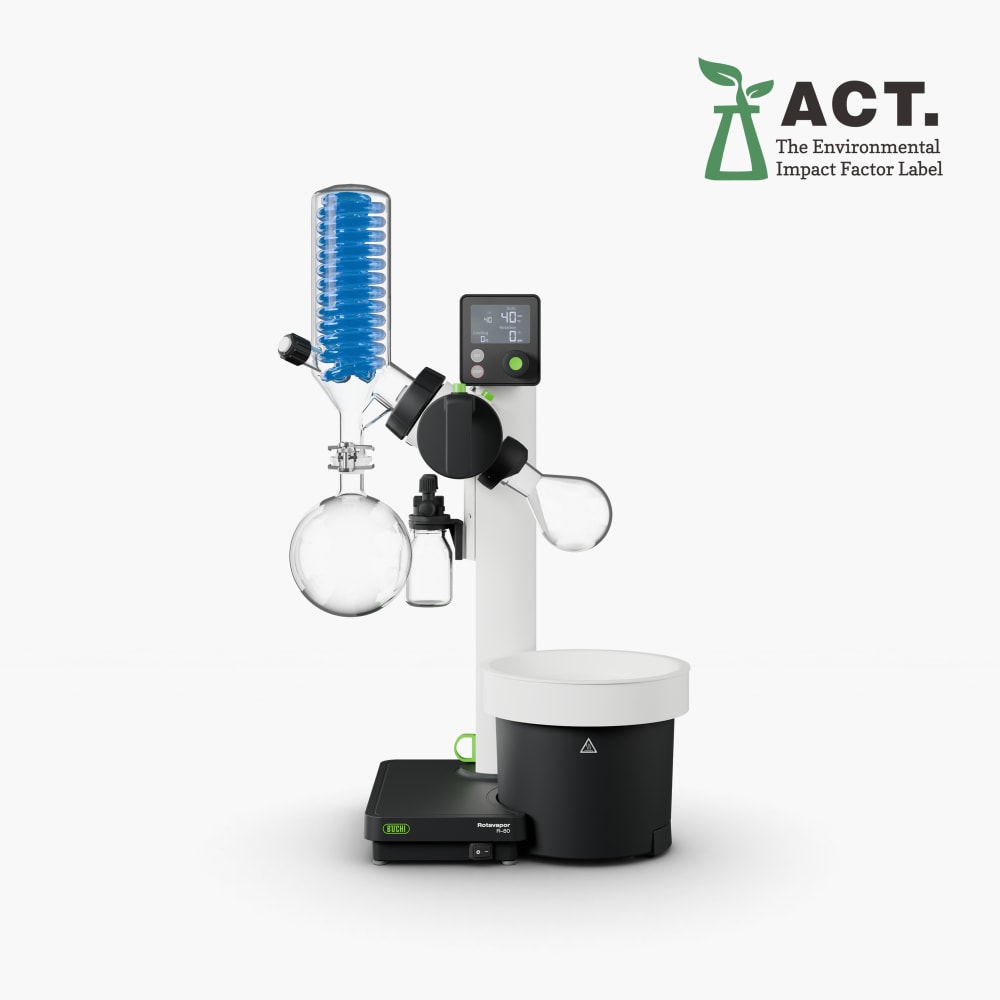
The useful sequence is:
solvent → desired boiling temperature → absolute operating pressure → pumping speed → pressure control → condenser capacity
A pump's deepest vacuum is a capability limit, not an instruction to run the rotary evaporator at that pressure.
Quick Answer
| Question | Correct starting point |
|---|---|
| What vacuum should I use? | The pressure that makes the solvent boil at the desired process temperature |
| Is lower pressure always better? | No. Excessively aggressive vacuum can cause bumping, foaming, or condenser overload |
| Does pump ultimate vacuum equal operating pressure? | No. Ultimate vacuum is the pump's capability; operating pressure is the process setpoint |
| What else sets the limit? | Solvent, temperature, vapor load, condenser, cooling, pump speed, and control |
1. Use Absolute Pressure When Comparing Vacuum Requirements
Rotary-evaporator pressure is most usefully discussed in terms of absolute pressure. Common units include mbar, hPa, Torr, mmHg, and Pa.
- 1 mbar = 100 Pa.
- 1 Torr ≈ 1.33 mbar.
- Atmospheric pressure near sea level is roughly 1013 mbar absolute.
Marketplace listings sometimes use values such as -0.098 MPa, which often describe gauge vacuum relative to atmosphere. That is not directly interchangeable with 6 mbar absolute.
2. Solvent Determines the Pressure Range
The vacuum system exists to lower a solvent's boiling point. Different solvents therefore require different process pressures.
KNF uses solvent type as the first pump-selection variable: lower-boiling solvents such as acetone do not require the same depth of vacuum as water, DMF, DMSO, or toluene.
3. Temperature Determines the Pressure Too
The same solvent can require different pressures depending on the desired boiling temperature. If the sample can tolerate more heat, less vacuum may be required. If the product is heat-sensitive, a lower boiling temperature may require deeper vacuum.
BUCHI's example table is based on a 30°C boiling point and 50°C bath. If the desired boiling temperature changes, the pressure changes as well.
4. Operating Pressure Is Not the Same as Ultimate Vacuum
Operating pressure is the pressure intentionally maintained during evaporation. Ultimate vacuum is the lowest pressure a pump can reach under specified test conditions.
For example, a chemistry diaphragm pump may be rated to 6 mbar ultimate vacuum, while ethanol in BUCHI's 30°C example uses about 97 mbar. Pulling immediately to 6 mbar would be an unnecessarily aggressive process if stable evaporation is already occurring at 97 mbar.
5. Why “Maximum Vacuum” Can Mislead
Marketplace listings often emphasize the deepest number because it looks impressive: 6 mbar, 2 mbar, 600 Pa, 0.098 MPa vacuum, or 10 mbar.
Deeper vacuum does not automatically mean faster evaporation, better recovery, better compatibility, or better pressure control. The useful comparison includes operating pressure, pumping speed, chemical resistance, control, and condenser performance.
6. Example Pressure Table for Common Solvents
The following examples are from BUCHI's published table for a 30°C boiling point with a 50°C heating bath:
| Solvent | Example pressure | Approx. Torr |
|---|---|---|
| Acetone | 370 mbar | ~278 Torr |
| Methanol | 218 mbar | ~164 Torr |
| Ethanol | 97 mbar | ~73 Torr |
| Toluene | 48 mbar | ~36 Torr |
| Water | 42 mbar | ~32 Torr |
7. Ethanol: Why 97 mbar Is an Example, Not a Rule
BUCHI lists 97 mbar for ethanol when the desired solvent boiling point is 30°C with a 50°C bath. That does not mean all ethanol rotary evaporations should run at 97 mbar.
For ethanol, define the desired boiling temperature, acceptable product temperature, condenser temperature, and pressure-control method before setting the process.
8. Water Requires Significantly Deeper Vacuum
In the same BUCHI example, acetone is 370 mbar, ethanol is 97 mbar, and water is 42 mbar at the same target boiling temperature. A pump that works well for acetone or ethanol may not provide the same performance when water, DMF, or DMSO becomes the limiting solvent.
9. Do Not Pull Full Vacuum Immediately
A rapid pressure drop can make the process unstable. Begin at a relatively mild vacuum, reduce pressure gradually, observe stable evaporation, and then stabilize near the desired process pressure.
This approach helps reduce bumping, foaming, sample carryover, condenser contamination, and solvent loss.
10. Bumping and Foaming Often Signal an Aggressive Pressure Strategy
When pressure falls too quickly, liquid can boil throughout the flask. The solution is not always a less powerful pump; it is often better pressure control and a slower ramp.
11. Vacuum Control Determines Setpoint Stability
Manual valve
Simple and suitable for closely supervised, low-frequency work, but operator dependent.
On/off or valve-based control
Maintains pressure within a defined band, but can oscillate around the setpoint.
Variable-speed control
Changes pump speed according to process demand and can provide smoother regulation with less unnecessary pumping.
12. The Condenser Sets a Practical Limit
Lower pressure can increase evaporation rate, but the condenser still has to recover the vapor. If vapor production exceeds condensation capacity, solvent can pass through the condenser, pump load can increase, and emissions or solvent loss can rise.
The useful vacuum setting is therefore a balance between heating, evaporation, and condensation—not simply the lowest possible pressure.
13. Pump Capacity Must Still Match Flask Size
The desired pressure tells you how deep the pump must go; it does not tell you how much gas and vapor the pump must move. Flask size and process vapor load affect pumping-speed requirements.
VACUUBRAND's product segmentation gives one example: a PC 3001 VARIO select is listed at 2 mbar and 2.0 m³/h for evaporation flasks up to 5 L, while a PC 3004 VARIO select is listed at 1.5 mbar and 4.6 m³/h for larger flasks. These are manufacturer-specific recommendations, not universal formulas.
14. Marketplace Examples: 6 mbar and 10 mbar
The DVP-633 listing used in Equipvia's pump guide states 33 L/min and 6 mbar ultimate vacuum. The important interpretation is:
6 mbar is a pump capability figure, not a universal rotary-evaporator operating setpoint.
A second C410 listing states 18 L/min and 10 mbar maximum vacuum. It should not be ranked only by 10 mbar versus 6 mbar; flow, compatibility, control, and condenser performance may matter more.
15. How to Read Vacuum Specifications in a Supplier Quote
| Supplier wording | What to verify |
|---|---|
| Ultimate vacuum | Absolute pressure and test conditions |
| Maximum vacuum | Ultimate absolute pressure or gauge vacuum? |
| −0.098 MPa | Gauge pressure relative to atmosphere? |
| 600 Pa or 6 mbar | Absolute or gauge? |
| 33 L/min | Free-air flow or flow at what operating pressure? |
| Pumping speed | Is a pump curve available? |
16. A Practical Method for Setting Vacuum
- Define the solvent or mixture.
- Define the desired boiling temperature from product sensitivity and process objectives.
- Find the corresponding vapor pressure.
- Set the bath temperature.
- Set condenser and chiller conditions.
- Start above the target vacuum.
- Reduce pressure gradually while watching stable boiling and condensation.
- Record the validated operating window.
Common Vacuum Mistakes
- Running at ultimate vacuum: the lowest pump pressure is not automatically the correct process pressure.
- Using one setting for every solvent: solvent vapor pressure changes the required setpoint.
- Ignoring temperature: pressure and boiling temperature are linked.
- Comparing −0.098 MPa and 6 mbar directly: one may be gauge and the other absolute.
- Pulling vacuum too quickly: rapid reduction promotes bumping and foaming.
- Ignoring condenser capacity: evaporation can exceed condensation.
- Buying from ultimate vacuum alone: speed, compatibility, and control matter too.
Frequently Asked Questions
What vacuum pressure should I use for a rotary evaporator?
Use the pressure that makes the solvent boil at the desired process temperature. There is no universal setting.
What vacuum pressure should I use for ethanol?
BUCHI gives 97 mbar as an example when ethanol boils at 30°C with a 50°C bath. Change the desired boiling temperature and the pressure changes.
What vacuum pressure should I use for water?
BUCHI gives 42 mbar for water at a 30°C boiling point with a 50°C bath. This is an example condition, not a universal water setting.
Is 10 mbar enough for a rotary evaporator?
It can be deep enough for many solvent-removal processes, but suitability depends on solvent and desired boiling temperature. Some high-boiling or low-temperature applications require deeper vacuum.
Is 6 mbar better than 10 mbar?
Not automatically. If both pumps reach the required pressure, pumping speed, compatibility, and control may matter more than the difference in ultimate vacuum.
Should I use maximum vacuum to make evaporation faster?
No. Use the pressure required for stable boiling and effective condensation. Aggressive vacuum can cause bumping, foaming, or condenser overload.
Final Takeaway
A rotary evaporator does not need one universal vacuum level. For BUCHI's example condition of a 30°C boiling point with a 50°C bath, the required pressures range from 370 mbar for acetone down to 42 mbar for water.
Buy a pump that can comfortably reach your lowest routine process pressure—but operate the rotary evaporator at the pressure the solvent and process actually require, not at the lowest number printed on the pump.