Vacuum Pump Selection for Rotary Evaporation: How to Choose the Right Pump
Choose a rotary evaporator vacuum pump by solvent, target pressure, pumping speed, flask size, chemical compatibility, vapor load, and control—not by ultimate vacuum alone.
Share this article
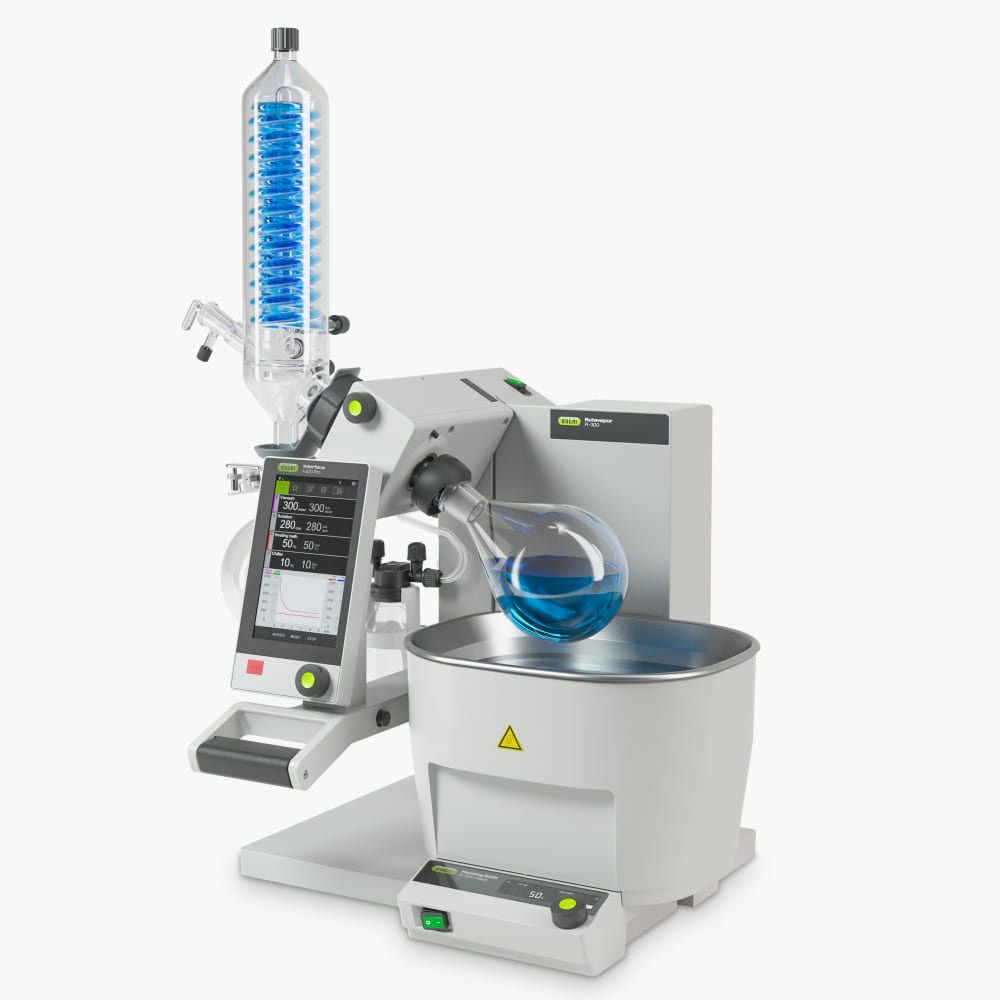
The best vacuum pump for a rotary evaporator is not automatically the pump with the lowest pressure rating. A good match must reach the pressure required for the solvents you actually remove, provide enough pumping speed for the flask and vapor load, tolerate solvent vapor, remain controllable near the useful boiling pressure, and work with the condenser and cooling system.
KNF's rotary-evaporation guidance frames the decision around solvent, flask size, bath temperature, and vacuum control. That is a better starting point than comparing pump model numbers or ultimate-vacuum figures in isolation.
Quick Selection Summary
| Decision factor | What to check | Why it matters |
|---|---|---|
| Solvents | Lowest pressure required for the least volatile routine solvent | Determines whether the pump can reach the useful process range |
| Chemical compatibility | Materials in the complete gas path | Solvent vapor can attack incompatible components |
| Flask size | Routine evaporating flask and daily workload | Larger vapor loads can require more pumping capacity |
| Pumping speed | Flow at useful pressure, not only headline flow | Too little flow slows evacuation; excessive flow can be harder to regulate |
| Vacuum control | Manual, valve/on-off, or speed-controlled | Determines stability and operator involvement |
| Condenser performance | Cooling temperature and capacity | Better condensation reduces vapor load reaching the pump |
| Maintenance | Diaphragms, oil, traps, condensate, and spares | Changes lifecycle cost and downtime |
1. Start With the Solvent, Not the Pump
Vacuum changes a solvent's boiling point. Lowering pressure allows the solvent to boil at a lower temperature, so the first technical question is:
What pressure does our process need for the solvents we actually use?
Relatively volatile solvents such as acetone do not require as deep a vacuum as less volatile solvents such as water, DMSO, DMF, or toluene. BUCHI publishes an example table for a 30°C boiling point with a 50°C heating bath:
| Solvent | Example pressure |
|---|---|
| Acetone | 370 mbar |
| Methanol | 218 mbar |
| Ethanol | 97 mbar |
| Toluene | 48 mbar |
| Water | 42 mbar |
These are examples, not universal setpoints. Change the desired boiling temperature and the required pressure changes too.
2. Ultimate Vacuum and Pumping Speed Solve Different Problems
Ultimate vacuum is the lowest pressure a pump can reach under specified conditions. It answers whether the pump can go deep enough.
Pumping speed describes how much gas the pump can move. It answers whether the pump can remove gas and vapor fast enough for the system load.
A pump can reach a very low ultimate pressure and still be poorly matched if its pumping speed is too low for the evaporator. The reverse is also true: a high-flow pump can be unnecessarily difficult to control if the application only needs modest flow.
3. Match Pumping Speed to Flask Size and Vapor Load
Flask size is a useful first screening variable, but it is not the only source of vapor load. A pump intended for a 250 mL flask should not be expected to serve a 20 L evaporation flask, and vice versa.
VACUUBRAND's current product segmentation gives one manufacturer-specific example:
| Pump example | Ultimate vacuum | Max pumping speed | Stated flask range |
|---|---|---|---|
| PC 3001 VARIO select | 2 mbar | 2.0 m³/h | Up to 5 L |
| PC 3004 VARIO select | 1.5 mbar | 4.6 m³/h | Larger than 5 L |
| PC 3003 VARIO select | 0.6 mbar | 2.8 m³/h | Larger than 5 L; higher-boiling applications |
This is VACUUBRAND's product segmentation, not a universal sizing formula. It shows why flask size, target pressure, and pumping speed have to be considered together.
4. Chemical Compatibility Is a Primary Requirement
The pump does not handle clean air. It can be exposed to solvent vapor and, if condensation is poorly managed, liquid condensate. Chemical resistance should therefore be treated as a core specification.
Request the material specification for the wetted gas path, including the diaphragm, pump head, valves, seals, tubing connections, separator, and exhaust-side components. PTFE or another fluoropolymer in one component does not prove that the complete gas path is compatible with every solvent.
5. Why Chemistry Diaphragm Pumps Are a Common Starting Point
For many laboratory rotary-evaporation applications, a chemical-resistant diaphragm pump is a practical starting point because it is oil-free, available with solvent-resistant wetted materials, compatible with electronic vacuum control, and has lower oil-maintenance burden than an oil-sealed pump.
This does not mean a diaphragm pump is correct for every process. The required pressure still has to be checked against the least volatile solvent and chosen bath temperature.
6. House Vacuum and Deeper-Vacuum Pumps
A central or house-vacuum connection can work in some facilities, but the actual pressure at the point of use may fluctuate as other users connect or disconnect. Verify pressure, stability, chemical compatibility, condensate handling, and whether a local controller or valve is required.
Higher-boiling solvents or low-temperature processes may require a higher-performance multistage diaphragm pump, hybrid system, or oil-sealed rotary-vane pump. Do not choose an oil-sealed pump simply because its ultimate-vacuum figure looks lower.
7. Vacuum Control Can Matter as Much as the Pump
A pump that can reach the correct pressure is only half of the problem. The system must also hold and adjust pressure near the useful boiling point.
Manual control
The operator adjusts a valve while watching the process. It is simple and inexpensive, but less repeatable and more operator dependent.
On/off or valve-based control
A controller maintains pressure within a band. It is more repeatable than manual operation, but pressure may oscillate around the setpoint.
Speed-controlled vacuum
The pump speed changes according to process demand. It can provide smoother regulation, reduce unnecessary pump speed, and support automation, but the value depends on run frequency, solvent variability, and the need for reproducibility.
8. Better Condensation Reduces the Pump's Burden
The vacuum pump should not be treated as the primary solvent-recovery device. The condenser should remove as much vapor as practical before it reaches the pump.
A poorly performing condenser can increase vapor load, solvent exposure inside the pump, emissions, and maintenance demand. VACUUBRAND recommends inlet separation and exhaust-side emission condensation for rotary-evaporator applications, while BUCHI offers secondary condensation on integrated systems.
9. Bath Temperature, Service, and Lifecycle Cost
Pressure and temperature are coupled. A higher bath temperature can reduce the depth of vacuum required if the sample can tolerate the heat. Define product-temperature sensitivity, bath temperature, desired boiling temperature, and condenser temperature before buying a pump.
Also compare noise, heat rejected into the room, diaphragm or seal intervals, oil maintenance, condensate handling, spare parts, controller compatibility, local service, and electrical requirements. For a pump that runs every day, lifecycle cost can matter more than purchase price.
10. Marketplace Examples
DVP-633: 33 L/min, 6 mbar chemistry diaphragm pump
One current Alibaba listing for a PTFE-coated chemical-resistant diaphragm pump showed product ID 1601607714000, model DVP-633, pumping speed 33 L/min, published ultimate/max vacuum 600 Pa / 6 mbar, fluoropolymer-related wetted-material descriptions, 200 W motor power, 9.5 kg weight, 12-month warranty, and MOQ 1 set.
C410: lower flow and shallower published vacuum
A second listing showed product ID 1600972510470, model C410, 18 L/min pumping speed, 10 mbar maximum vacuum, PTFE wetted material, 90 W motor power, below-50 dB noise claim, and explicit rotary-evaporation application.
Neither listing is a universal recommendation. The correct choice depends on pressure, flow, solvents, control, condenser, and the complete quotation.
11. A Practical Pump-Selection Workflow
- List the routine solvents.
- Define the desired boiling-temperature range.
- Identify the lowest routine operating pressure.
- Define flask size and daily throughput.
- Check all chemical compatibility.
- Choose manual, valve/on-off, or variable-speed control.
- Verify condenser and chiller performance.
- Compare pump curves at the actual operating pressure.
- Check condensate and exhaust management.
- Compare lifecycle cost, service, spares, and downtime.
12. Quote Specification Template
| Requirement | Your process |
|---|---|
| Evaporation flask size | |
| Routine batch volume | |
| Main and least volatile solvents | |
| Desired boiling temperature | |
| Target operating pressure | |
| Required pumping speed | |
| Wetted materials | |
| Vacuum-control type | |
| Pump curve available? | |
| Separator, trap, or exhaust condenser | |
| Voltage, noise, warranty, and spares | |
| Complete quoted price |
Common Selection Mistakes
- Choosing the deepest vacuum available: the pump only needs to reach the useful process range with enough control and speed.
- Ignoring pumping speed: ultimate vacuum does not describe vapor-handling rate.
- Choosing from flask size alone: solvent and bath temperature can change required pressure dramatically.
- Ignoring solvent compatibility: a pump can meet pressure specifications and still fail prematurely.
- Oversizing the pump: excess flow can increase cost and make regulation harder.
- Using a weak condenser and compensating with more pump: the condenser should recover solvent first.
Frequently Asked Questions
What type of vacuum pump is commonly used with a rotary evaporator?
Chemical-resistant diaphragm pumps are a common choice for laboratory rotary evaporation because they are oil-free and available in solvent-resistant configurations. The exact pump still has to meet solvent, pressure, and flow requirements.
Is a deeper-vacuum pump always better?
No. A pump must reach the required process pressure while remaining controllable and compatible with the solvent path. Excess capacity can add cost and make control harder.
Does a larger flask need a larger pump?
It may need more pumping capacity, but flask size alone is not enough. Vapor load, solvent, condenser, pressure, and control method all matter.
Should I choose a diaphragm or rotary-vane pump?
A chemistry diaphragm pump is often a practical starting point for routine laboratory evaporation. A rotary-vane pump may be justified for deeper-vacuum work, but solvent vapor and oil-management requirements must be addressed.
How should I compare two pump quotations?
Normalize ultimate pressure, pumping speed at useful pressure, wetted materials, controller, condenser path, accessories, service, warranty, spares, and complete-system cost.
Final Takeaway
Choose a rotary-evaporator vacuum pump in this order:
solvent → desired boiling temperature → absolute operating pressure → pumping speed → chemical compatibility → pressure control → condenser capacity
The strongest pump on paper is not automatically the best pump for the process. The best match is the one that reaches the needed pressure, moves the vapor load, survives the solvent environment, and holds a stable operating window.