How to Choose a Rotary Evaporator: A Practical Selection Guide
A practical framework for choosing a rotary evaporator by matching application, batch volume, vacuum, cooling, condenser, controls, installation requirements, and total system cost.
Share this article
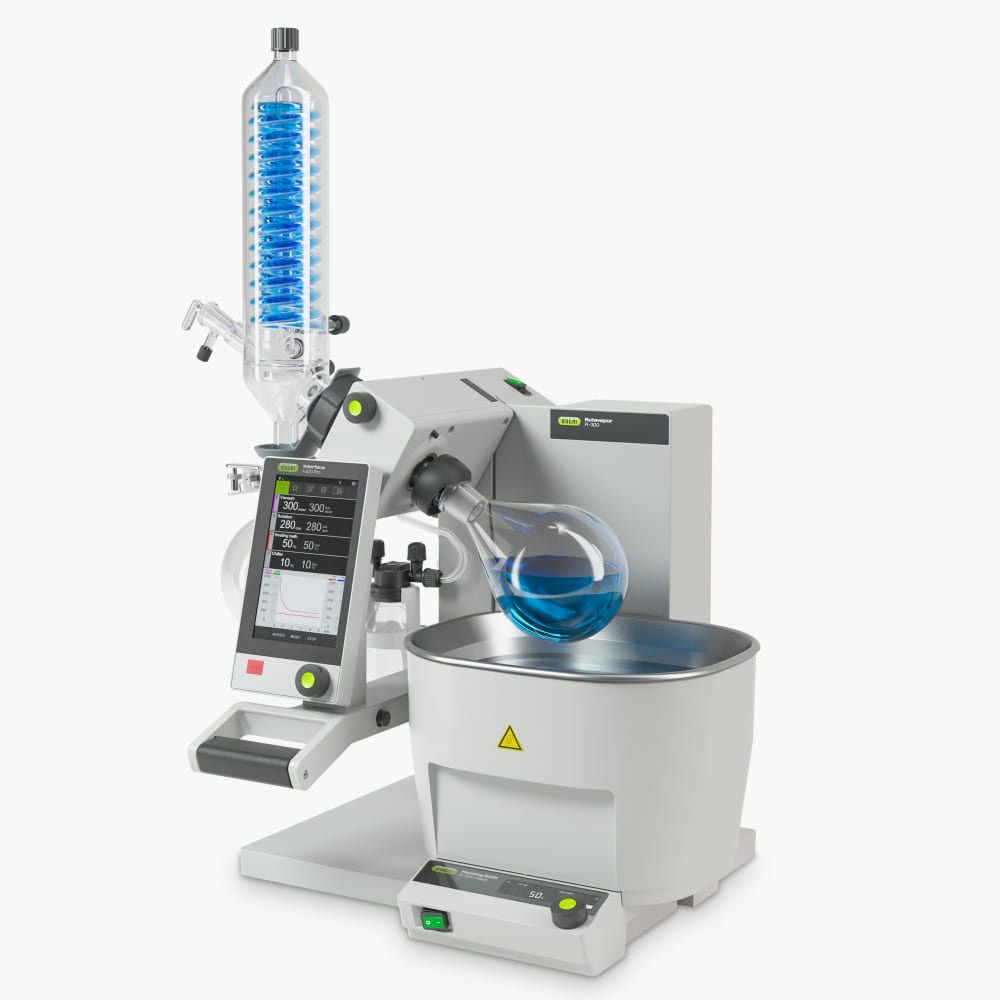
Choosing a rotary evaporator is not just a matter of comparing flask size, rotation speed, or brand. The evaporator has to work as part of a complete system, with the vacuum source, condenser, cooling system, glassware, and controls matched to the solvent, batch volume, throughput, and workflow.
For most buyers, the best starting point is not a product catalog. It is a process definition: what you need to evaporate, how much you process at a time, how often you run the process, and what vacuum and cooling infrastructure you already have. Once those requirements are clear, you can compare models on the specifications that actually matter.
Before You Compare Models, Define These Requirements
| Requirement | Why it matters |
|---|---|
| Application | Determines the overall system configuration. |
| Solvent(s) | Affects vacuum level, materials, temperature, and cooling. |
| Typical batch volume | Helps determine practical flask and bath capacity. |
| Daily throughput | Shows whether a larger system or more automation is justified. |
| Temperature limits | Influences bath settings and vacuum strategy. |
| Vacuum requirement | Determines pump and controller requirements. |
| Cooling requirement | Determines condenser and chiller requirements. |
| Automation requirement | Affects repeatability, operator workload, and cost. |
| Installation and budget | Determines which configurations are practical in your lab. |
1. Start With the Process, Not the Rotary Evaporator
A specification sheet only becomes useful after you know what the system has to do. Start by documenting the process itself.
What are you using the rotary evaporator for?
Common tasks include solvent removal, sample concentration, solvent recovery, routine reaction work-up, drying, and method development. These tasks can place very different demands on the same nominal flask size. A system suitable for occasional small-batch concentration may not be a good fit for repeated solvent recovery throughout the day.
Which solvents will you process?
Solvent properties affect the pressure required to evaporate at an acceptable temperature, the chemical compatibility of the vacuum path, seals, tubing, and pump, the vapor load reaching the condenser, and the cooling conditions required for reliable condensation.
This is why pump manufacturers such as KNF start rotary-evaporation pump selection with the solvent, flask size, bath temperature, and method of vacuum control rather than with a pump model.
How much material do you process per batch?
Use your normal working batch as the starting point, not the largest batch you might process once a year. Record the typical liquid volume, largest routine batch, number of batches per day, acceptable processing time, and expected future increase in workload.
This distinction matters because capacity and throughput are not the same thing.
How often will the system run?
A manually operated system can be perfectly reasonable for occasional work. Repetitive daily operation may justify motorized lifting, tighter vacuum control, programmable methods, or a workflow designed around faster turnaround. The right level of equipment depends on the workload, not on how many features appear on the control panel.
2. Understand the Complete Rotary Evaporator System
A rotary evaporator does not perform the complete separation process by itself. A typical system may include:
- rotary drive;
- evaporating flask;
- heating bath;
- vapor duct and seals;
- condenser;
- receiving flask;
- vacuum controller or regulator;
- vacuum pump or laboratory vacuum source;
- cooling-water source or recirculating chiller;
- tubing, traps, adapters, and application-specific glassware.
Manufacturers increasingly present rotary evaporation as a system rather than a single instrument. IKA, for example, sells complete packages that combine the evaporator, bath, glassware, vacuum pump, vacuum controller, recirculating chiller, and connection hardware. That is a useful purchasing mindset even if you ultimately buy the components separately.
What comes with the evaporator?
Never assume that a quoted rotary evaporator includes the vacuum pump, controller, chiller, or all required glassware. Ask the supplier for a written list of included components, optional components, required peripherals, recommended tubing and fittings, spare glassware, replacement seals, and electrical requirements.
Current Marketplace Examples
These listings are included as comparison examples, not as product ratings or endorsements. They show why the complete package needs to be checked instead of comparing the evaporator body alone.
| Listing | What to check | Link |
|---|---|---|
| Yuhua 2 L full-system listing | Advertised with a water chiller, vacuum pump, and vacuum controller; confirm the exact models and included components. | View current listing |
| LAB1ST rotary evaporator listing | Review the capacity options and verify any configuration described in the title against the detailed specification table. | View current listing |
| YHCHEM RE-502, 2 L | Check whether the quotation includes the pump, chiller, controller, and complete glassware package. | View current listing |
3. Choose Capacity Based on Routine Batch Volume and Throughput
Flask capacity is usually the first specification buyers notice, but it should not be the only sizing criterion.
Flask capacity is not the same as working volume
A flask's nominal volume is a physical capacity specification. Your usable working volume depends on the process, foaming tendency, rotation, heat transfer, and manufacturer guidance. Avoid selecting a system from a simple rule such as “a 2 L flask is always suitable for X mL.” Use the manufacturer's operating instructions and your process requirements to determine a practical working range.
Match the system to your normal batch
If most of your work is small-volume R&D, an oversized system can create unnecessary cost, space, handling, cooling, and vacuum requirements. If you regularly process larger batches, repeatedly running an undersized system can create its own cost through operator time and slow throughput.
Think in batches per day
Ask how many batches must be completed in one shift, how long loading, evaporation, draining, cleaning, and setup take, whether a larger flask would actually reduce total cycle time, and whether automation would improve throughput more than simply increasing flask size.
Heidolph has highlighted this same trade-off in high-throughput applications: increasing vessel size is not the only way to increase throughput; automation and liquid handling can also change the workflow.
A larger evaporator changes the rest of the system
Moving up in flask capacity can also increase requirements for heating, condensation, vacuum pumping, cooling capacity, glassware handling, and bench or hood space. Treat capacity as a system decision.
4. Match the Vacuum System to the Solvent and Process
Vacuum selection is one of the most important parts of rotary-evaporator configuration. The objective is not to buy the pump with the lowest possible ultimate-pressure number. The objective is to maintain the pressure required by the process, at a controllable pumping speed, with materials compatible with the vapor stream.
What vacuum level does the process require?
Reducing pressure lowers the boiling temperature of a solvent. The required pressure therefore depends on the solvent and the temperature at which you want the process to run. If heat exposure needs to be limited, deeper vacuum may be required. If the sample tolerates more heat, higher bath temperature may reduce the amount of vacuum needed.
The process determines the requirement.
Ultimate vacuum and pumping speed are different specifications
Ultimate vacuum describes how low a pump can reduce pressure under specified conditions. Pumping speed describes how much gas or vapor the pump can move. Both matter.
KNF explicitly cautions that a larger pump is not automatically better for rotary evaporation. A pump with excessive flow can be harder to regulate and more expensive to buy and operate; a pump that is too small can lengthen processing time.
Decide how you want to control the vacuum
Vacuum may be controlled manually, by on/off control between set points, or by more adaptive systems that change pump operation to maintain the desired process pressure. More sophisticated control can be valuable where you need repeatable procedures, less operator intervention, reduced bumping risk, better solvent recovery, or operation across changing solvent conditions.
Check chemical compatibility
The vapor path may expose the pump, tubing, seals, controller, and traps to solvent vapor. Do not assume compatibility from a generic statement such as “chemical resistant.” Ask the supplier for the specific wetted materials and verify them against the solvents you actually use.
5. Make Sure the Cooling System Can Handle the Vapor Load
Evaporation and condensation are two sides of the same heat-transfer process. BUCHI explains rotary evaporation as a heat balance: heat added on the evaporation side must ultimately be removed during condensation. If vapor is generated faster than it can be condensed, system pressure can rise and more solvent vapor can reach the vacuum pump.
That is why cooling is a system requirement, not an accessory decision made at the end.
Tap water, dry ice, or a recirculating chiller?
Common cooling approaches include laboratory cooling water, ice or dry-ice configurations, and recirculating chillers. Heidolph identifies cooling method as a key buying decision because it affects system performance, operating economy, handling, and throughput.
The right choice depends on required condenser temperature, solvent properties, operating hours, availability and cost of cooling water, environmental requirements, desired process consistency, and available space.
Cooling temperature is not cooling capacity
A chiller may be capable of reaching a low fluid temperature but have limited cooling capacity at that temperature. When comparing chillers, check the manufacturer's cooling-capacity curve or rated cooling capacity at the temperature you intend to use, not only the lowest temperature printed on the front page.
When a dedicated chiller makes sense
A recirculating chiller can be attractive when the laboratory needs more consistent cooling, reduced water use, repeatable conditions, or longer operating periods. But the chiller must still be sized to the vapor load and operating temperature.
6. Choose the Condenser for the Application and Available Space
Rotary evaporators are commonly offered with vertical, diagonal, and cold-finger or dry-ice condenser arrangements. The important point is that orientation alone does not determine performance.
IKA, for example, states that the vertical and diagonal condensers used on its RV 10 have the same cooling surface and cooling power. That makes a useful general buying lesson: compare the actual condenser specification and the manufacturer's application guidance instead of assuming that one orientation is universally more efficient.
Compare these condenser factors
- condenser configuration;
- cooling surface;
- available coolant;
- coolant temperature;
- solvent vapor load;
- footprint and overall height;
- glassware access;
- receiving-flask configuration;
- application-specific accessories.
Vertical vs diagonal
The practical choice may be influenced by installation space and glassware layout as much as by the process. Yamato, for example, notes space and application considerations in its condenser selection guidance, while IKA shows that two orientations can have equivalent cooling surface and power within a given system.
Cold-finger configurations
Cold-finger or dry-ice condensers can be useful where a dry-ice-based cooling arrangement is preferred or where a continuous cooling-water supply is not desirable. The actual suitability depends on the solvent and manufacturer configuration.
7. Check the Heating Bath, Rotation Range, and Lift
After capacity, vacuum, cooling, and condenser requirements are understood, compare the main evaporator's operating features.
Heating bath
Check the bath medium supported by the manufacturer, temperature range, heating power, bath size, temperature control, over-temperature protection, and physical adjustment range. The required operating temperature should come from the process and the manufacturer's instructions, not from a generic “best temperature” published online.
Rotation range
Rotation promotes mixing and increases the liquid-film area available for evaporation. Compare the available speed range with your real workflow rather than assuming the highest RPM is automatically superior.
Yamato's current product range illustrates why this matters: different models offer different speed ranges and operating modes, including features aimed at particular R&D workflows.
Manual vs motorized lift
A manual lift can be simple and economical. A motorized lift can reduce handling effort and improve workflow where the unit is used frequently or larger glassware is involved. Consider use frequency, flask size, operator ergonomics, maintenance requirements, emergency lifting behavior, and cost.
8. Decide How Much Automation You Actually Need
Automation is valuable when it solves a workflow problem. It is not valuable simply because the instrument has more menu options.
Basic manual control
Manual control may be suitable when procedures are simple, run frequency is low, operators remain nearby, and process variability is acceptable.
Digital vacuum control
Digital control is useful when pressure needs to be repeatable and closely managed.
Programmable and adaptive operation
Programmable operation can reduce repeated manual adjustments in standardized workflows. Higher-level systems may coordinate pump speed, vacuum, bath, or cooling equipment.
Evaluate these features against four questions:
- Do you run the same procedure repeatedly?
- How important is process reproducibility?
- How much operator attention does the current process require?
- Will the feature save enough time or reduce enough process variation to justify its cost?
A feature that never gets used is not an upgrade.
9. Check Glassware, Seals, Tubing, and Replacement Parts
Glassware and seals are not secondary details. They are part of the vacuum boundary and will eventually require replacement or maintenance.
Glassware configuration
Confirm evaporating-flask sizes, receiving-flask sizes, joint sizes, condenser compatibility, bump traps or foam-management accessories, and feed tubes or continuous-feed accessories.
Coated vs uncoated glassware
Some manufacturers offer safety-coated glassware. Do not assume the coating makes the glass “unbreakable” or changes allowable operating limits unless the manufacturer explicitly documents that claim. Treat coating as a specific feature to evaluate against the manufacturer's safety documentation.
Wetted materials and solvent compatibility
Request a materials list for seals, tubing, vacuum valves, pump head, diaphragm or other pump wetted parts, and traps and adapters.
Spare-parts availability
Before purchase, check whether you can obtain replacement evaporating flasks, receiving flasks, condensers, seals, vapor ducts, tubing, clamps, and bath components. A low purchase price is less attractive if ordinary replacement parts are difficult to source.
10. Verify Installation, Utilities, and Safety Requirements
A rotary evaporator that fits the process but not the laboratory is still the wrong system.
Measure the complete installation
Do not measure only the evaporator base. Include condenser height, flask swing and lift travel, vacuum pump, chiller, tubing bends, ventilation clearance, service access, and electrical connections.
BUCHI's pre-installation documentation treats pump and chiller clearances, power, cooling water, ventilation, and workspace as installation requirements. That is a strong reminder to evaluate the complete footprint before ordering.
Check power and utilities
Confirm voltage, frequency, plug or electrical connection, total power demand, cooling-water requirements, drainage if applicable, ventilation requirements, and laboratory vacuum availability, if used. Never assume a listing marked “110/220 V” is ready for your site without confirming the exact ordered configuration.
11. Compare Total System Cost, Serviceability, and Lifecycle Support
A low evaporator price can be misleading if the system still needs several major components. Calculate the cost of the working configuration:
Rotary evaporator + heating bath + vacuum pump + vacuum controller + chiller or cooling system + required glassware + traps, tubing, and adapters + spare seals and glassware + shipping/import costs + service and maintenance.
Ask what is actually included
For every quotation, request an itemized bill of materials. This makes it easier to compare offers that are packaged differently.
Check ongoing support
Ask about warranty, replacement-part availability, glassware lead times, technical support, manuals, wiring diagrams where applicable, service procedures, and consumable part numbers. For imported equipment, parts availability can matter as much as the initial purchase price.
12. Build Your Shortlist With a Specification Checklist
| Requirement | Your specification |
|---|---|
| Primary application | |
| Solvent(s) | |
| Typical batch volume | |
| Largest routine batch | |
| Runs per day | |
| Required throughput | |
| Sample temperature constraints | |
| Required pressure/vacuum range | |
| Existing vacuum source | |
| Vacuum control required | |
| Existing cooling source | |
| Chiller required | |
| Condenser preference | |
| Available bench/hood width | |
| Available height | |
| Manual or motorized lift | |
| Automation required | |
| Required glassware/accessories | |
| Facility voltage/frequency | |
| Spare-parts requirement | |
| Target budget |
When comparing quotations, force every supplier offer back into this same structure. That makes missing specifications much easier to spot.
13. Common Rotary Evaporator Buying Mistakes
Choosing by flask capacity alone
Capacity matters, but it does not define the complete system. A larger flask can also change heating, vacuum, cooling, handling, and installation requirements.
Treating the vacuum pump as an afterthought
The pump must match solvent, process pressure, vapor load, chemical compatibility, and control strategy.
Assuming the biggest pump is the best pump
Excessive pumping speed can be difficult to control and unnecessarily expensive. Insufficient pumping speed can slow the process.
Ignoring cooling requirements
A powerful evaporator paired with inadequate condensation capacity can create a poorly balanced system.
Assuming condenser orientation determines performance
Compare actual condenser surface, cooling conditions, and manufacturer guidance.
Paying for automation the workflow does not need
Start with the process and operator workload, then justify automation from the task.
Forgetting installation space and utilities
Check the complete footprint, height, power, coolant, ventilation, and service access before ordering.
Comparing bare-machine prices instead of working-system cost
Make every quote include the same required components before comparing price.
Ignoring replacement glassware and seals
Parts that wear or break should be easy to identify and source.
Frequently Asked Questions
What size rotary evaporator do I need?
Start with your typical batch volume and required daily throughput rather than the largest possible batch. Then confirm the manufacturer's recommended flask operating range and check whether the corresponding bath, condenser, vacuum source, and cooling system are sized for the same workload.
Do I need a chiller for a rotary evaporator?
Not every setup uses a dedicated recirculating chiller. Laboratories may use facility cooling water, dry-ice configurations, or recirculating chillers. The correct choice depends on the solvent, vapor load, operating time, required consistency, and available utilities.
What vacuum pump do I need for a rotary evaporator?
Choose the pump based on solvent, required pressure, flask size, vapor load, bath temperature, chemical compatibility, and how you plan to control the vacuum. Do not select from ultimate-vacuum numbers alone.
How much vacuum does a rotary evaporator need?
There is no single pressure that is correct for every solvent and process. The target pressure should allow evaporation at an appropriate process temperature while maintaining stable, controllable operation.
Is a vertical or diagonal condenser better?
Not universally. Condenser geometry has to be considered together with cooling surface, coolant conditions, application, and installation space. IKA, for example, states that its RV 10 vertical and diagonal condensers provide the same cooling surface and power.
Is a 2 L or 5 L rotary evaporator better?
Neither size is inherently better. Compare your routine batch volume, number of batches per day, available space, glassware handling, and the vacuum and cooling requirements of the complete system.
What equipment do I need for a complete rotary evaporator setup?
A typical setup may require the evaporator and bath, glassware, vacuum source, vacuum controller or regulator, cooling source or chiller, tubing, traps, and application-specific accessories. The exact package varies by manufacturer.
Final Takeaway
A rotary evaporator should be selected as a process system, not as an isolated machine.
Define the application first. Then work through batch volume and throughput, vacuum, cooling, condenser, controls, glassware, installation, and lifecycle support in that order.
When those requirements are written down, comparing products becomes much easier—and a supplier quotation becomes a technical comparison rather than a list of marketing claims.