How to Remove DMSO with a Rotary Evaporator: Deep Vacuum, Condenser & Pump Requirements
DMSO is one of the more demanding solvents to remove on a rotary evaporator. The key variables are target boiling temperature, single-digit-mbar vacuum capability, leak tightness, vapor-path design, condenser behavior, and pump protection.
Share this article
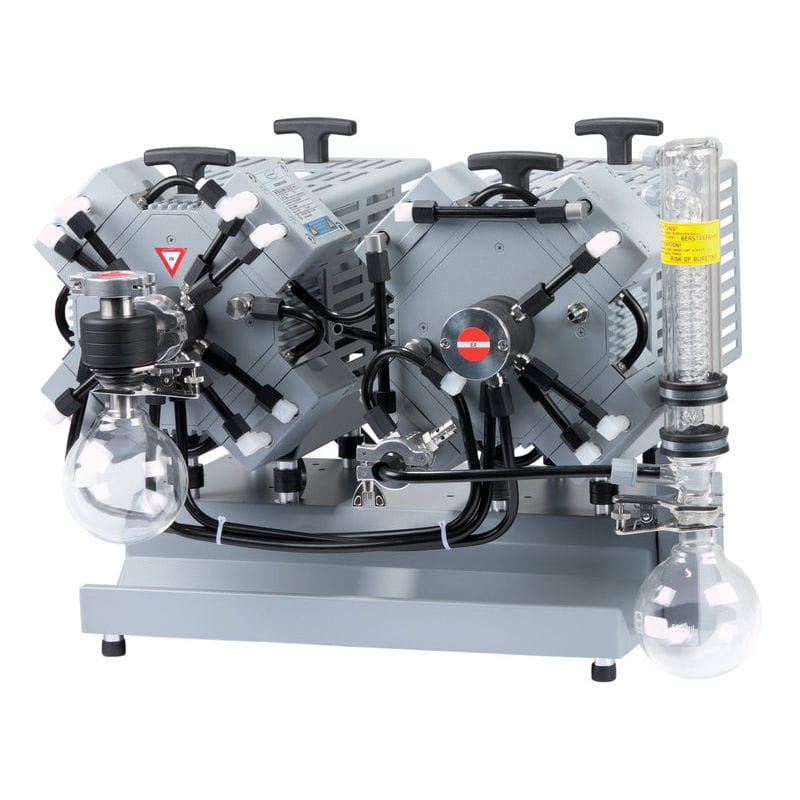
DMSO is not a good solvent for testing whether a rotary evaporator can simply "pull vacuum."
It is a better test of whether the complete system can sustain a deep, controlled vacuum under a high-boiling-solvent load.
A setup that removes acetone, dichloromethane or ethanol easily can still struggle badly with dimethyl sulfoxide (DMSO).
The main reason is vapor pressure.
At moderate temperatures, DMSO has a very low vapor pressure. To make it boil at a temperature suitable for many laboratory samples, the system may have to operate in the low-single-digit mbar range.
That immediately makes several details more important:
- ultimate vacuum;
- pump performance near 1–10 mbar;
- leak tightness;
- vacuum control;
- chemical compatibility;
- glassware and vapor-path design;
- condenser behavior;
- solvent trapping and pump protection.
Heidolph explicitly treats DMSO as a high-boiling rotary-evaporation solvent and publishes a manufacturer-specific reference condition of 85°C heating bath, 5 mbar vacuum, with a 15°C chiller condition in its solvent-data tool.
That is not a universal DMSO recipe.
But it shows the scale of the vacuum requirement.
Decision Summary
If DMSO is a routine solvent in your lab, select the system around the intended DMSO boiling temperature first. A pump rated around 6–10 mbar may have little or no useful pressure margin for low-temperature DMSO work. A chemically resistant pump capable of around 1 mbar or below provides more headroom, but the complete system still has to be leak-tight and controllable.
Affiliate disclosure: Some links in this guide are affiliate links. If you use them to contact a supplier or place an eligible order, Equipvia may earn a commission at no additional cost to you. Affiliate status does not determine which products or suppliers we include.
Why DMSO Is More Difficult Than DMF
Both DMSO and DMF are high-boiling solvents, but DMSO is even more demanding at low temperature.
Using NIST vapor-pressure data:
- DMF at 30°C is approximately 7.3 mbar;
- DMSO at 30°C is approximately 1.14 mbar.
That is a major equipment difference.
A pump that has reasonable margin for DMF can be operating very close to its ultimate-vacuum limit when asked to evaporate DMSO at the same temperature.
This is why DMSO deserves its own equipment-selection guide rather than being buried inside a generic "high-boiling solvents" article.
Related guide: How to Remove DMF with a Rotary Evaporator
DMSO Vacuum Pressure by Boiling Temperature
NIST publishes Antoine-equation parameters for dimethyl sulfoxide.
For the lower-temperature range, NIST gives one coefficient set from 293 to 323 K. A second coefficient set covers 325.49 to 442.09 K.
Using those NIST parameters gives the following approximate pure-DMSO vapor pressures:
| Desired DMSO boiling temperature | Approx. absolute pressure | Approx. Torr |
|---|---|---|
| 20°C | 0.56 mbar | 0.42 Torr |
| 25°C | 0.80 mbar | 0.60 Torr |
| 30°C | 1.14 mbar | 0.85 Torr |
| 35°C | 1.60 mbar | 1.20 Torr |
| 40°C | 2.21 mbar | 1.66 Torr |
| 45°C | 3.02 mbar | 2.27 Torr |
| 55°C | 5.34 mbar | 4.00 Torr |
| 60°C | 7.10 mbar | 5.33 Torr |
| 70°C | 12.21 mbar | 9.16 Torr |
| 80°C | 20.23 mbar | 15.17 Torr |
These values are calculated from the NIST Antoine parameters for pure DMSO.
They are reference values, not guaranteed process setpoints.
Why 50°C is not shown
NIST's two published Antoine-fit ranges leave a small gap around approximately 50–52°C.
Rather than extrapolating beyond the stated range and presenting that result as an official-condition value, this guide leaves that point out.
That is the type of detail that matters when technical content is supposed to support equipment decisions rather than just fill a solvent table.
Heidolph's DMSO Example: 5 mbar
Heidolph's current solvent-data tool lists:
- solvent: dimethyl sulfoxide;
- heating bath temperature: 85°C;
- vacuum: 5 mbar;
- footnote: at a chiller temperature of 15°C.
This is useful because NIST data show that pure DMSO reaches approximately 5.34 mbar at 55°C.
So the manufacturer-specific Heidolph setting is directionally consistent with a DMSO vapor temperature in the mid-50°C range.
Do not turn that into:
"DMSO must always run at 5 mbar."
Instead read it as:
A real rotary-evaporator manufacturer treats DMSO as a single-digit-mbar process.
That is the equipment-selection signal.
What Pump Capability Does DMSO Actually Require?
Start with the desired boiling temperature.
If you want DMSO near 60°C
Pure-DMSO reference pressure is approximately:
7.1 mbar
A 10 mbar pump is not a comfortable match.
A 6 mbar pump has only limited nominal margin.
If you want DMSO near 40°C
Reference pressure is approximately:
2.21 mbar
A 6 mbar pump cannot theoretically reach that pure-solvent boiling pressure.
A 2–3 mbar-class pump is at or near the process target.
A ~1 mbar-class pump gives more useful margin.
If you want DMSO near 30°C
Reference pressure is approximately:
1.14 mbar
Even a pump rated to ≤1 mbar is operating close to the required pressure range.
For this kind of low-temperature target, system leakage, vapor load and the actual pumping-speed curve become critical.
Buyer Check
Never specify a DMSO pump only as "ultimate vacuum ≤1 mbar." Ask for pumping performance around the actual target pressure.
Why Ultimate Vacuum Alone Is Not Enough
Suppose two pumps are rated:
- Pump A: 6 mbar ultimate vacuum;
- Pump B: 1 mbar ultimate vacuum.
For DMSO, Pump B has a clear pressure advantage.
But that still does not tell you:
- pumping speed at 2 mbar;
- pumping speed at 5 mbar;
- chemical compatibility;
- resistance to condensed solvent;
- pressure-control capability;
- whether the pump loses performance under vapor load.
The useful comparison is:
Can the pump reach and hold the intended operating pressure while DMSO is actively evaporating?
That is different from:
What pressure does the pump reach in a blank ultimate-vacuum test?
Related guide: Vacuum Pump Selection for Rotary Evaporation
A ≤1 mbar Marketplace Example
The DVP2H listing already reviewed in Equipvia's DMF research is also relevant as a DMSO pump-specification example.
The current Alibaba listing states:
- Product ID:
1600792651611 - model: DVP2H
- pump type: diaphragm pump
- published ultimate vacuum: ≤1 mbar
- pumping speed: 2 m³/h
- motor power: 360 W
- speed: 1400 rpm
- PTFE inlet/outlet
- carbon-fiber-reinforced PTFE inlet plate
- dimensions: 270 × 280 × 170 mm
- weight: 15 kg
- warranty: 1 year
- MOQ: 1 set
Its Alibaba Affiliate link has already been verified through the account's backend.
Review current DVP2H listing →
What this specification means for DMSO
A ≤1 mbar ultimate-vacuum specification gives much more useful pressure headroom than a 6–10 mbar pump for DMSO.
But look at the NIST reference values:
- DMSO at 30°C: ~1.14 mbar;
- DMSO at 35°C: ~1.60 mbar;
- DMSO at 40°C: ~2.21 mbar.
For a 30°C target, even this pump's headline ultimate-vacuum specification is close to the process requirement.
That is why the supplier should still provide:
- a pump curve;
- wetted-material details;
- continuous-duty information;
- controller compatibility;
- DMSO compatibility;
- separator / trap options.
The product is useful as a deep-vacuum diaphragm-pump example, not proof that every DMSO process will work.
Welch's High-Boiling-Solvent Positioning
Welch currently positions deeper-vacuum chemical-duty pumps for high-boiling rotary-evaporation solvents.
Its rotary-evaporation guidance lists pump families around approximately:
- 12 mbar for many common solvents;
- 2–2.7 mbar for higher-boiling duties such as DMF;
- deeper chemical-duty configurations where lower pressure is required.
Welch also specifically references DMSO at 55°C in connection with its two-stage DryFast Ultra pumps.
The exact model recommendation belongs to Welch's own product family, but the broader engineering message aligns with the NIST calculation:
DMSO becomes a low-single-digit-mbar process when the desired boiling temperature is in the 40–60°C region.
Leak Tightness Matters More as Pressure Falls
Heidolph states that an absolutely leak-proof rotary evaporator system is important for high-boiling solvents such as DMF and DMSO.
This becomes intuitive when you compare target pressures.
At 100 mbar, a small leak may reduce performance without completely preventing evaporation.
At 2 mbar, the same leak can become the dominant gas load.
Check:
- vapor duct seals;
- rotary seals;
- flask joints;
- condenser joints;
- receiving flask joints;
- vacuum tubing;
- vacuum-controller fittings;
- pump-side connectors.
Diagnostic principle
If the pump reaches its normal vacuum when isolated but not when connected to the rotary evaporator, do not immediately buy a deeper pump.
First determine whether the assembled system is leaking.
DMSO Has a Second Niche Problem: It Can Solidify Near Room Temperature
NIST lists DMSO's triple-point temperature at approximately 291.67 K, which is about 18.5°C.
That is unusually important for an evaporation solvent.
Engineering implication
For pure or DMSO-rich material, surfaces near or below this temperature can create a possibility of solidification.
Mixtures can behave differently because dissolved components and other solvents can shift phase behavior.
This does not mean that every condenser operated below 18.5°C will automatically plug.
It means DMSO-specific evaporation has a phase-behavior issue that ethanol or acetone users may never encounter.
Why this matters near the endpoint
A published study on low-temperature solvent removal reported that rapid DMSO evaporation can produce enough evaporative cooling for partial freezing.
For a small concentrated sample, the endpoint can therefore behave differently from the middle of the evaporation.
If a process becomes unexpectedly sluggish near dryness, consider:
- rising solute concentration;
- decreasing liquid volume;
- evaporative cooling;
- DMSO-rich material solidifying;
- a change in mixture composition.
Do not assume every slowdown means the pump is failing.
Colder Condenser Temperature Is Not Automatically Better
DMSO exposes the weakness of the generic rule:
"Make the condenser as cold as possible."
A colder condenser can improve the temperature driving force for condensation.
But DMSO also has a relatively high solidification temperature.
That means condenser strategy should account for both:
- vapor recovery;
- phase behavior of the condensate.
Heidolph's solvent-data example uses a 15°C chiller condition for its DMSO row.
Because DMSO's pure-compound triple point is around 18.5°C, the practical condensate behavior should be monitored in the actual system rather than assumed from coolant temperature alone.
The exact behavior depends on composition, glass temperature, vapor load and flow.
This is a good example of why a DMSO-specific method is more useful than a universal "rotavap chiller temperature" rule.
High-Boiling Glassware Can Matter
Heidolph publishes glassware specifically described for high-boiling media such as xylene, DMF and DMSO.
Its Glassware R configuration uses:
- ascending condensation;
- a reflux-capable layout;
- a 0.6 m² condenser surface on the cited industrial glassware.
For small quantities, Heidolph also discusses diagonal glassware with a speed-controlled pump.
These are manufacturer-specific designs.
The important general point is:
High-boiling-solvent work may require more attention to vapor-path and condensate routing than routine low-boiling solvent removal.
Ask the rotavap supplier:
- Which glassware set is intended for DMSO?
- Is there a high-boiling configuration?
- Is ascending condensation available?
- Where is DMSO expected to condense?
- Can condensed DMSO drain without accumulating?
- Is reflux operation supported if needed?
Pump Protection Still Matters
DMSO vapor and condensate should not be treated as harmless gas load.
Welch recommends cold traps particularly for volatile or corrosive-solvent service to protect the vacuum pump and extend pump life.
Whether a cold trap is required for your DMSO process depends on:
- primary condenser effectiveness;
- pump chemistry;
- vapor load;
- pump manufacturer guidance;
- laboratory SOP.
Do not create a trap problem while solving a pump problem
Because DMSO can solidify near room temperature, very cold trapping can collect DMSO effectively but may also produce solid material.
Trap geometry, cleaning and recovery procedures therefore matter.
Use a trap configuration supported by the equipment manufacturer and laboratory procedure.
Bath Temperature vs Vacuum: The Core Tradeoff
DMSO's vapor-pressure curve makes the tradeoff obvious:
| Desired DMSO boiling temperature | Approx. pressure |
|---|---|
| 30°C | 1.14 mbar |
| 40°C | 2.21 mbar |
| 45°C | 3.02 mbar |
| 55°C | 5.34 mbar |
| 60°C | 7.10 mbar |
| 70°C | 12.21 mbar |
A warmer process dramatically reduces the vacuum burden.
But a warmer process also increases thermal exposure of the sample.
So the correct system decision is not:
deepest vacuum possible
or:
hottest bath possible
It is:
the lowest combination of thermal stress and equipment burden that still delivers the required evaporation rate.
For temperature-sensitive compounds, deeper vacuum may justify the added equipment cost.
For robust samples, operating at a higher DMSO boiling temperature may simplify the vacuum requirement.
Why Vacuum Control Becomes More Valuable With DMSO
At low pressure, a small absolute pressure change can be a large percentage change.
For example:
- 2 mbar → 3 mbar is a 50% increase in absolute pressure;
- 100 mbar → 101 mbar is only a 1% increase.
This makes stable vacuum control more important for DMSO.
KNF describes:
- manual vacuum control;
- two-step / hysteresis control;
- adaptive control.
For repeat DMSO work, controlled pressure is generally more informative than simply opening the system to maximum pump vacuum.
A speed-controlled or electronically regulated system can help prevent:
- large pressure overshoot;
- unstable boiling;
- repeated operator adjustment.
A Practical DMSO System-Qualification Workflow
Before deciding whether a rotary evaporator is suitable for routine DMSO removal, use this sequence.
Step 1 — Define the product-temperature limit
How warm can the sample safely become?
Step 2 — Choose the desired DMSO boiling range
Do not start from the pump.
Step 3 — Convert boiling temperature to reference pressure
Use reliable DMSO vapor-pressure data.
Step 4 — Check pump headroom
The target pressure should not sit at the pump's ultimate-vacuum limit.
Step 5 — Obtain the pump curve
Check pumping speed around the actual operating pressure.
Step 6 — Verify leak tightness
Test the complete assembled system.
Step 7 — Verify chemical compatibility
Confirm wetted materials against DMSO and any co-solvents.
Step 8 — Check glassware configuration
Ask whether the manufacturer has a high-boiling-solvent configuration.
Step 9 — Review condenser and chiller conditions
Account for DMSO's condensation and possible solidification behavior.
Step 10 — Protect the pump
Evaluate separators, traps and exhaust-side condensation.
Step 11 — Validate the endpoint
A method that works with 500 mL of dilute solution may behave differently near the final concentrated volume.
Procurement Specification for Routine DMSO Removal
Send suppliers a process requirement rather than a generic product question.
| Requirement | Your process |
|---|---|
| Main solvent | DMSO |
| Co-solvents | |
| Desired DMSO boiling temperature | |
| Target operating pressure | |
| Lowest required pressure | |
| Flask size | |
| Routine batch volume | |
| Expected DMSO removed per batch | |
| Pump ultimate vacuum | |
| Pumping speed at 1 mbar | |
| Pumping speed at 2 mbar | |
| Pumping speed at 5 mbar | |
| Pump curve supplied? | |
| DMSO-compatible wetted materials? | |
| Vacuum control method | |
| High-boiling glassware available? | |
| Condenser configuration | |
| Chiller setpoint | |
| Inlet separator / trap | |
| Exhaust condenser | |
| Continuous duty? | |
| Voltage / frequency | |
| Warranty | |
| Spare diaphragms / valves |
If the supplier cannot answer the pressure-performance questions, the quotation is not yet detailed enough for a DMSO-focused system decision.
When Rotary Evaporation May Not Be the Best DMSO Method
This is especially relevant for DMSO because many DMSO workflows involve:
- small medicinal-chemistry samples;
- heat-sensitive compounds;
- concentration to dryness;
- many parallel samples.
A 2026 BioChromato case discussion describes a medicinal-chemistry workflow where an alternative atmospheric-pressure evaporation system was used because DMSO removal near the endpoint was difficult to manage on a rotary evaporator.
That is a vendor case, so it should not be treated as neutral proof that one technology is universally superior.
But the use case is legitimate:
If the sample is only a few milliliters, or if many small DMSO samples must be taken to dryness, the best question may not be "which bigger rotavap pump should we buy?"
Alternative equipment categories can include:
- centrifugal evaporators;
- parallel evaporators;
- vacuum-vortex / specialized sample evaporators;
- other validated solvent-exchange workflows.
Equipvia's role is not to force every separation problem into one equipment type.
Common DMSO Rotavap Mistakes
Assuming a 10 mbar pump is enough
DMSO may require significantly lower pressure at moderate boiling temperatures.
Assuming ≤1 mbar means unlimited headroom
At a 30°C DMSO boiling target, pure-solvent pressure is already around 1.14 mbar.
Ignoring the pump curve
Ultimate vacuum and useful pumping speed are different specifications.
Ignoring leaks
A system that is "good enough" for ethanol may fail at 2 mbar.
Making the condenser as cold as possible without considering DMSO phase behavior
DMSO can solidify near room temperature.
Using a generic glassware configuration without checking high-boiling guidance
The vapor path may matter.
Treating a small-sample endpoint like a large-volume steady process
DMSO concentration to dryness can become unstable or slow near the endpoint.
Frequently Asked Questions
Can you remove DMSO with a rotary evaporator?
Yes. Manufacturers such as Heidolph and Welch explicitly address DMSO as a rotary-evaporation solvent. It requires deeper vacuum and more careful system matching than many common low-boiling solvents.
What vacuum is needed for DMSO at 40°C?
Using NIST's Antoine parameters for pure DMSO, the calculated vapor pressure at 40°C is approximately 2.21 mbar absolute.
What vacuum is needed for DMSO at 30°C?
Approximately 1.14 mbar absolute for pure DMSO using the applicable NIST Antoine equation.
Is 5 mbar enough for DMSO?
It corresponds to a pure-DMSO boiling temperature in roughly the mid-50°C range. Heidolph's solvent-data tool currently lists DMSO at 5 mbar with an 85°C heating bath and a 15°C chiller condition.
Is a 6 mbar pump enough for DMSO?
It may support DMSO evaporation at higher boiling temperatures, but it cannot provide comfortable margin for low-temperature targets around 30–50°C. Check the actual desired process pressure and the pump curve.
Is a 1 mbar pump enough for DMSO?
It provides much more useful capability, but at a 30°C target the pure-DMSO reference pressure is approximately 1.14 mbar, so even a 1 mbar-rated pump has limited theoretical margin. System leakage and pump performance under vapor load become critical.
Why can DMSO freeze during evaporation?
NIST reports a triple point near 18.5°C. Rapid evaporation also cools the remaining liquid. A published solvent-removal study observed partial freezing of DMSO during rapid evaporation.
Should the DMSO condenser be below 18°C?
There is no universal rule. The condenser needs sufficient temperature driving force, but DMSO phase behavior, mixture composition and condensate drainage also matter. Follow the specific rotavap and chiller manufacturer's guidance.
Is DMSO harder to remove than DMF?
At the same moderate temperature, DMSO has a lower vapor pressure and generally requires deeper vacuum. For example, at 30°C the NIST-derived reference values are roughly 1.14 mbar for DMSO versus about 7.3 mbar for DMF.
Final Takeaway
DMSO is a genuinely narrow but technically important rotary-evaporation application.
It should be treated as its own equipment-selection problem.
The correct sequence is:
product temperature limit → DMSO boiling temperature → absolute pressure → pump headroom → pump curve → leak tightness → chemical compatibility → high-boiling glassware → condenser behavior → trap / pump protection
The key numbers show why:
- 30°C → ~1.14 mbar;
- 40°C → ~2.21 mbar;
- 45°C → ~3.02 mbar;
- 55°C → ~5.34 mbar;
- 60°C → ~7.10 mbar.
A generic "rotavap vacuum pump" that works perfectly for ethanol may not be a DMSO pump.
For routine DMSO work, the lab should evaluate the complete low-pressure evaporation system, not just the rotary evaporator body.