How to Size a Chiller for a Rotary Evaporator
Size a rotary evaporator chiller by required condenser temperature and cooling capacity at that temperature—not by minimum temperature or flask size alone.
Share this article
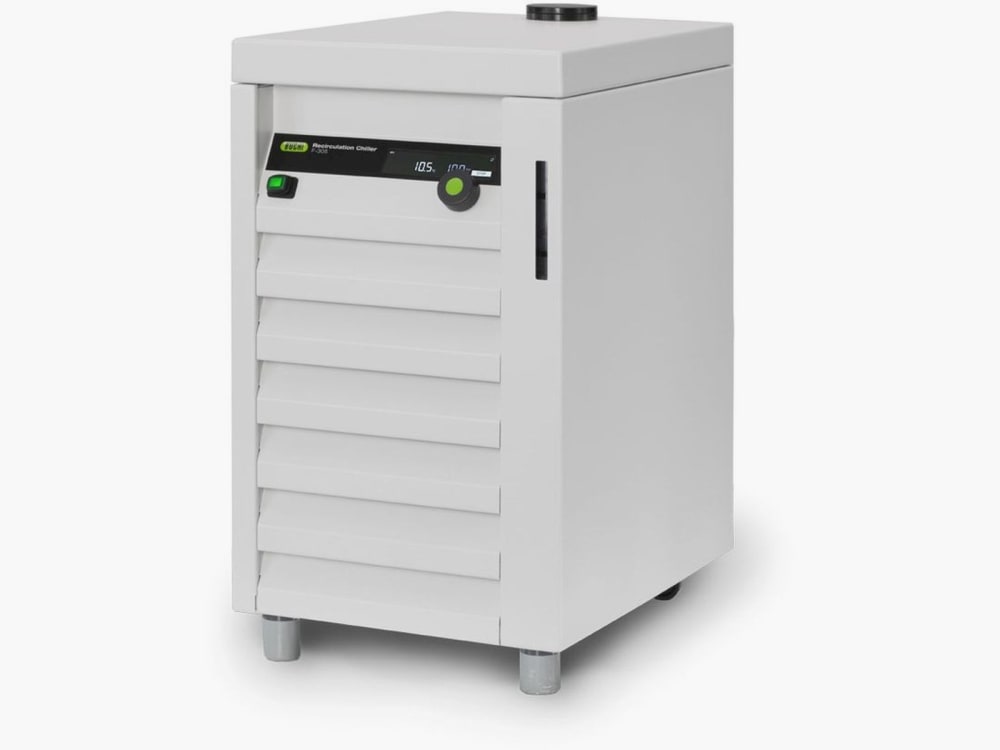
A rotary evaporator chiller should not be selected from minimum temperature alone.
A chiller that advertises -20°C can still be too small if it cannot remove enough heat at the temperature where your condenser actually operates.
The two questions that matter most are:
- What condenser temperature does the process require?
- How much cooling capacity does the chiller provide at that temperature?
JULABO's rotary-evaporator guidance makes the same point: chiller selection should consider vapor temperature, desired evaporation rate, and condenser temperature. The lower the condenser temperature, the more cooling capacity is required.
That means a useful chiller specification is not:
Temperature range: -20 to +20°C
by itself.
It is something closer to:
350 W at 0°C
or:
730 W at 10°C
because those values tell you how much heat the chiller can remove at a defined operating point.
Decision rule: Select the chiller from cooling capacity at the intended operating temperature, then verify flow, pressure, reservoir, coolant compatibility, voltage and installation requirements.
Affiliate disclosure: Some links in this guide are affiliate links. If you use them to contact a supplier or place an eligible order, Equipvia may earn a commission at no additional cost to you. Affiliate status does not determine which products or suppliers we include.
Quick Chiller-Sizing Summary
| Factor | What to define | Why it matters |
|---|---|---|
| Solvent | Main and most demanding routine solvents | Affects vapor temperature and condensation requirement |
| Desired vapor temperature | Process boiling temperature under vacuum | Helps establish condenser-temperature target |
| Condenser temperature | Coolant temperature entering the condenser | Directly affects condensation performance |
| Evaporation rate | How much solvent you intend to remove per unit time | Drives cooling load |
| Cooling capacity | Watts or kW at the actual operating temperature | Determines whether the chiller can absorb the heat load |
| Flask size | 2 L, 5 L, 20 L, 50 L, etc. | Useful scale indicator, but not enough by itself |
| Flow | Coolant circulation rate | Needed to move cooling capacity through the condenser |
| Pump pressure | Delivery pressure / head | Must circulate coolant without overstressing glass connections |
| Reservoir | Working volume | Affects system stability and coolant management |
| Multiple evaporators | Number and simultaneous duty | Cooling loads must be combined |
| Ambient conditions | Room temperature and ventilation | Affects chiller heat rejection and available capacity |
1. The Chiller's Job Is to Condense Vapor, Not Simply Make Cold Liquid
The chiller removes heat from the condenser circuit.
During rotary evaporation:
- the bath supplies heat;
- the solvent evaporates;
- vapor moves into the condenser;
- the condenser transfers that heat into the circulating coolant;
- the chiller rejects that heat to the room or facility.
If the chiller cannot keep up, the coolant temperature rises and vapor may pass through the condenser instead of being recovered.
Heidolph's cooling guide warns that if more vapor is generated than can be condensed, solvent can be lost and the vacuum pump or environment can be exposed to solvent vapor.
So the chiller is part of the evaporation-rate limit of the complete system.
Related guide: How to Choose a Rotary Evaporator: A Practical Selection Guide
2. Do Not Size a Chiller From Minimum Temperature
A common listing might say:
Temperature range: -20 to +20°C
That tells you where the thermostat may be able to operate.
It does not tell you how many watts of cooling are available at:
- +10°C;
- 0°C;
- -10°C;
- -20°C.
Cooling capacity usually decreases as the operating temperature drops.
BUCHI's current chiller range illustrates this clearly:
| BUCHI model | Cooling at 15°C | Cooling at 10°C | Cooling at 0°C |
|---|---|---|---|
| F-305 | 550 W | 440 W | 250 W |
| F-308 | 900 W | 730 W | 450 W |
| F-314 | 1400 W | 1150 W | 720 W |
| F-325 | 2500 W | 2200 W | 1400 W |
The same chiller has materially less cooling capacity at 0°C than at 15°C.
That is why this question:
"Does it reach -20°C?"
is less useful than:
"How many watts can it remove at the coolant temperature we plan to use?"
3. Start With the Temperature Relationship
One commonly used rotary-evaporation guideline is the 20-degree rule.
JULABO describes the relationship as approximately:
- heating bath: 50°C;
- vapor: 30°C;
- condenser coolant: 10°C.
That creates roughly 20°C between each stage.
Heidolph and BUCHI also discuss balancing heating, evaporation and condensation rather than simply maximizing temperature differences.
The 20-degree rule is a process guideline, not a universal requirement.
The correct temperatures depend on:
- solvent;
- product sensitivity;
- vacuum level;
- condenser design;
- cooling capacity;
- desired throughput.
What the rule is useful for
It prevents one of the most common mistakes:
heating the bath aggressively while giving the condenser almost no temperature margin.
If vapor enters the condenser at 30°C and the coolant is also near 30°C, condensation capacity will be poor regardless of nominal chiller size.
4. Solvent Changes the Cooling Requirement
Different solvents:
- boil at different pressures and temperatures;
- have different heat loads during evaporation;
- may require different condenser temperatures;
- may evaporate at very different rates under the same bath and vacuum settings.
JULABO recommends sizing for the solvent that requires the lowest condenser temperature when one chiller will support a range of solvents.
That does not mean the coldest solvent always creates the largest total load.
It means the chiller must meet both:
- the required operating temperature;
- the required cooling capacity at that temperature.
Multi-solvent labs
Build a solvent matrix:
| Solvent | Desired vapor temperature | Planned coolant temperature | Expected evaporation rate |
|---|---|---|---|
| Solvent A | |||
| Solvent B | |||
| Solvent C |
Size from the most demanding temperature-and-load combination, not from the solvent name alone.
5. Evaporation Rate Is a Better Sizing Variable Than Flask Size
A 5 L flask does not generate one fixed cooling load.
A 5 L system running slowly can create less condenser duty than a smaller system operated aggressively.
Cooling demand changes with:
- solvent;
- batch volume;
- bath temperature;
- vacuum pressure;
- rotation;
- evaporation rate;
- condenser area.
That is why JULABO's sizing logic includes desired evaporation rate, not only vessel size.
Flask size is still useful
Flask size is a practical first filter because larger systems usually have the potential to evaporate more solvent.
JULABO currently groups example chiller families around:
- benchtop rotary evaporators up to 5 L;
- 20 L systems;
- 50 L systems.
But those are manufacturer recommendations within JULABO's own product family, not universal wattage rules.
6. Cooling Capacity Must Be Quoted at a Temperature
A chiller specification such as:
Cooling capacity: 500 W
is incomplete unless the temperature basis is clear.
Compare these two statements:
500 W cooling capacity
and:
500 W cooling capacity at 0°C
The second is much more useful.
Why the temperature basis matters
A refrigeration system normally loses capacity as the setpoint moves lower.
The BUCHI data above shows exactly this behavior.
The same effect appears in larger marketplace equipment.
One current 50 L rotary-evaporator chiller listing, for example, publishes:
- 9850 W at 0°C;
- 6350 W at -20°C.
That is a reduction of several kilowatts simply from changing the operating temperature.
This is why procurement should request a capacity curve or at least several capacity points.
7. Do Not Confuse Electrical Power With Cooling Capacity
Marketplace listings sometimes mix:
- compressor input power;
- total electrical power;
- cooling capacity;
- heater power;
- pump power.
They are not the same specification.
A product may consume 500 W electrically without providing 500 W of refrigeration at every temperature.
When a supplier writes:
Power: 500 W
ask:
Is that electrical input or refrigeration capacity?
Then ask:
At what coolant temperature is refrigeration capacity measured?
This one clarification prevents a large number of poor chiller comparisons.
8. Flow Rate Matters Because Cooling Has to Reach the Condenser
Cooling capacity is useful only if the coolant can circulate through the condenser at an appropriate rate.
The circulation loop includes:
- chiller reservoir;
- pump;
- supply tubing;
- condenser;
- return tubing;
- valves or restrictions.
Too little flow can reduce heat transfer.
Excessive pressure can create another problem: glass condenser connections and hoses have practical pressure limits.
Heidolph notes that excessive water pressure can cause hoses to detach. Recirculating systems can offer better control of delivery pressure.
Ask for both flow and pressure
Do not accept only:
Pump flow: 20 L/min
Also ask:
- at what pressure?
- what is the pump curve?
- what is maximum head?
- can delivery pressure be adjusted?
- what tubing ID is required?
9. Reservoir Size Is Not Cooling Capacity
A larger reservoir can help with:
- coolant inventory;
- thermal stability;
- filling and priming;
- multiple connected components.
But reservoir volume does not tell you refrigeration power.
A 20 L reservoir with a weak compressor can still be undersized.
A smaller reservoir with adequate refrigeration capacity can maintain a demanding load more effectively.
Treat reservoir size as a hydraulic and operational specification, not the main chiller-sizing number.
10. How to Tell When the Chiller Is Undersized
JULABO gives a particularly useful practical sign:
If the chiller temperature rises above the setpoint during operation, the process load can be exceeding available cooling capacity.
Other signs can include:
- condenser outlet warming significantly;
- visible vapor moving beyond the effective condensing zone;
- reduced solvent recovery;
- more solvent reaching the pump or secondary condenser;
- evaporation rate becoming unstable as coolant warms.
Do not immediately solve this by lowering the chiller setpoint.
A colder setpoint can actually reduce the chiller's available refrigeration capacity.
The correct response is to determine whether:
- the operating temperature is appropriate;
- the chiller has enough capacity at that temperature;
- coolant flow is adequate;
- condenser area is sufficient;
- evaporation is being driven too aggressively.
11. Can One Chiller Run Multiple Rotary Evaporators?
Yes, sometimes.
Heidolph gives an example of a 1200 W chiller used with three rotary evaporators.
JULABO also states that one chiller can support multiple evaporators if total cooling demand is accounted for.
Do not simply divide nominal chiller wattage by the number of instruments.
For each simultaneously operating evaporator, account for:
- solvent;
- evaporation rate;
- vapor temperature;
- condenser temperature;
- operating schedule.
The chiller must support the combined simultaneous load.
Hydraulic design also matters
Multiple evaporators may require:
- parallel distribution;
- balancing valves;
- suitable pump flow;
- adequate pump pressure;
- compatible return plumbing.
A chiller can have enough compressor capacity and still perform poorly if circulation is badly distributed.
12. Tap Water, Dry Ice, or Recirculating Chiller?
Heidolph compares three common condenser-cooling approaches.
Tap water
Advantages:
- simple;
- low initial equipment cost.
Limitations:
- water consumption;
- supply temperature can vary;
- pressure can vary;
- cooling performance depends on facility water.
Heidolph describes typical water cooling around 15–20°C and notes substantial water consumption for standard condenser operation.
Dry ice
Advantages:
- very low temperature;
- useful for some low-boiling solvent applications.
Limitations:
- fixed very low temperature;
- manual handling;
- consumable cost;
- not automatically the best solution for high-boiling media.
Recirculating chiller
Advantages:
- adjustable temperature;
- closed-loop operation;
- more repeatable cooling;
- avoids continuous tap-water use;
- easier integration with controlled processes.
For repeat rotary-evaporation work, a correctly sized recirculating chiller usually provides the most controllable cooling architecture.
13. Marketplace Example: Small Chiller for a 3 L Rotary Evaporator
One current Alibaba listing is explicitly marketed as a recirculating chiller for a 3 L rotary evaporator.
When reviewed on September 18, 2026, it showed:
- Product ID:
62285035917 - Model: HC3/10
- temperature range: -10 to +20°C
- refrigeration capacity explicitly shown: 350 W at 0°C
- reservoir: 3 L
- circulation flow: 17 L/min
- refrigerant: R404A
- voltage: 110/220 V options, 50/60 Hz
- warranty: 2 years
- supplier: Aibote Henan Science And Technology Development Company Limited
- supplier tenure shown: 15 years on Alibaba
The same page also contains a separate 450 W value described in a way that can be read as overall power/cooling capability. Because the listing mixes these fields, the safest comparison figure is the explicitly temperature-qualified:
350 W at 0°C
and the supplier should be asked to clarify the 450 W number.
Buyer Check
Ask for the complete refrigeration-capacity curve, not only the -10°C minimum temperature.
14. Marketplace Example: Large Chiller for a 50 L Rotary Evaporator
A current DLSB-50/40 Alibaba listing is explicitly marketed for a 50 L rotary evaporator.
When reviewed on September 18, 2026, it showed:
- Product ID:
1601054534901 - model: DLSB-50/40
- cooling capacity: 9850 W at 0°C
- cooling capacity: 6350 W at -20°C
- reservoir: 17 L
- flow: 35 L/min
- pump head: 11 m
- refrigerant: R404
- voltage: 220 V
- warranty: 1 year
- supplier: Henan Touch Science Instruments Co., Ltd.
- supplier tenure shown: 10 years on Alibaba
The page contains an inconsistency around the stated minimum coolant temperature: one part shows -40°C, while another section reportedly shows -80°C.
That does not affect the usefulness of the two temperature-qualified capacity points, but the exact operating range should be confirmed before purchase.
View current DLSB-50/40 listing →
Why this example matters
The listing makes the central sizing principle visible:
- 9850 W at 0°C;
- 6350 W at -20°C.
A colder chiller is not automatically a more powerful chiller.
15. A Practical Chiller-Sizing Workflow
Use this sequence before requesting quotes.
Step 1 — Define the routine solvents
List what the system will actually distill.
Step 2 — Define the desired vapor temperature
This comes from process requirements and vacuum setting.
Step 3 — Define the condenser coolant temperature
Use manufacturer guidance and a reasonable temperature difference from vapor.
Step 4 — Define the evaporation-rate target
How much solvent must be condensed per hour?
If you do not know this number, at least estimate:
- batch volume;
- batch time;
- solvent removed per batch.
Step 5 — Request cooling capacity at that coolant temperature
Do not accept only minimum temperature.
Step 6 — Add operating margin
Real systems experience:
- warm ambient conditions;
- fouling;
- long hoses;
- variable flow;
- transient peaks;
- solvent changes.
Do not design the chiller exactly at a theoretical peak with no margin.
Step 7 — Verify coolant flow
Check the condenser's flow requirement and circuit restriction.
Step 8 — Verify pump pressure
Make sure the circulation pump can overcome the loop resistance without overstressing glassware or tubing.
Step 9 — Check reservoir and coolant
Confirm:
- coolant volume;
- coolant chemistry;
- viscosity at low temperature;
- material compatibility.
Step 10 — Verify utilities and heat rejection
Check:
- voltage;
- current;
- frequency;
- room ventilation;
- clearances;
- maximum ambient temperature.
Remember: the chiller removes heat from the process and rejects that heat into the room unless connected to another facility heat-rejection system.
16. What to Ask a Supplier for 2 L, 5 L, 20 L, or 50 L Systems
Do not ask only:
"Which chiller do you recommend?"
Send a structured requirement.
For a small 2–5 L system
Ask for:
- cooling capacity at 10°C;
- cooling capacity at 0°C;
- minimum operating temperature;
- flow;
- pressure/head;
- reservoir volume;
- tubing connection size.
For a 10–20 L system
Also ask for:
- full capacity curve;
- condenser heat-load basis;
- continuous-duty rating;
- ambient-temperature derating;
- whether the chiller can support full evaporation rate continuously.
For a 50 L system
Also request:
- capacity at multiple sub-zero temperatures;
- pump curve;
- facility electrical load;
- heat rejection to the room;
- installation footprint;
- coolant requirements;
- bypass / pressure-control provisions;
- service and compressor information.
The larger the evaporator, the less acceptable a single headline temperature becomes as a chiller specification.
17. Chiller Quote Specification Template
Use the same table for every supplier.
| Requirement | Your process |
|---|---|
| Rotary evaporator model | |
| Evaporation flask size | |
| Routine batch volume | |
| Main solvents | |
| Target evaporation rate | |
| Vapor temperature | |
| Condenser coolant setpoint | |
| Required cooling capacity at setpoint | |
| Chiller capacity at +15°C | |
| Chiller capacity at +10°C | |
| Chiller capacity at 0°C | |
| Chiller capacity at -10°C | |
| Chiller capacity at -20°C | |
| Minimum operating temperature | |
| Reservoir volume | |
| Pump flow | |
| Pump pressure / head | |
| Coolant type | |
| Tubing connection | |
| Maximum ambient temperature | |
| Voltage / frequency | |
| Electrical input | |
| Dimensions / weight | |
| Noise | |
| Warranty | |
| Spare parts / service | |
| Complete quoted price |
18. Common Chiller-Sizing Mistakes
Buying from minimum temperature alone
A -20°C rating says nothing about available watts at -20°C.
Confusing electrical input with refrigeration capacity
"500 W power" and "500 W cooling at 0°C" are different specifications.
Sizing from flask volume alone
Flask size is only a scale indicator. Solvent and evaporation rate determine the actual heat load.
Assuming colder is always better
Running colder can reduce available chiller capacity and increase energy use.
Ignoring flow
A high-capacity chiller cannot cool effectively if coolant circulation through the condenser is inadequate.
Ignoring pump pressure
Too much delivery pressure can create hose or glassware problems.
Using one chiller for multiple evaporators without summing load
The chiller must support simultaneous duty, not average duty.
Forgetting ambient heat rejection
A large chiller can add substantial heat to a small laboratory.
Comparing supplier quotes without a capacity curve
Two chillers with the same minimum temperature can have very different useful cooling performance.
Frequently Asked Questions
What size chiller do I need for a rotary evaporator?
There is no universal wattage based only on flask size. Define the required condenser temperature and expected evaporation rate, then choose a chiller with adequate cooling capacity at that temperature.
Is a 500 W chiller enough for a 5 L rotary evaporator?
It may be for some processes and insufficient for others. The useful question is how much cooling the chiller provides at the actual coolant setpoint and how much solvent the process evaporates per unit time.
What temperature should a rotary evaporator chiller be set to?
A commonly used starting guideline is to keep condenser coolant roughly 20°C below vapor temperature, but the correct setpoint depends on solvent, pressure, condenser design, cooling capacity and manufacturer guidance.
Is -20°C better than 0°C for a rotavap chiller?
Not automatically. A lower temperature can improve the temperature driving force for condensation, but many chillers provide less refrigeration capacity at lower temperatures. The complete heat balance matters.
How many watts of cooling does a rotavap need?
Cooling requirement depends on solvent, evaporation rate, vapor temperature and condenser target temperature. Request a capacity calculation from the equipment supplier when process throughput is important.
Can one chiller cool two rotary evaporators?
Yes, if its refrigeration capacity, flow and pump pressure can support the combined simultaneous load. Different solvents or different setpoints make the calculation more demanding.
Can I use tap water instead of a chiller?
Yes in some laboratory setups if water temperature, flow, pressure and local water-use policies are acceptable. A recirculating chiller offers more repeatable closed-loop cooling.
How do I know if my chiller is too small?
A strong warning sign is coolant temperature rising above the setpoint during steady operation. Reduced solvent recovery or vapor passing through the condenser can also indicate inadequate cooling.
Final Takeaway
The correct rotary evaporator chiller is not the one with the lowest advertised temperature.
It is the one that can provide enough cooling capacity at the actual condenser temperature while maintaining appropriate coolant flow and pressure.
Use this sequence:
solvent → vapor temperature → condenser temperature → evaporation rate → required cooling capacity at that temperature → flow → pressure → reservoir → utilities
Then ask the supplier for a cooling-capacity curve.
The single most useful comparison is not:
"Which chiller reaches -20°C?"
It is:
"How many watts of refrigeration does this chiller provide at the temperature where our condenser will actually operate?"
Editorial note: Cooling requirements are process-specific. Verify current cooling-capacity curves, coolant compatibility, pressure limits, installation requirements and the exact quoted configuration before purchase or operation.