Syringe Filters for HPLC: Nylon, PTFE, PVDF or PES
Through 0.20 µm nylon the average analyte loss in one 2022 study was 71%, while a cannabinoid note in methanol put nylon among the best. Both can be right.
Disclosure: We may earn a commission if you purchase through links on this page, at no additional cost to you. Our selection criteria do not depend on commission; see our affiliate disclosure.
Through 0.20 µm nylon, the average analyte lost in a 2022 Journal of Separation Science study was 71.3%. Through 0.45 µm polypropylene it was 15.15%. The authors got there with eleven contaminants, six filter types and three liquids: methanol, deionised water and lake water. Then there is Shimadzu's cannabinoid note, run in methanol, where nylon and PTFE lost the least of seven materials. Nylon ends up on both sides of the argument.
So which is it? Both. A syringe filter is a chemical surface, not neutral plastic, and the best membrane shifts with the analyte, the liquid and the concentration. What follows is what the published data show, where vendors contradict each other, and how to choose a starting membrane and pore size before you validate on your own method.
The short answer
Solvent first. Water-based samples go with a hydrophilic membrane (PES, PVDF, nylon or RC), and aggressive organics go with PTFE or polypropylene. Recovery comes second, and it belongs to your analyte and membrane as a pair, so test it. Pore size is a smaller decision than catalogues suggest: 0.45 µm by default, 0.2 µm to protect fine-particle columns. With nylon, throw away at least the first millilitre. In a regulated assay, validate instead of trusting a catalogue chart.
Why the filter can change your result
MilliporeSigma ran a combination migraine tablet through three Millex filters: hydrophilic PTFE, Durapore PVDF and nylon. It is their own product line, so read accordingly. Acetaminophen and acetylsalicylic acid stuck to the nylon, whose amino, carboxylic acid and amide groups can pair up with acidic or basic molecules. PTFE and PVDF barely touched them. Caffeine from the same tablet passed all three untouched. One filter, two drugs lost, one kept.
Binding saturates, and that is the useful part. Naproxen at 244 ppm showed no loss at all. At 2.4 ppm the first millilitre came out low, and recovery was quantitative by the third or fifth. The lower the concentration, the more filtrate it takes to fill the membrane's binding sites.
Agilent saw a smaller version of the same thing. On 0.45 µm, 25 mm Captiva Premium filters and five commercial drugs, acetaminophen came through nylon at about 97% in the first millilitre and through glass fibre/nylon at about 93%, then at 99.5% to 100.1% afterwards. Ibuprofen, ranitidine, simvastatin and loratadine sat near 99% to 101% on every filter.
What the studies actually found
Four sources, four pictures.
Razak's group (2022) tested six filter types against eleven contaminants of emerging concern in methanol, deionised water and lake water. Nylon did worst: 64.87% average adsorption at 0.45 µm and 71.30% at 0.20 µm. PTFE at 0.20 µm took 47.38%. Polypropylene (15.15% and 16.10%) and 0.20 µm regenerated cellulose (16.15%) lost the least.
Shimadzu's cannabinoid poster went the other way. Seven materials, 0.45 µm, 13 mm discs, eleven cannabinoids in methanol, ten replicates each. Nylon and PTFE recovered best, with relative standard deviations of 0.82% and 0.87%. The rest scattered up to 2.7%.
MilliporeSigma's pharmaceutical work found nylon grabbing two of three actives while hydrophilic PTFE and PVDF let them through. Agilent's Captiva test lost about 3% to nylon on a single drug, in the first millilitre only.
So why the spread? The matrix, probably. Razak's methanol runs cost 16.72% of the analyte, while deionised water cost 48.19% and filtered lake water 48.94%. Shimadzu used methanol alone, and one pore size. One reading is that methanol hides what water exposes, and no source tests that directly. The Shimadzu numbers reached this article secondhand, through a third-party page summarising the application note, so check the PDF before quoting them.
Matching the membrane to the solvent
Compatibility is the easier half. Fisher's guide rates hydrophobic PTFE high for chemical resistance, nylon and PVDF medium, and PES low to medium. Agilent's note sorts by sample: cellulose acetate or PES for aqueous, PP or PTFE for aggressive organics, and for mixtures a pick from PTFE, PP, nylon, RC or PES by solvent ratio.
PES is where vendors clash. Chromatography Direct says it does not suit organic mobile phases and points you to nylon or PTFE. Agilent lists it for organic/aqueous mixtures, by percentage. Ten percent organic is not neat acetonitrile, so both statements survive. For mostly organic work, read the maker's chart for your exact solvent before you buy a box.
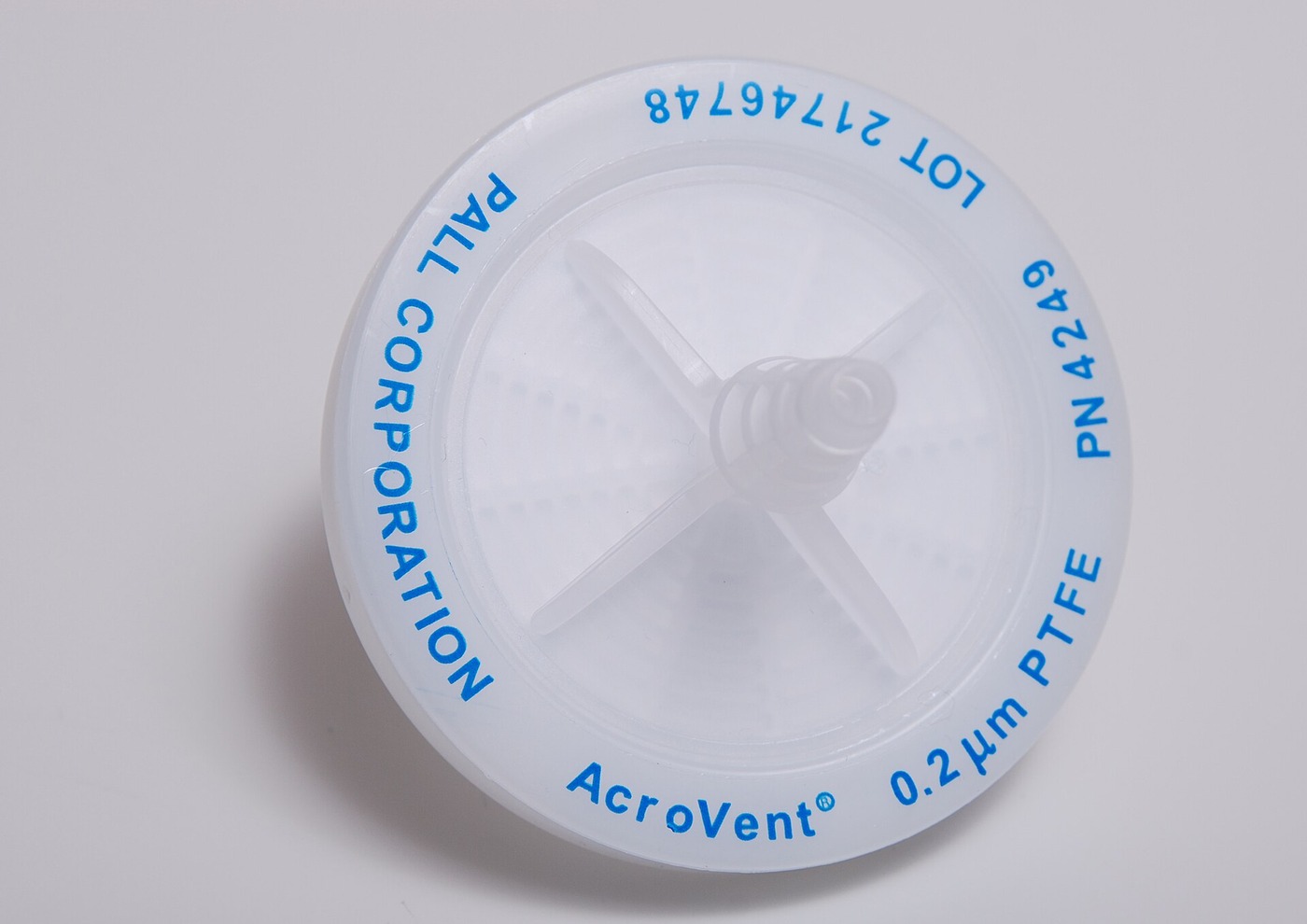
Wetting trips people up too. Hydrophobic PTFE will not pass water until it has been wetted, and the same source says to flush it with methanol first or the filter airlocks. Some catalogues sell hydrophilic PTFE, Millex among them, built for both organic and aqueous liquids. Three letters on the box do not tell you which kind you have.
Extractables and ghost peaks
The filter can add things as well as remove them. Pall's nylon application note extracted its Acrodisc filters with methanol, collected only the first millilitre, and compared against other commercial nylon membranes by UHPLC at 214 nm. Pall reports extra peaks from the other brands and none from its own. That is a vendor result about a vendor product, but it supports one point: two filters sold as "nylon" are not interchangeable.
An independent testing lab, Jordi Labs, profiled one nylon syringe filter and detected caprolactam dimer and tetramer and an adipic acid–nylon 6 dimer among its leachables in water and saline. That is one device, not a survey. MicroSolv's primer adds that PVDF can release extractables in contact with alcohols or some organics, and advises pre-flushing for LC-MS and trace work.
How much to discard
Nobody agrees on a number:
- Agilent: discard the first 1 mL, mainly for nylon.
- MicroSolv: the first 2 mL or so, since that carries the highest extractables.
- MilliporeSigma: 5 mL discarded in its blend-uniformity work, and the amount should be set by validation according to analyte concentration.
The differences reflect different purposes. One number is for sorption of a drug, another for removing leachables. The right figure for you is the larger of the two your method needs, found by collecting successive fractions and comparing them.
Dirty samples and prefilters
A membrane clogs long before it wears out. Soil extracts, formulations with excipients and anything cloudy can block a 0.45 µm surface within a few millilitres. Several makers sell the same membrane with a glass fibre layer in front. Agilent tested glass fibre/nylon and glass fibre/PTFE versions, and a Millipore-branded presentation describes a nylon filter with a glass fibre prefilter as a one-step cleanup of large and small particulates without clogging. MACHEREY-NAGEL's CHROMAFIL Xtra brochure lists 25 mm devices with a 1.0 µm prefilter above a 0.20 or 0.45 µm membrane, a void volume under 80 µL, and polyester, regenerated cellulose, PVDF, PTFE and nylon options. A prefilter adds a layer where analyte can stick or hold liquid, so the validation steps above apply to it too.
Reading a catalogue listing
Catalogue tables compress a lot. In Fisher's brochure, for example, the sterile PES and PVDF devices are 33 mm and packed 50 to a box, while the PTFE 13 mm devices come 100 to a box and are listed as non-sterile. Sterility is irrelevant for an HPLC vial, so do not pay for it. What does matter is whether the maker certifies the filter for HPLC. MACHEREY-NAGEL states that every membrane type is HPLC-tested and that certificates are available, and Pall says it evaluates samples across its HPLC Acrodisc line for UV-detectable extractables. These are manufacturer statements, not independent audits, but they at least tell you the maker has a release test to compare against your blanks.
Pore size: 0.2 or 0.45 µm?
Sources give three different rules. A Millipore-branded presentation advises 0.2 µm for columns packed below 3 µm and 0.45 µm above. VWR notes that the choice is often made on analytical column packing size. Chromatography Direct says a 0.22 µm filter on a standard HPLC system "just slows you down" without measurable benefit. Foxx Life Sciences goes further and calls 0.2 µm required for sub-2-µm UHPLC columns.
"Required" is the strongest wording in this set, and it comes from a filter vendor, so treat it as a vendor view. A sensible reading is that the finer pore adds protection for small-particle columns at the cost of back-pressure and filtering time. It is not a recovery fix. In the Millex study, pore size had little effect on analyte binding: the 0.2 µm and 0.45 µm hydrophilic PTFE filters gave very similar naproxen results.
Diameter and hold-up volume
The housing matters because the filter keeps liquid. In MilliporeSigma's test, a 33 mm Millex returned about 1.4 mL of a 2 mL water sample, while a 25 mm polypropylene device returned about 0.6 mL. For a 1 mL injection vial, that is the difference between enough sample and a short one. One supplier suggests 13 mm filters for volumes up to 10 mL and 30 mm for up to 200 mL.
Validate the pair, then lock the part number
For regulated work, USP chapter <1092> says filter material should be chosen and experimentally justified early in dissolution method development, according to MilliporeSigma's summary. The practical lesson from that same study is to lock the brand as well as the material. When MilliporeSigma compared hydrophilic PTFE filters from several vendors, they saw significant differences for some analytes such as loratadine, and they also saw lot-to-lot variation with PVDF filters in one comparison. If a second source is ever needed, test it before swapping.
Where to start
Fisher's chart lists PES and PVDF as low protein binders and hydrophilic PTFE as highly chemical resistant, which makes those three the usual opening bids for aqueous and mixed samples. The same chart puts nylon at medium protein binding, so protein samples tilt toward PES or PVDF. Agilent steers neat aggressive organics to PTFE or PP. For trace and LC-MS work, MicroSolv suggests low-extractable, HPLC-certified filters and a pre-flush.
PFAS is the odd one. A Millipore-branded deck, built around a modified EPA 537.1 LC-MS method, advises against PTFE and PVDF there and tested PES and nylon. It is a vendor slide set, not a regulation. Your method decides.
Picture a weakly basic drug, a few ppm, in water and methanol. Hydrophilic PTFE is the first thing to try, since nylon grabbed acetaminophen, a basic drug, in MilliporeSigma's test. Push six 1 mL portions through a single device, inject each, and express every peak area as a percentage of a centrifuged control. Agilent and MilliporeSigma both used centrifugation as their reference. If portion one reads low, discard that volume from then on. If it does not, record that and drop the discard.
Equipvia may earn a commission from qualifying purchases through this link. The link resolved to Product ID 1601165945380 during review. CPS resolution does not verify the seller's technical claims, the membrane's suitability for a given analyte, affiliate eligibility, or commission attribution. Check the actual selected variant and current terms before ordering.
The listing is the kind that hides the decision in the drop-down. Its title names PTFE, nylon, PES, PVDF, MCE, PP and CA membranes across 0.22 and 0.45 µm and four diameters, while the quantity tier starts at 50 pieces. Ask the seller to confirm which membrane, pore size and diameter the quoted variant contains, whether the housing is the same across variants, and whether an HPLC extractables certificate is available for that specific combination. A price for the family is not a price for the membrane you validated.
Frequently asked questions
Is nylon or PTFE better for HPLC samples?
Neither wins everywhere. One study found nylon lost 65% to 71% on average across three matrices, while a cannabinoid note found nylon and PTFE both recovering well in methanol. Agilent saw only a 3% first-millilitre loss to nylon, on one drug. Test your own analyte.
Do I need to pre-wet a syringe filter?
Hydrophobic PTFE does; flush it with methanol first. Nylon behaves differently. MilliporeSigma found that saturating it with sample improves recovery, so the usual discard doubles as pre-wetting.
Can I reuse a syringe filter?
Single use. No maker reviewed for this article supports reuse, and carryover is the obvious risk. Note the lot number of the box you open, since lot-to-lot differences turned up in one MilliporeSigma comparison.
Final takeaway
The solvent picks the membrane family. Your analyte picks the winner, and a handful of filtered fractions will show you which one it is. Start at 0.45 µm and move to 0.2 µm only if the column packing is small. After a filter passes, freeze the brand, membrane, diameter, pore size and part number, because another vendor's PTFE is not guaranteed to behave like the first. Then file the fraction data and blank injections with the method, where the next analyst will look for them.
Share this article