Karl Fischer Reagent: One- or Two-Component, Strength and Titer
The number on the bottle is a nominal strength. What the titrator needs is how many milligrams of water that bottle actually consumes per millilitre today.
Disclosure: We may earn a commission if you purchase through links on this page, at no additional cost to you. Our selection criteria do not depend on commission; see our affiliate disclosure.
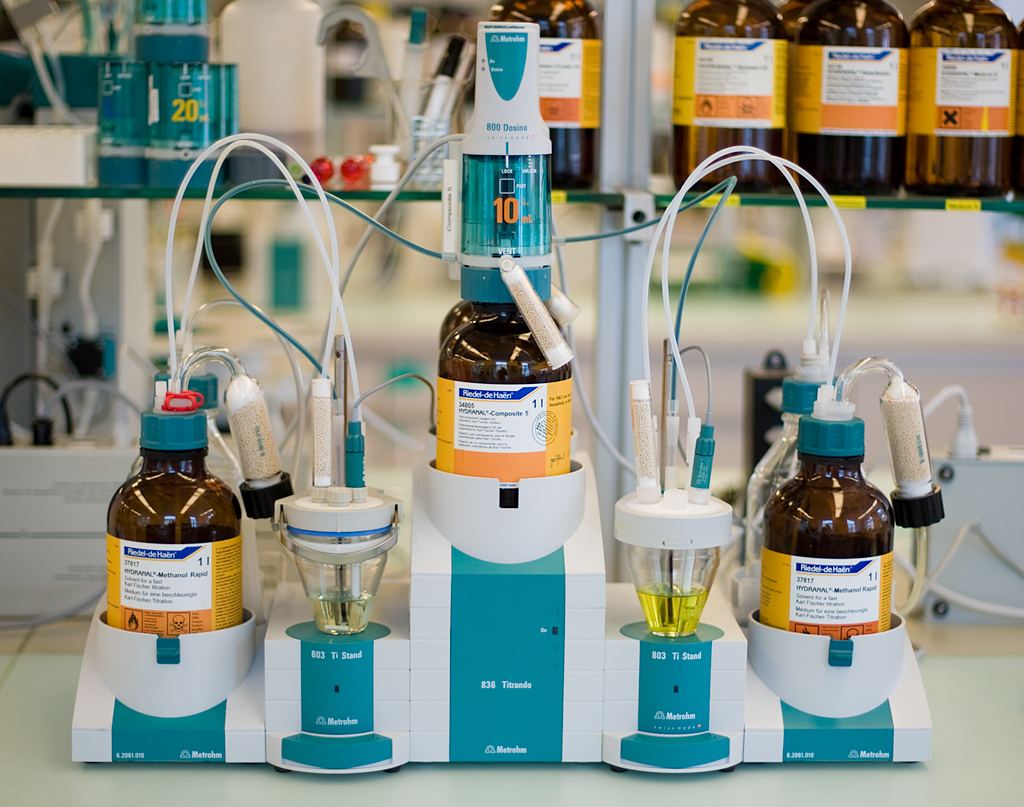
A bottle of volumetric Karl Fischer titrant says "5" on the label, and it is tempting to type 5.00 into the titrator and move on. The number on the label is a nominal strength. What the instrument needs is the titer, meaning how many milligrams of water one millilitre of that particular bottle, on that particular day, actually consumes. Most of the practical decisions about reagent choice come back to that gap.
This guide covers three choices: one-component or two-component reagent, which titrant strength to buy, and how to check the titer. It also covers the sample types that need a different reagent altogether. The sources are the ASTM E203 scope and notes, seen through store previews and catalogue excerpts rather than the full licensed text, several editions of USP <921> via third-party copies, and manufacturer literature from Merck, Metrohm and Honeywell Fluka listings. Manufacturer claims are attributed as such, and where sources disagree both values are given.
Where volumetric titration fits
Volumetric Karl Fischer adds an iodine-containing titrant of known strength until the endpoint is reached. Merck's brochure recommends the volumetric method for water contents from 0.1 % to 100 %, and the coulometric method, which generates iodine in the cell, for less. Its web page puts coulometric titration at roughly 10 ppm to 10,000 ppm. ASTM E203 words the boundary differently: volumetric titration can measure low levels, but coulometric titration is generally accepted as more accurate for routine very-low-level work, and if samples routinely hold 500 mg/kg or less, coulometry should be considered.
Those two boundaries do not line up. 500 mg/kg is 0.05 %, while Merck's volumetric floor is 0.1 %. Between them, and up to about 1 %, either technique can be defended, and the choice usually comes down to what the lab already owns. This article assumes the volumetric side of that line.
One-component or two-component
In a one-component system the titrant carries everything the reaction needs: iodine, a base, sulfur dioxide and an alcohol. You fill the cell with a plain solvent, usually methanol, and titrate. In a two-component system the titrant holds iodine dissolved in an alcohol, and the sulfur dioxide and base sit in a separate solvent that goes into the cell. Honeywell's training slides describe the split the same way.
The claims for each side come from the sellers. Merck lists large water capacity and no crystallisation among the advantages of its one-component reagents. For two-component systems its web page cites better buffer capacity, faster titration rates and slightly better titer stability, and recommends them for series on the same matrix and for strongly acidic or alkaline samples. The Honeywell slides make a similar case: more accuracy for small amounts of water, higher buffer capacity, an exact and stable titer. No independent comparison turned up, and "slightly better" is not a number.
The two designs also differ in what you stock. A one-component lab buys one reagent and a cheap solvent. A two-component lab buys a titrant and a solvent that must be matched to it, and the solvent is consumed and replaced as water capacity runs out. A reasonable rule, though it is judgment and not published guidance: for mixed samples and occasional use, one-component is the simpler default. For a high-volume series of one matrix, or for samples that shift the pH of the cell, the case for two-component is stronger, because the buffer sits in the solvent that you change on a schedule.
Brand labels need a second glance too. One distributor lists a single-component, pyridine-free reagent with a water equivalence of at least 5.2 mg/mL, while its two-component titrant is listed at 5.0 mg/mL. Both are "5". Neither number replaces your own titration.
Titrant strength: 5 mg/mL or 2 mg/mL
Titrant concentration is the other catalogue decision. USP <921> says that for trace water, under 1 %, it is preferable to use a reagent with a water equivalency factor of not more than 2.0. The same chapter's guidance on sample size aims for enough specimen to titrate at least 2 mg of water. A 5 mg/mL titrant is the typical general-purpose strength in the listings reviewed, and manufacturers sell weaker and stronger grades for lower and higher contents.
A quick calculation shows why the strength matters. Suppose you want to use at least a tenth of a 20 mL burette, which is 2 mL. At 5 mg/mL that corresponds to 10 mg of water, and at 2 mg/mL to 4 mg. For a sample holding 0.5 % water, those are 2 g and 0.8 g of sample respectively. For a sample at 0.1 % they become 10 g and 4 g. The weaker titrant lets you use less material for the same burette volume, which helps when the sample is scarce, and its smaller water increment per drop also helps precision on small amounts. The cost is more reagent per determination for high-water samples, which are better served by the stronger grade. The 10 % burette fraction here is illustrative, not a rule from the standard.
Titer determination, and why you cannot skip it
USP <921> states plainly that the stoichiometry of the Karl Fischer reaction is not exact and that reproducibility depends on the relative concentrations of the reagent ingredients, the solvent for the specimen, and technique. That is why the method relies on an empirically standardised procedure, and why the titer is measured instead of assumed. The chapter also stresses that precision is governed largely by how well atmospheric moisture is excluded. A reagent bottle that is opened often is likely gaining water, and the titer falls with it.
The standard sets out the options. Purified water, sodium tartrate dihydrate, a USP Reference Standard, or commercial standards with a certificate of analysis traceable to a national standard can be used. The factor F, in mg of water per mL of reagent, is the mass of water in the standard divided by the reagent volume used. Metrohm's application bulletin defines the same thing in the same units and lists three standard types: a liquid water standard of roughly 10 mg/g, solid sodium tartrate dihydrate at about 15.6 % water, and pure water.
For sodium tartrate dihydrate the water fraction comes from the formula. Two waters weigh 36.04 and the salt weighs 230.08, so the fraction is 36.04 divided by 230.08, or 0.1566. That is where the familiar 15.66 % comes from. One supplier's listing notes that the exact value is on the certificate of analysis, and the certificate's number should beat the textbook one.
Here is the arithmetic for the USP weighing range. The text seen in the USP 38 and 40 copies asks for 20 to 125 mg of the salt, weighed by difference. That is 3.1 mg to 19.6 mg of water. At a 5 mg/mL titrant the consumption runs from 0.63 mL to 3.9 mL. At 2 mg/mL it runs from 1.6 mL to 9.8 mL. The low end is the problem. A 0.63 mL titration is a small slice of a burette, and on a balance reading to 0.1 mg a 20 mg specimen carries about 0.5 % uncertainty from one reading alone. Weighing nearer the middle of the range, around 100 mg, gives 3.1 mL at 5 mg/mL.
The editions do not agree. An older copy hosted on a public site, edition unclear, says to add 150 to 350 mg of sodium tartrate and uses the same 2 × 18.02 / 230.08 ratio. That is 23 to 55 mg of water, a much larger charge than the later text. If a legacy SOP quotes 150 mg or more, check which edition it was written against before treating the difference as an error in either.
Two practical notes from the USP text are easy to miss. First, the solubility of sodium tartrate dihydrate in methanol is limited, so fresh methanol may be needed for repeat titrations of the standard in the same cell. Second, the endpoint is defined electrically, at 100 ± 50 microamperes of direct current at about 200 mV applied potential. A slow-dissolving salt can trigger an early endpoint, a mechanism inferred here and not documented in the standards. The titrant volume would then be understated and the calculated F too high. If repeat values drift upward as you add standard, suspect dissolution before you suspect the reagent.
Reagent makers sell water standards in ampoules at 0.01 %, 0.1 % and 1 %, plus a 5 mg/mL standard, a lactose standard and an oil standard. For daily titer checks a sealed ampoule removes the weighing step. The salt is the cheaper way to check a large batch, and the better choice when you want a solid you can weigh and keep dry.
One fragment from an older USP text suggests restandardising daily when the reagent is in continuous use. The sentence was cut off in the copy available, so read the current chapter before writing it into an SOP. USP also advises that bulk reagent stock be kept in a sealed, glass-stoppered container, protected from light and refrigerated.
Equipvia may earn a commission from qualifying purchases through this link. The link resolved to Product ID 62023367160 during review. CPS resolution does not verify the seller's technical claims, the reagent's water content, affiliate eligibility, or commission attribution. Check the actual selected variant and current terms before ordering.
A "general reagents" classification is the part to read carefully. For a titer standard, the useful number is not the assay percentage but the water content on the certificate for that lot, because the whole calculation divides by it. A reagent sold on a 99 % assay with no water figure is a chemical, not a standard, and using it would put an unquantified term into every result that follows. Ask for the certificate of analysis, check whether the water value is stated per lot, and keep the opened bottle dry, since the salt takes up and loses water depending on how it is stored.
When the sample changes the reagent
ASTM E203 lists the compounds that can be titrated directly. They include stable ketones, with diisopropyl ketone, camphor, benzophenone, benzil and dibenzalacetone given as examples, and stable aldehydes such as formaldehyde, sugars and chloral. It also says that formaldehyde polymers hold combined water as methylol groups which is not titrated unless sodium methoxide is added in excess and then partly neutralised with acetic acid. Weak amines, defined by a Kb below 2.4 × 10⁻⁵, can be titrated directly. Sulfuric acid up to 92 % can be titrated directly. Some acids, formic, acetic and adipic among them, are slowly esterified, and with pyridine-based reagents the standard suggests 30 to 50 % pyridine in methanol as solvent. It also warns that compounds which take part in oxidation-reduction reactions in an iodine-iodide system interfere.
Reactive carbonyls are where reagent choice stops being optional. Merck says its methanol-free ketone titrant and solvent are needed for ketone and aldehyde samples because standard methanol reagents cause side reactions and unreliable endpoints. Metrohm's white paper on ketones explains the mechanism: ketal formation with the alcohol releases water, which raises the apparent water content. It adds that methanol-free reagents still contain some alcohol, so side reactions are suppressed rather than removed, and that the Honeywell reagents it tested can release iodine depending on storage conditions, which has to be removed before use by adding water in acetonitrile. Those are accounts from reagent makers and an instrument maker. They agree with each other and with the ASTM split between stable and reactive carbonyls, which is as close to independent confirmation as this article gets.
A short selection routine
This is a condensed version of the above, not a published procedure.
- Check the water range first. Under about 0.05 %, consider coulometry; over 0.1 %, volumetric is comfortable; in between, use what you have.
- Check the sample for ketones, reactive aldehydes, strong amines and acids before picking a reagent. A methanol-based reagent on a reactive ketone gives a drifting endpoint, and the number it prints will look plausible.
- Pick the titrant strength from the expected water and the sample you can afford to use. Choose 2 mg/mL for trace work and 5 mg/mL as the general-purpose default.
- Start with one-component unless you have a high-volume single-matrix workflow or an extreme-pH matrix.
- Standardise when opening a new bottle and at the start of each working day, then keep a log. A titer that creeps downward between checks usually points to moisture getting into the bottle or the burette.
What this article could not check
The full ASTM E203 text was not read, so notes on interferences and appendix procedures come from previews and catalogue excerpts. The USP <921> text was read through third-party copies of editions 38 and 40, plus a 35 copy for some passages and an older unidentified edition, not the current official chapter. The claims about reagent performance come from manufacturers and were not tested against each other here. Anyone writing a method should check the current USP and ASTM texts and the certificate for the exact lot of reagent and standard in use.
Share this article