Molecular Sieves: 3Å or 4Å, Beads or Powder, Loading and Activation
THF from a sodium still came out at 43 ppm. THF standing over activated 3 Å sieves came out at 4.1 ppm in three days. The still had the reputation.
Disclosure: We may earn a commission if you purchase through links on this page, at no additional cost to you. Our selection criteria do not depend on commission; see our affiliate disclosure.
The most surprising number in the solvent-drying literature is not about sodium or hydrides. In a 2010 study from the University of Johannesburg, tetrahydrofuran that started at 107.8 ppm water came out of a sodium/benzophenone still at 43.4 ppm, and came out of a bottle of activated 3 Å sieves at 4.1 ppm after three days. The still was the one with the reputation, and the bottle of sieves was the one that worked.
That result is why sieves are now the default for many labs, and also why the details matter: the pore size, the form, the loading, and above all the activation, which published sources describe with temperatures anywhere from 120 °C to 350 °C. This guide goes through those choices. The core evidence is peer-reviewed solvent-drying work by Williams and Lawton (2010), Burfield and Smithers (several parts, 1977 to 1983) and Yasukawa and colleagues (2022). The Williams and Lawton paper was read through text copies, the Burfield papers through excerpts, and the 2022 paper as an abstract only. Product details come from Sigma-Aldrich, Carl Roth, Arkema and FUJIFILM Wako literature, which are sellers, so their statements are attributed as such.
What the best evidence shows
The Williams and Lawton paper (J. Org. Chem. 2010, 75, 8351) measured water in solvents by coulometric Karl Fischer titration in a glovebox. For THF, standing over 3 Å sieves at 10 % mass/volume gave 27.7 ppm after 24 hours. At 20 % m/v it gave 14.7 ppm at 24 hours, 6.1 ppm at 48 hours and 4.1 ppm at 72 hours. The authors report that lower loadings also work but take significantly longer, about five days, to reach single-digit ppm. They also passed THF once over silica columns, which left 56.2 ppm for one grade (28 to 200 mesh) and 105.7 ppm for another (35 to 60 mesh), essentially no drying at all in the second case. Neutral alumina on a column was faster, and the paper suggests it for quick drying followed by storage over 3 Å sieves.
A course handout summarising the same work gives more solvents: dichloromethane at 10 % for 24 hours reached about 0.1 ppm, acetonitrile about 0.5 ppm, toluene about 0.9 ppm, and methanol and ethanol at 20 % over five days about 10.5 and 8.2 ppm. Those are treated as secondhand here, since the original table was not seen.
The older Burfield series adds the reasons. Part 1 (1977) reported that benzene containing 100 ppm of water, treated statically at 5 % w/v, fell below 0.01 ppm within a day with alumina, and that molecular sieves, silica gel and the hydrides also gave very dry solvent in that time. Part 6 reported that bead sieves, though ultimately efficient, are relatively slow at removing bulk water, and suggested that diffusion into the internal channels is the rate-limiting step. That is the physical reason for the loading and time figures above.
3 Å or 4 Å
The A-type sieves differ in the exchanged cation. 3 Å is the potassium form with an effective opening of about 3 Å, 4 Å is the sodium form at about 4 Å. In practice most vendors split the work this way: Carl Roth's solvent table lists 3 Å for acetone, acetonitrile, ethanol and methanol, and 4 Å for ethyl acetate, dichloromethane, diethyl ether, DMF, hexane and chloroform. FUJIFILM Wako puts methanol, ethanol, acetone and acetonitrile under 3 Å, and xylene, chloroform, nitromethane and DMSO under 4 Å, noting that 4 Å has greater drying capacity than 3 Å.
The reason is exclusion. If the solvent molecule fits in the pore, it competes with water for the same space. A University of Massachusetts microscopy page says 4 Å is not suitable for ethanol, methanol or acetone because the pore does not exclude them. The rule is easy to state and surprisingly messy in the sources, in four ways.
First, Sigma-Aldrich's page for its 4 Å product cites use of the sieves for removing all traces of water from methanol and acetone, which is the opposite of the UMass advice. Second, Burfield and Smithers (1978) tested DMF, which Roth assigns to 4 Å. Their table, at 5 % w/v and starting from 2,860 ppm water, shows 3 Å at 98 ppm and 4 Å at 108 ppm after 72 hours, essentially a tie, and the authors judged sequential drying with 3 Å the simplest and most effective method. Third, Wako lists THF and dioxane under 5 Å and Roth lists dioxane under 4 Å, while Williams and Lawton dried THF to 4.1 ppm with 3 Å. Fourth, the pore sizes themselves are fuzzy. Sigma's table gives water a critical diameter of 3.2 Å, which is larger than the nominal 3 Å opening, yet the same company says 3 Å adsorbs water. Another page gives water as 1.93 Å. Ammonia is 3.6 Å in Sigma's table and 2.9 Å in Roth's. So a nominal pore size is a rating, not a hard cutoff, and solvents near the boundary are the ones where the sources disagree.
A workable default, which is judgment and not published guidance: use 3 Å for anything small and polar, since it is the form with evidence behind it for THF, methanol, ethanol, acetonitrile and DMF, and keep 4 Å for larger nonpolar solvents where the catalogues agree. Buy one 3 Å product and one 4 Å product before buying several grades of either.
Beads or powder
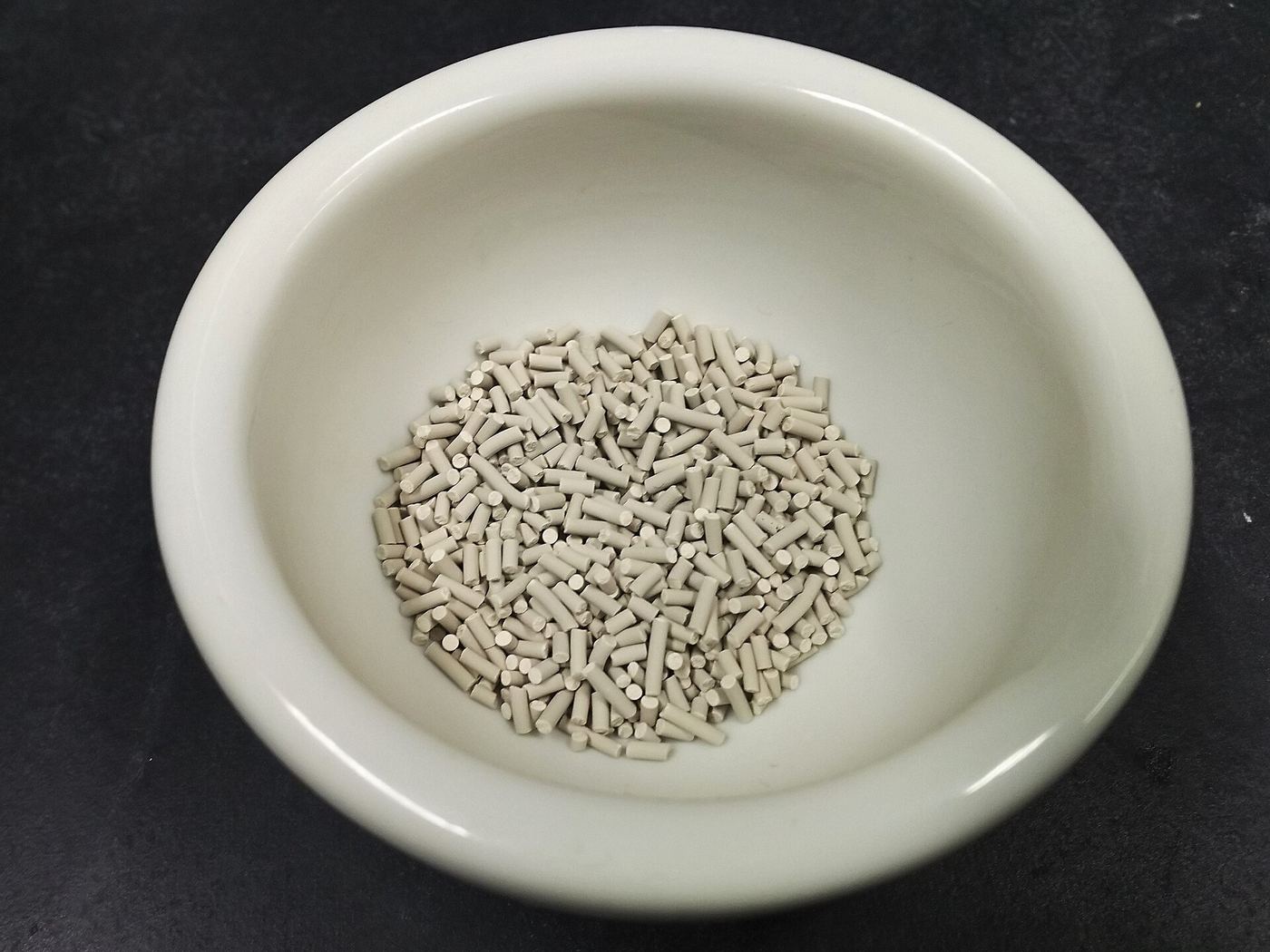
Sigma-Aldrich says 4 to 8 mesh beads are normally used in gas-phase work and 8 to 12 mesh in liquid-phase work, and that the powder forms are for specialised applications. Its table also lists a higher theoretical water capacity for 4 Å powder (28.5 %) than for 4 Å beads (23 %), and a much lower bulk density, 30 against about 45 lb/cu ft.
The powder is not simply better. Burfield and Smithers (1983), in their alcohol study, singled out the poor performance of 3 Å powder for methanol compared with the other alcohols, and the course handout says higher-mass alcohols should be dried with powdered 3 Å sieves instead of beads. The numbers in that table's excerpt could not be decoded, so they are not quoted here. What the excerpt does say is that 4 Å and 5 Å beads were relatively ineffective for methanol, and that 3 Å beads were a useful desiccant. For most bottle-storage work, then, 3 Å beads at 8 to 12 mesh are the sensible purchase, and powder is worth keeping for a specific case you have a reason for.
How much, and how long
The sources do not agree on loading. Williams and Lawton use 10 to 20 % m/v, and show that the higher figure helps. UMass suggests about 5 to 10 % by volume, scooped into the bulk bottle. A Sigma-Aldrich product Q&A says the capacity of its sieves is about 20 % by weight.
That capacity figure invites a mistake. At 20 % m/v you add 200 g of sieves to a litre. If the sieves hold 20 % of their weight in water, that is 40 g of capacity, against roughly 0.1 g of water in a litre of THF at 107.8 ppm (taking its density as about 0.9 g/mL, an approximation). Capacity is a factor of several hundred more than needed. The large loading is there for the rate and the equilibrium, not the capacity, which is why dropping the mass to a few percent slows the result.
In practice that means a standard 2.5 L solvent bottle takes about 500 g of sieves at 20 % m/v, or 250 g at 10 %, which is arithmetic and not a recommendation from any source. Sigma-Aldrich says its 4 Å sieves can be reused after regeneration, and reuse is what keeps this cheap. Williams and Lawton note that simple storage over 3 Å sieves gives THF with very low water content within 48 to 72 hours, so the sieves can sit in the bottle you store from, not in a separate still.
Activation: where the numbers do not match
Sieves arrive holding some water, and an unactivated bottle can add water to a dry solvent. Sigma's table lists a moisture content of 1.5 % on its beads. Carl Roth says its product is activated at 500 to 600 °C at manufacture but still recommends activating again before the first use.
Then the recommendations part ways. Sigma-Aldrich quotes regeneration ranges of 175 to 260 °C for 3 Å and 200 to 315 °C for 4 Å, yet a product Q&A on its site points to an oven at 350 to 400 °F, which works out to roughly 177 to 204 °C, so even one company's pages do not line up with each other. Arkema asks for more heat and a purge: 250 to 300 °C under vacuum or dry gas for 3 Å, 300 to 350 °C for 4 Å. Roth is content with a drying cabinet at 200 to 300 °C. Wako gives two tiers, 150 to 180 °C for 2 to 3 hours as ordinary practice, and 300 to 350 °C under vacuum or dry gas for 3 to 4 hours when a polar solvent has to be driven off completely. The teaching handouts are blunter still. One university sheet wants more than 300 °C at atmospheric pressure for at least 3 hours, or about 200 °C in a vacuum oven, while a Cornell group sheet settles for 120 °C under high vacuum overnight.
Yasukawa and colleagues (J. Org. Chem. 2022, 87, 13750) addressed the problem directly. The abstract says there had been no comprehensive study of heat-drying methods and that this matters for reproducibility, and reports that 5 Å sieves dried at 160 °C for 5 hours under vacuum worked well for ketimine synthesis. A separate abstract titled "New Usage of Molecular Sieves" says microwave and heat-gun activation are not standardised. Only the abstracts were read, and that study concerned catalysis rather than solvent drying, so it does not settle the solvent question. It does show that the spread in the sources is real.
Part of the spread is vacuum. The university sheet puts the atmospheric requirement above 300 °C and the vacuum one near 200 °C. Wako runs the other way, pairing vacuum with 300 to 350 °C, so the sources do not even agree on direction. One workable reading, which is judgment and not a published rule: if you have a vacuum oven or Schlenk line, a lower temperature under vacuum for several hours is defensible, and if you only have a muffle or drying oven, aim near the upper end for at least three hours. After activation, cool in a closed system. Sigma's advice for a small batch heated under vacuum with a burner is to leave it in the flask under vacuum for at least 30 minutes before exposing it to air.
A short buying and use routine
This is a condensed version of the above, not a published procedure.
- Name the solvent first. Small polar solvents (methanol, ethanol, acetonitrile, acetone, THF, DMF) go with 3 Å; larger nonpolar ones can take 4 Å.
- Buy beads at 8 to 12 mesh unless you have a reason for powder.
- Plan on 10 to 20 % m/v and several days. Methanol and ethanol are the slow ones, at about five days.
- Activate before the first use, even from a sealed bottle, using a temperature your own oven or vacuum line can actually hold for the time you can afford.
- Cool the sieves in a closed vessel and add them to the solvent without delay.
- If a Karl Fischer titrator is available, check the water content before trusting the label.
Equipvia may earn a commission from qualifying purchases through this link. The link resolved to Product ID 1600795884229 during review. CPS resolution does not verify the seller's technical claims, the bead size, affiliate eligibility, or commission attribution. Check the actual selected variant and current terms before ordering.
Bead size is the part worth pausing on. Converting 3 to 5 mm to the mesh language the vendors use puts it at roughly 4 to 6 mesh, coarser than the 8 to 12 mesh the same manufacturers specify for liquid-phase work, and coarser beads have less external area and longer diffusion paths. That does not make the product wrong, since bulk sieve is sold this way for column and dessicator use, but a lab that wants the recommended liquid-phase size should ask for 8 to 12 mesh in writing rather than accept whichever bead size the listing defaults to.
What else to check
Sigma lists a slurry pH of 10.5 for its A-type sieves, so they are basic. For acid-sensitive or base-sensitive materials, test a small amount before committing a bottle. Sigma and others also sell acid-resistant 4 Å pellets for such cases. This is a reason to test, not a documented failure.
Nothing on the bottle tells you the water content of the solvent you end up with. Check with Karl Fischer titration if you can. Without it, use sieves for storage and treat the figures here as the best case.
What this article could not check
The full text of the Burfield papers was not available, and the 1983 alcohol table was too garbled to quote. The Yasukawa paper was read as an abstract only. The Williams and Lawton paper was read through text copies in which most of the tables other than Table 1 were not visible. The recommendations by solvent come from sellers who have a commercial interest. Check the specific solvent in the literature before relying on any single source.
Share this article