Laboratory Fire Extinguishers: ABC against CO₂ against Class D, Travel Distance 75 against 50 against 30 ft, and 6-Year against 12-Year Dry Chemical Testing
OSHA sets 75 ft for Class A and 50 ft for Class B; one university sets 30 ft for Class D. The 6-year figure is internal maintenance, the 12-year figure is the hydrostatic test — and some pages print only one.
Disclosure: We may earn a commission if you purchase through links on this page, at no additional cost to you. Our selection criteria do not depend on commission; see our affiliate disclosure.
The default in most university laboratories is a multipurpose ABC dry chemical unit, with the exceptions following what the room holds: metals, oxidisers, sensitive electronics. Travel distance, minimum rating and test interval differ between OSHA and the university pages, and the differences are listed here rather than reconciled.
Which type, by source
- At least one ABC unit per laboratory unless a hazard such as a metal fire calls for another type.
- ABC within 75 ft of travel and one in the room, with specialty units for kitchens and for labs that need them.
- ABC for most labs, Class D where combustible metals are used.
- ABC adequate for most but not all occupancies, with high-hazard operations possibly needing CO₂ or foam.
- BC or ABC dry chemical where flammable liquids are used, and a graphite Class D agent where appropriate.
- ABC preferable to water or CO₂ for laboratory work.
Where the sources split on water
One university prohibits units containing ammonium compounds on chlorine- and bromine-containing oxidisers and directs water-type units there. A second says water extinguishers should not be used in any science laboratory. A third allows water for Class A only, never on electrical or flammable-liquid fires.
Those are consistent only if the room is not storing a chlorine or bromine oxidiser. No page read says what to do with a lab that stores both those oxidisers and flammable liquids.
What each agent covers
Class by class: water for A only; ABC dry chemical for A, B and C; carbon dioxide for B and C, leaving no residue, which is why it suits electronics, and ineffective on A; dry powder for metal fires only; and wet chemical for Class K.
A second list is broader: Class B and C both take CO₂, foam, dry chemical (BC or ABC) and Halotron; Class D takes dry powder or sand, listed Class D units only and never pressurised types; Class K takes wet chemical.
Two details worth carrying: in Class D work, "dry" means free of moisture and the extinguished metal stays in place until cool; and on a mixed fire, a Class D unit goes on the metal while ABC covers the rest.
A supplier figure, not a measurement: CO₂ throws about 3 to 8 ft horizontally and discharges in 8 to 30 seconds.
Travel distance: 75, 50 and 30 ft
OSHA 29 CFR 1910.157, as summarised by its own eTool: Class A 75 ft or less, Class B 50 ft or less.
The NIOSH checklist for the same section adds Class C at 50 to 75 ft following the A or B hazard present, Class D at 75 ft, and a footnote that as little as 30 ft may be required for Class B depending on extinguisher size and hazard.
Other 75 ft rules: the limit exists because the time to fetch an extinguisher and return to the fire is limited; and units should be within easy reach of flammable storage and no more than 75 ft from anywhere in a building.
One university's procedure, last reviewed 12 July 2023: Class A 75 ft, Class B 50 ft, multipurpose ABC 50 ft general spacing, Class D 30 ft, Class K 30 ft.
The conflict is Class D — 75 ft in the NIOSH table and in a state template, 30 ft at that university. The stricter figure is the 30 ft one, and the NFPA table behind either was not found.
What the distances cover
A circle of that radius, ignoring walls and corridors, so an upper bound:
| Radius | Area covered |
|---|---|
| 75 ft | about 17,700 sq ft |
| 50 ft | about 7,850 sq ft |
| 30 ft | about 2,830 sq ft |
A different approach appears in one university policy: a maximum of 11,250 sq ft per extinguisher for all three hazard levels, with a minimum 2-A rating at 3,000 sq ft per unit of A in light hazard, 1,500 in ordinary and 1,000 in extra hazard with a 4-A minimum there.
In arithmetic: a 2-A unit covers 6,000 sq ft in light hazard and 3,000 in ordinary, a 4-A unit covers 4,000 sq ft in extra hazard, and an 11,250 sq ft area is a square about 106 ft on a side.
Minimum rating
- 4A:60B:C as one campus minimum.
- 4A:80BC as another university's suggestion.
- 2-A for light and ordinary hazard, 4-A for extra hazard, in the policy above.
- No rating given on one page.
80B against 60B is a one-third larger Class B rating, and the 80BC form omits a number for C because Class C carries none.
Inspection
OSHA's eTool, by section: monthly visual inspection under 1910.157(e)(2); annual maintenance check under 1910.157(e)(3); and annual employee training where hose stations replace extinguishers under 1910.157(d)(3).
University pages add the practice: monthly checks by a department-assigned person with a contractor annually in the five years between 6-year tests; monthly plus an annual damage check for dents, broken parts and corrosion, with a tag showing service within a year; a monthly check that the unit is in place and unobstructed with the date and initials on the tag; and a monthly visual for ABC, D, K and CO₂ units.
Testing: the table that does not agree
OSHA Table L-1, hydrostatic intervals: CO₂ 5 years; dry chemical with a stainless steel shell 5 years; dry chemical, stored pressure, with mild steel, brazed brass or aluminium shells 12 years; Halon 1211 and 1301 12 years. Stored-pressure dry chemical units on the 12-year schedule are emptied and maintained every 6 years under 1910.157(e)(4), and disposable non-refillable units are exempt.
One university: every 5 years hydrostatic test and maintenance for CO₂, wet chemical, foam and pressurised water; every 12 years hydrostatic test for dry chemical, dry powder and halogenated units; every 6 years maintenance for those three.
A third page, from a partly garbled table: ABC on monthly, 1-year, 6-year and 12-year intervals, Class D the same, and Class K and CO₂ at 5 years for the internal check with no hydrostatic figure listed.
And one campus says units must be serviced and tested every 6 years and after use or when the gauge leaves the green, without mentioning hydrostatic testing at all.
The distinction that resolves the apparent conflict: 6 years is internal maintenance, 12 years is the hydrostatic pressure test. A page that prints only "6 years" has left out the second.
Tests that cannot wait for the schedule
Conditions that call for a hydrostatic test regardless of interval: repairs by soldering, welding, brazing or patching compounds; damaged cylinder or shell threads; corrosion that has caused pitting, including under removable nameplates; new evidence of corrosion or mechanical injury; and a calcium chloride agent used in a stainless steel shell.
A campus list of different triggers: the unit has been used, the pin has been pulled, or the gauge is outside the green. The first list is about the shell, the second about the contents and the pressure indicator — so a discharged or tampered unit appears on the second list only.
Hose and cylinder test pressures
CO₂ hose assemblies with a shut-off nozzle are tested at 1,250 psi (8,620 kPa); dry chemical and dry powder hose assemblies at 300 psi (2,070 kPa); CO₂ cylinders and the nitrogen or CO₂ cylinders on wheeled units every 5 years at five-thirds of the stamped service pressure; and the hose interval follows the extinguisher it is fitted to.
Worked with an example value: a cylinder stamped at 1,800 psi would be tested at 3,000 psi. Check the stamp on the unit in front of you — this article does not know what it reads.
Who has to have one at all
Where an emergency plan expects all employees to fight fires, the selection, inspection, maintenance and training rules all apply. Laboratory and shop personnel are not required to use extinguishers and should do so only when it is safe. Where hose stations replace extinguishers, employees must be trained at least annually.
Training content across pages: the PASS technique — pull, aim at the base, squeeze, sweep — and RACE, with hands-on use of a simulator, a water-filled unit and a live extinguisher.
Equipvia may earn a commission from qualifying purchases through this link. The link resolved to Product ID 60680804673 during review. CPS resolution does not verify the seller's technical claims, the 89B rating, affiliate eligibility, or commission attribution. Check the actual selected variant and current terms before ordering.
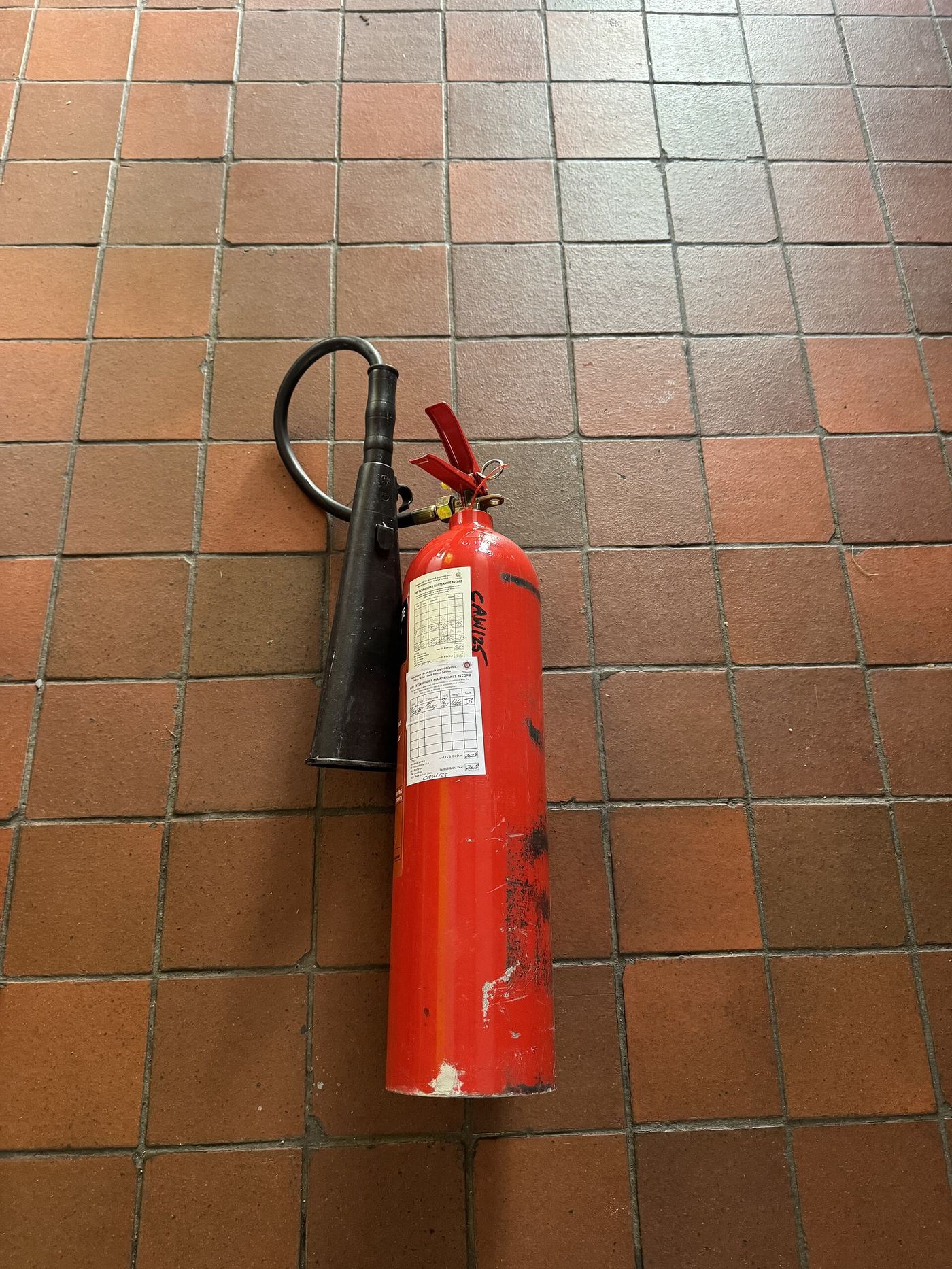
Read the rating before the price. This unit is 89B — a Class B rating only, with no A and no C number, because Class C carries no number and CO₂ is ineffective on Class A. That makes it the right second unit beside a dry chemical one and the wrong only unit in a lab with paper, cardboard and benches. A 5 kg CO₂ unit also needs a 5-year hydrostatic test under the OSHA table, against 12 years for a stored-pressure dry chemical unit — so the cheaper unit carries more service work over its life.
Cleanup, and the ABC powder
The ABC agent is usually a mixture of monoammonium phosphate and ammonium sulfate. The fine powder is hard to clean up after use. Units containing ammonium compounds are barred from areas with chlorine or bromine oxidisers. And CO₂ leaves no residue, which is why it suits electronics.
No page read quantifies equipment damage from ABC powder: the advice to prefer CO₂ near instruments is stated as a preference, not backed by a number.
Class C: the fire that is not really a class
De-energise first, then treat the fire as A or B — and Class C distance follows the A or B hazard in the room. No separate Class C spacing exists in these pages, so a room that is both A and B falls under the stricter 50 ft figure.
Counting the work over 20 years
For a stored-pressure ABC unit: 240 monthly visual checks, 20 annual maintenance checks, three 6-year internal maintenance services at years 6, 12 and 18, and one 12-year hydrostatic test at year 12.
For a CO₂ unit on a 5-year cycle: four hydrostatic tests over 20 years, at years 5, 10, 15 and 20, with the same monthly and annual checks. CO₂ units are weighed during maintenance rather than checked by gauge.
Mounting and weight
Where the unit is under 40 lb, the top should be less than 5 ft above the floor and the bottom more than 4 in. above it. One university lists its ABC unit at 10 lb and does not weigh its Class D and CO₂ units; most laboratory units are under 40 lb, so the 5 ft limit is the one that applies in practice. The rule for heavier units was not in the excerpt read, so a wheeled or large CO₂ unit needs the full procedure. Four of the pages read give no mounting height at all.
Who owns what
A fire marshal's office maintains all extinguishers except specialty types, with the lab or college maintaining specialty units such as Class D. Class D and CO₂ purchases go through EHS rather than a purchasing card. Department personnel do the monthly checks and a contractor the annual ones. In lab areas a supervisor ensures the monthly checks are completed, with fire wardens covering other areas. And the lab tells the chemical hygiene officer when the room's hazards change or a unit is discharged.
Dates of the pages
A procedure implemented 1 June 2004 and last reviewed 12 July 2023; a campus page updated 5 March 2026; a programme dated 3 June 2026; a university page with 17 November 2026 metadata; a policy at revision 8 dated 10 October 2022; a NIOSH checklist from 2004; and no date on two of the pages.
What this article could not check
The NFPA 10 text behind the 30, 50 and 75 ft figures and the rating tables was not read, nor was the reason for the 30 ft Class D distance at one university. No source resolves what to do in a lab storing both oxidisers and flammable liquids. No independent discharge-time or range data for CO₂ or ABC units was found, one policy was available only as an excerpt, and the mounting rule for units over 40 lb was not found.
Share this article