Gas Cylinder Restraints: One Chain at Two-Thirds Height or Two at One-Third and Two-Thirds, and 1 to 6 Cylinders Per Chain
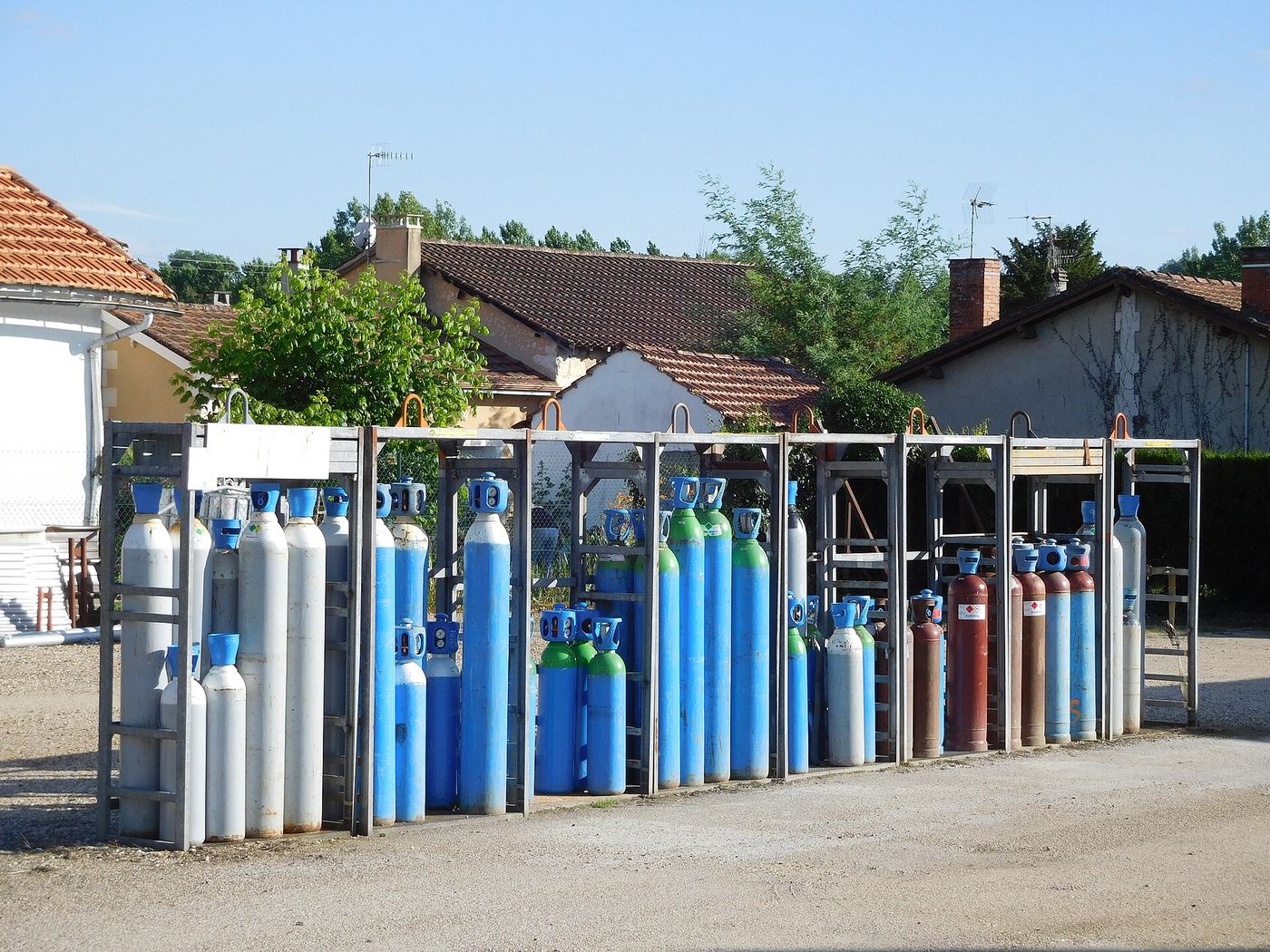
Ten pages say one chain at two-thirds height, three say two at one-third and two-thirds, and the count per chain runs from one to six. No page publishes the breaking load.
Disclosure: We may earn a commission if you purchase through links on this page, at no additional cost to you. Our selection criteria do not depend on commission; see our affiliate disclosure.
Thirteen university and agency pages were read for this article. Ten specify one chain or strap, three specify two at one-third and two-thirds height, and the number of cylinders allowed on one chain runs from one to six. No page publishes a rated load for the chain or for the wall anchor. Below, the heights are converted to inches and the disagreements listed rather than settled.
Where the restraint goes, by source
One restraint, as written:
- A strap or chain about two-thirds of the way up, attached to a fixed, immovable object.
- A chain link or strap about two-thirds up.
- At least one strap or chain of 1/4 in. diameter, above the centre of gravity, about two-thirds up.
- A chain or strap at two-thirds of the height from the floor.
- Secured by the body rather than the valve, at two-thirds height.
- One chain, strap or stand, two-thirds of the way up from the floor.
- A chain or strap two-thirds of the way up, with a stand as the alternative.
- Tight, between one-half and two-thirds of the height.
- Above the centre of gravity, roughly two-thirds up, and not hanging below the midpoint.
- Near the top third of the cylinder, below the shoulder.
Two restraints, as written: at least two non-combustible restraints at one-third and two-thirds height for cylinders taller than 26 in; two steel or aluminium chains at one-third and two-thirds up from the base; and the same two-chain layout described as the preferred method in one agency chapter.
The tally is ten pages with one restraint and three with two.
The same heights in inches
Vendor tables give a size 300 steel cylinder at 9 × 55 in. with a 9.25 in. outside diameter, and a size 200 at 9 × 51 in.:
| Cylinder | One-third | Midpoint | Two-thirds |
|---|---|---|---|
| 55 in. | 18.3 in. | 27.5 in. | 36.7 in. |
| 51 in. | 17.0 in. | 25.5 in. | 34.0 in. |
| 33 in. | 11.0 in. | 16.5 in. | 22.0 in. |
The half-to-two-thirds band on the 55 in. cylinder is 27.5 to 36.7 in., and the rule that the chain not sit below the midpoint puts the lowest allowed point at 27.5 in.
For a tape measure: one chain at exactly 36.7 in. satisfies nine of the ten single-restraint pages, with the half-to-two-thirds band at its upper edge; the "top third" wording starts at 36.7 in., so that chain sits on the edge of its zone; and two chains at 18.3 and 36.7 in. satisfy the three two-restraint pages as well as the two-thirds rule of the other ten.
One restraint or two
The two-restraint rule cites a state code, a laboratory fire standard, a health-care facilities standard and a county fire district detail — the list was visible, the code text was not.
Its height line is 26 in., and five of six vendor cylinder sizes fall under it. Pages that want one restraint rarely say why. A 2004 national laboratory paper notes that the compressed gas association's guidance does not say which restraint type to use, and that an OSHA construction clause calls for a cylinder truck or chains — both second-hand.
How many cylinders on one chain
Per restraint: one, with gang chaining prohibited and nesting avoided, in three pages; one, or up to six with approval, in one; two if ganged, and two on a wall bracket, in two; two in parallel, three nested or three in a triangle, in two more; and up to three, tight, in one.
The range is one to six. One page adds a hazard of its own: when the strap comes off to move one cylinder, both can fall.
What the cylinders weigh
Three sources, three numbers for what looks like the same cylinder: 137 lb average tare for the 9 × 55 in. size 300; about 62 kg (136 lb) for a 140 cm cylinder at 13 MPa described as full; and up to 300 lb for a full-size cylinder.
The 62 kg figure matches the empty weight rather than a full one, and the pages do not say whether tare was meant. Totals from those numbers: tare only gives 137 lb for one, 274 for two, 411 for three and 822 for six; at 300 lb per cylinder it is 900 lb for three and 1,800 for six.
No page read gives the breaking load of the chain or of the wall anchor against those figures.
What the restraint is made of
Chain: the recommended chain is 1/4 in. diameter, attributed to a gas supplier by one university and repeated by two others; chain thinner than that, flat-link chain, wire and rope are listed as not strong enough.
Straps: a nylon strap with a locking buckle or a self-locking hook to prevent accidental release; polyester or nylon straps that resist fraying better than older fabric, replaced when frayed; no wire, rope or frayed strap; periodic inspection with immediate replacement of damaged straps, though no interval is given. A 2004 paper adds that chains are stronger than rope or cord and do not depend on knot-tying skill.
Brackets and stands: wall mounts anchored to wall studs, with a bench mount only if the table is fixed to the floor; wall anchors installed by the facilities group; floor stands with a bracket held by two wing nuts, avoiding strap-type stands and very low stands with small footprints; a rack designed for small cylinders where that fits, and a bench mount rated for one cylinder holding no more; lecture bottles in a purpose-built rack or clamped to a heavy-based ring stand.
Carts split the sources: one lists a cylinder cart as an acceptable thing to attach to, another says carts are not a safe way to secure an uncapped cylinder even briefly.
Equipvia may earn a commission from qualifying purchases through this link. The link resolved to Product ID 1601573122005 during review. CPS resolution does not verify the seller's technical claims, the chain size, affiliate eligibility, or commission attribution. Check the actual selected variant and current terms before ordering.
A bracket is only as good as its chain and its anchor, and the listing states neither. Ask for the chain diameter against the 1/4 in. minimum that three universities quote, for the cylinder diameter range it closes on, and for the fixings — because the wall, not the bracket, is what holds 137 lb of steel at two-thirds height. Then check the height: a bracket fixed where the chain lands below the cylinder's midpoint fails the rule that appears on every page read here.
How far a cylinder has to lean before it falls
A standing cylinder tips when its centre of gravity passes over the edge of its base. Assuming the centre of gravity sits at half the height — a simplification, since valve, dome and contents shift it — the tip angle is the arctangent of the radius over half the height:
| Cylinder | Tip angle |
|---|---|
| 9.25 × 55 in. | about 9.5° |
| 9 × 51 in. | about 10.0° |
| 7 × 33 in. | about 12.0° |
| 7 × 19 in. | about 20.2° |
These are static geometry rather than a test. A cylinder bumped at speed goes over with less lean, which is what the 2016 near miss describes.
What the pages say happens after a fall
A 2004 national laboratory paper calculated what happens when a valve shears off a typical 140 cm cylinder at 13 MPa, and calls its own figures upper bounds: argon 155 m/s with a thrust-to-weight of 3.2; nitrogen 192 m/s at 4.8; helium 167 m/s at 10.7; hydrogen 202 m/s at 17.1 — against 1.2 to 2 for launch vehicles on the pad.
Incidents it lists: a 13 MPa argon cylinder pulled over in 1990 with the regulator stem breaking and an employee 1.5 m away; about 100 improperly restrained cylinders failing in the 1994 Northridge earthquake; a 45.5 kg CO₂ cylinder at 5.7 MPa travelling about 9 m in 1995; and a 13 MPa nitrogen cylinder sliding down stairs and striking an employee in 1996.
The conflict over whether a sheared valve makes a rocket is unresolved here: a 2009 mailing-list post from a university chemical hygiene officer says no account of such a projectile could be found, citing a 2006 book that says the valve opening is too small, with no reference given; the 2004 paper calculates thrust-to-weight ratios of 3.2 to 17.1; and the gas association's own statement was not found.
One 2016 near miss: a vendor moved a cylinder to clear a doorway and did not re-strap it, equipment bumped it, and the regulator snapped off. The main valve stayed closed and nothing discharged. The lessons listed were a hydrostatic test after any fall, re-strapping after any move, and treating temporary storage like permanent.
Rules that sit next to the restraint rule
- Oxygen separation: 20 ft from flammable gas, or a non-combustible barrier at least 5 ft high with a half-hour fire rating; 20 ft from highly combustible materials; and oxygen kept away from oil and grease.
- Heat: a 50 °C (125 °F) ceiling in one source and 125 °F in another, the same limit rounded differently.
- Caps: on unless a regulator is attached; cylinders kept out of any electric circuit path.
- At the regulator: crack the valve open and shut once before attaching with the outlet pointed away; no more than 1½ turns open for flammable gas; regulators removed when cylinders are not in use; corrosive gas cylinders returned to the supplier within a year.
- Movement: a hand truck with a chain or belt, never with a regulator attached; cap on, no lifting by the cap, no magnetic slings; a gauge reading of 0 psig does not mean empty; safety glasses, heavy gloves and protective footwear; and no use or storage in cold rooms or other rooms without outside-air ventilation.
A five-minute check with a tape measure
- Height: on a 55 in. cylinder, a single chain at 27.5 to 36.7 in.; a second chain at 18.3 in. if the two-restraint wording applies.
- Count: more than three cylinders on one chain exceeds every source except the one allowing six with approval.
- Chain: under 1/4 in., flat links, wire or rope fail the published list.
- Strap: any fraying means replace it or use a chain.
- Anchor: a stud, bracket or stand, and one rated for one holds one.
- Moved since it was last strapped? That is where the 2016 case started.
Dates of the pages
A fact sheet revised 17 September 2024; a page updated 1 October 2026; a footer of 2019 with no guidance date; a 2016 incident bulletin; a September 2004 conference paper; a 2023 PDF upload; a September 2009 mailing-list post; and four pages with no date at all.
What this article could not check
No breaking load for 1/4 in. chain, for a strap, or for a wall anchor in drywall or stud appears in any of these sources; no test of tip or sway of a restrained laboratory cylinder exists in them; the texts of the gas association's guidance, the OSHA construction clause, the laboratory and health-care fire standards and the state code appear only as citations by others; several institutional pages were read only as search excerpts; the gas association's own statement on projectile behaviour was not found; and no fixed interval for strap inspection or for hydrostatic testing after a fall is published.
Share this article