Centrifuge Rotors: Fixed-Angle against Swing-Bucket, k-Factors from 280 to 5,522, and Rotor Life by Material
Two rotors at the same 14,000 rpm differ by 59 percent in force, and a protocol written in rpm does not transfer between them. The k-factor is the number that does.
Disclosure: We may earn a commission if you purchase through links on this page, at no additional cost to you. Our selection criteria do not depend on commission; see our affiliate disclosure.
Two rotors spun at 14,000 rpm gave one maker 13,100 × g and 20,817 × g. A fixed-angle rotor on a superspeed centrifuge lists a k-factor of 408, a swinging-bucket rotor on the same line lists 1,503, and a large bucket rotor lists 5,522. Rotor life runs from 5 years to no limit at all, depending on material and on which document you read. Below, the published numbers are set side by side and the arithmetic is checked.
Same rpm, different force
RCF = 1.118 × 10⁻⁵ × r (cm) × rpm². One maker's rotor manuals print the same relation as 1.12 × r (mm) × (rpm/1000)².
Two rotors for 1.5 and 2 mL tubes at 14,000 rpm: one with a 5.98 cm radius at 13,100 × g, one with 9.50 cm at 20,817 × g. The ratio of forces is 1.59 and the ratio of radii is 1.59 — the force scales with radius exactly, and recomputing gives 13,104 and 20,817 × g.
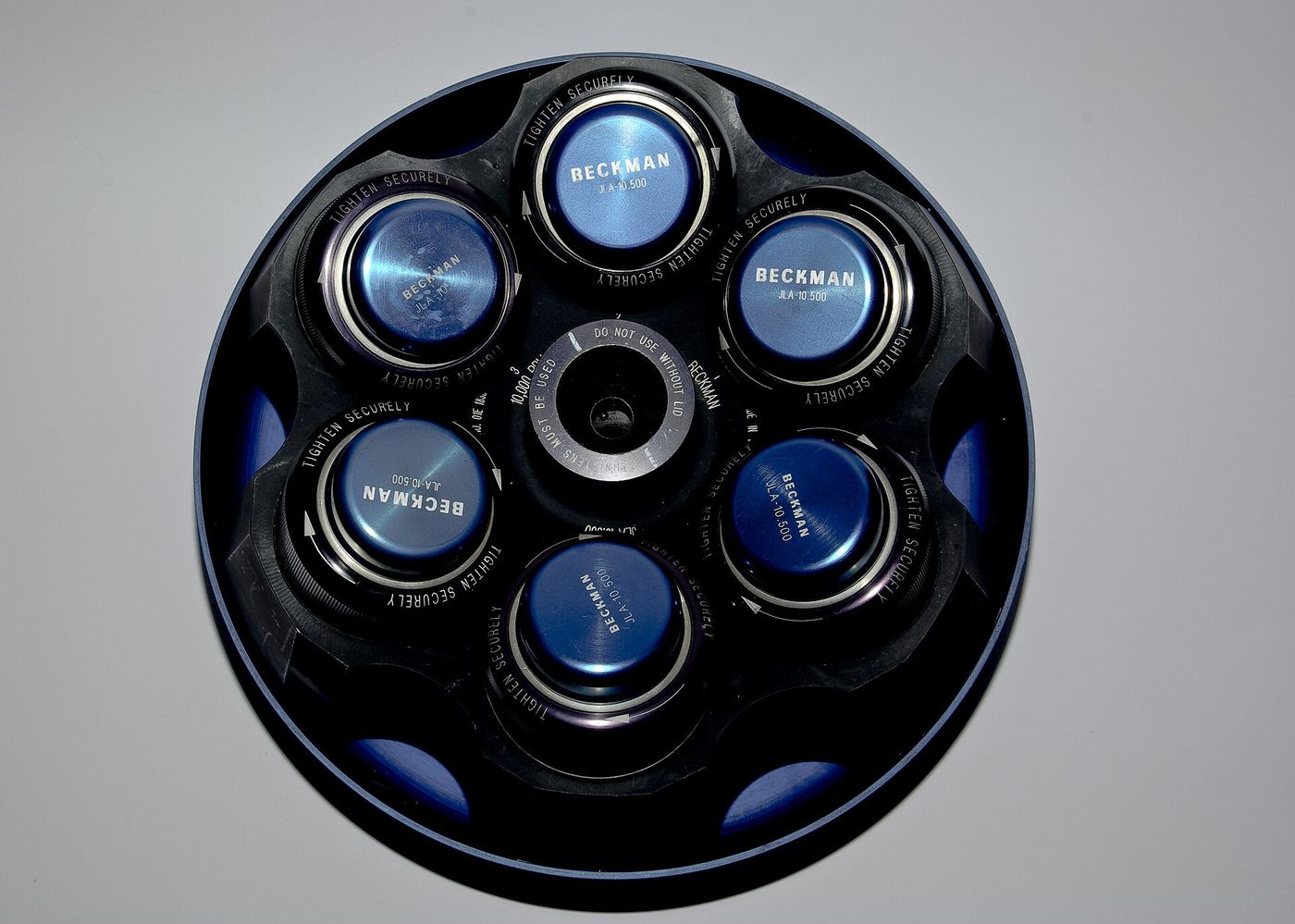
Catalog figures for a benchtop centrifuge with a swing-bucket rotor: the A-4-81 at 4 × 500 mL gives 4,000 rpm and 3,220 × g, while the centrifuge maximum is 14,000 rpm and 20,913 × g. Those imply radii of 18.0 cm and 9.54 cm. At 3,000 rpm the swing bucket gives 1,810 × g; at 2,000 rpm, 805 × g.
Speed needed for a target force, at four radii:
| Radius | 3,000 × g | 12,000 × g |
|---|---|---|
| 5.98 cm | 6,699 rpm | 13,397 rpm |
| 9.50 cm | 5,315 rpm | 10,629 rpm |
| 10.4 cm | 5,080 rpm | 10,159 rpm |
| 18.0 cm | 3,861 rpm | not reachable |
The same 4,000 rpm gives 1,070 × g at 5.98 cm and 3,220 × g at 18.0 cm — a factor of 3. A protocol written in rpm therefore does not transfer between rotors, and the 18.0 cm rotor cannot reach 12,000 × g at all, because 4,000 rpm is its ceiling.
Two geometries
| Feature | Fixed-angle | Swing-bucket |
|---|---|---|
| Moving parts | none | buckets swing out |
| Metal stress | lower, longer lifetime | higher |
| Maximum force | higher | lower |
| Run time | often shorter | often longer |
| Tube position | usually 45° | horizontal during the run |
| Pellet | on the side wall to the bottom | at the bottom |
| Pellet recovery | harder | easier |
| Tube formats | limited | high, including plates and adapters |
| Capacity | limited | high |
Larger tube angles give tighter pellets and smaller angles spread the pellet over a larger area. Catalog angles: 25° and 34° on two fixed-angle rotors, 45° on an ultracentrifuge rotor, 30° on a 6 × 13.5 mL rotor, and 90° or horizontal on swinging buckets.
The force varies along the tube as well. rmax / rmin is 2.8 on one 34° fixed-angle rotor, 2.3 and 2.0 on two titanium ultra rotors, and 1.33 on a swinging-bucket rotor — so a fixed-angle tube sees nearly three times the force at its tip as at its mouth, while a swinging bucket is nearly uniform.
Published forces confirm it: 27,000 × g at rmin and 75,600 × g at rmax on the same fixed-angle rotor, against 5,170 and 6,870 × g on a 500 mL swinging-bucket rotor. The speed implied by those bucket figures is about 5,300 rpm.
Equipvia may earn a commission from qualifying purchases through this link. The link resolved to Product ID 1601358720652 during review. CPS resolution does not verify the seller's technical claims, the radius, affiliate eligibility, or commission attribution. Check the actual selected variant and current terms before ordering.
A rotor sold by tube count and volume is only half specified. Without rmax and rmin there is no way to compute the k-factor, no way to convert a protocol written for another rotor, and no way to check that the quoted maximum RCF is consistent with the quoted speed. Ask for both radii, the angle, the maximum RCF with the radius it refers to, and the tube's own RCF limit — which is often far below the rotor's, 4,696 × g for a 50 mL conical in one bucket rotor against 23,500 × g in a fixed-angle rotor.
Equipvia may earn a commission from qualifying purchases through this link. The link resolved to Product ID 1601358951789 during review. CPS resolution does not verify the seller's technical claims, the radius, affiliate eligibility, or commission attribution. Check the actual selected variant and current terms before ordering.
A swinging-bucket rotor buys capacity and an easy pellet at the cost of speed and force: in the published catalog the swinging rotors reach 1.5 to 2.0 times the radius of the fixed-angle rotors at less than half the speed, and their k-factors run 3.7 to 13.5 times larger. That is a slower separation for the same particle, which is exactly what the k-factor is for. Confirm which buckets and adapters ship with it — the capacity claims usually assume a set that is sold separately.
What the k-factor is
The clearing factor describes pelleting efficiency at maximum speed: smaller k means faster separation. One maker says it matters less for general work and still matters for ultracentrifugation.
k = 2.53 × 10⁵ × ln(rmax / rmin) / (rpm / 1000)², and pelleting time in hours is t = k / s, with s in svedbergs.
Recomputed from published radii and speeds:
| Rotor | rmax | rmin | rpm | k computed | k published |
|---|---|---|---|---|---|
| JA-25.50 | 108 mm | 38.5 mm | 25,000 | 418 | 418 |
| Type 70 Ti | 91.9 mm | 39.5 mm | 70,000 | 43.7 | 44 |
| Type 70.1 Ti | 82 mm | 40.5 mm | 70,000 | 36.5 | 36 |
The force check matches too: 75,600 × g computed at rmax against 75,600 published, and 26,950 against 27,000 at rmin.
Two 70,000 rpm rotors make the point in the maker's own note: 504,000 × g with a 52.4 mm pathlength and k 44, against 450,000 × g with a 41.5 mm pathlength and k 36. The lower-force rotor pellets more than 18 percent faster, and 1 − 36/44 is 18.2 percent — the k values alone give the answer.
Catalog k-factors, fixed against swinging
| Rotor | Type | rpm | Max RCF | k |
|---|---|---|---|---|
| A27-8x50 | fixed | 27,000 | 87,207 × g | 408 |
| T29-8x50 | fixed | 29,000 | 100,605 × g | 354 |
| TH13-6x50 | swinging | 13,100 | 30,314 × g | 1,503 |
| BIOFlex HS | swinging | 7,000 | 10,025 × g | 4,889 |
| BIOFlex HC | swinging | 5,500 | 7,068 × g | 5,522 |
| Fiberlite F15-8x50cy | fixed | — | — | 1,381 |
| TX-400 | swinging | — | — | 1,808 |
| JA-30.50 Ti | fixed | 30,000 | 108,860 × g | 280 |
| JA-10 | fixed | — | — | 3,610 |
Ratios: TH13-6x50 against A27-8x50 is 3.7 in k and 2.9 in force; BIOFlex HC against A27-8x50 is 13.5 in k; TX-400 against F15-8x50cy is 1.31 in k. Both the TH13 and the A27 hold 50 mL tubes, so that comparison is like for like in volume class, though not in speed.
The maximum radius implied by each force and speed pair is 10.7 cm for both 8 × 50 mL fixed-angle rotors, 15.8 cm for the TH13, 18.3 cm for BIOFlex HS and 20.9 cm for BIOFlex HC.
Converting a protocol time
Time scales with k: T2 = T1 × (K2 / K1). A generic worked example: 45 minutes in a rotor with k 250 becomes 45 × 133 / 250 = 24 minutes in one with k 133. With catalog rotors, 10 minutes in the TX-400 at k 1,808 becomes 7.6 minutes in the F15-8x50cy at k 1,381.
Running below maximum speed raises k with the inverse square of speed. A rotor with k 418 at 25,000 rpm has k 1,161 at 15,000 rpm and 2,613 at 10,000 rpm, and 27,216 × g at rmax at 15,000 rpm. That formula is not published by any maker read here; the sources only note that published k values usually apply at the rated maximum.
The conversion covers pelleting only, for the same particle in a comparable buffer with similar viscosity, density and temperature, ignoring acceleration and braking. Fixed-angle to swinging-bucket conversions are estimates.
Tube limits can decide the rotor
Recommended maximum RCF for conical tubes, by rotor:
| Tube | Rotor | Max RCF |
|---|---|---|
| 15 mL | F15-6x100y | 24,652 × g |
| 15 mL | TX-400 | 4,696 × g |
| 15 mL | TX-200 | 5,580 × g |
| 15 mL | TX-750 | 4,816 × g |
| 50 mL | F15-6x100y | 23,500 × g |
| 50 mL | TX-400 | 4,696 × g |
| 50 mL | BIOShield 720 | 6,500 × g |
The 50 mL limits differ by a factor of 5 between the fixed-angle and bucket rotors, so a rotor chosen for force can be limited by the tube long before it reaches its own rating.
Force on a bucket
A fully loaded benchtop bucket of 1,650 g at 4,816 × g carries about 17,530 lbf, or over 8.5 tons per bucket; a superspeed rotor with 6 × 1 L cavities at 15,150 × g carries over 17 tons per cavity. Full-size ultracentrifuges reach about 800,000 × g and micro models over 1,000,000 × g. The check: 1.65 kg × 4,816 × 9.807 m/s² is 77,930 N, or 17,520 lbf, which matches the slide.
Rotor life by material
| Material | Warranty | Finite life |
|---|---|---|
| Plastic | 5 years | 5 years or 30,000 runs |
| Aluminum, superspeed | 7 years | 14 years |
| Aluminum, ultra | 5 years or 2,000 runs | 5 years or 2,000 runs |
| Titanium | 5 years or 5,000 runs | 10 years or 5,000 runs |
| Titanium, swinging bucket | 5 years or 2,000 runs | 5 years or 2,000 runs |
| Carbon fiber | 15 years | no limit |
A maker's own safety guide gives 7 years for its J-series rotors, 2,000 runs or 5 years for zonal, continuous-flow and rock-core rotors, and 5 years for ultracentrifuge rotors. It names stress corrosion as the main aging risk for aluminum, credits titanium with better corrosion resistance, retires carbon-fiber parts on their printed expiration date, recommends rather than requires preparative rotor logs, and keeps purchase dates on file for J2, J6 and Avanti J rotors.
The implied run rates matter more than the years: 2,000 runs in 5 years is 1.1 runs a day, 5,000 in 10 years is 1.4 a day, and 30,000 in 5 years is 16.4 a day. At 10 runs a day, 2,000 runs arrive in 200 days and 5,000 in 500 — both inside a single warranty year — while 30,000 runs takes 3,000 days, or 8.2 years. At one run a day, 2,000 runs takes 5.5 years, which is past the 5-year line for aluminum ultra rotors.
Inspection: once a year in operation and once every three years disassembled, by an authorised technician, for one benchtop series. Replacement intervals quoted elsewhere are 7 to 10 years, and one blog figure of 50,000 runs works out at 19.6 runs a day over 7 years — that figure was not found in any manufacturer document. The 7-year warranty against a 14-year finite life for aluminum superspeed rotors is also unresolved between two sources.
Records to keep, from a university rotor guide: purchase date, manufacturing date and serial number for each rotor; the correct centrifuge for each rotor; maximum speed and sample density ratings; a speed-derating disk where the warranty requires one; and the correct overspeed disk on the bottom of ultra rotors, in good condition.
What the standard covers
IEC 61010-2-020:2016 is the third edition, replacing the 2006 edition, and applies to electrically powered laboratory centrifuges, read together with IEC 61010-1. It defines rotor, rotor assembly, chamber, bucket, bioseal and disruption, and specifies a test in which a bucket or rotor bioseal is exposed to a concentrated suspension of bacterial spores while the centrifuge runs, with no spores permitted to escape. A fourth edition circulated as prEN IEC 61010-2-020:2024, with the microbiological test method in Annex AA.
Biocontainment rotors are marketed against that framework: one maker's TX-400 and TX-750 are sold as biocontainment certified, and the TX-750 listing cites testing at three named facilities whose reports were not read here.
Reading a rotor sheet
Pull these before comparing two rotors: maximum speed and maximum RCF with the radius they refer to; rmax, rmin and the k-factor at maximum speed; the angle, or horizontal for a swinging bucket; the tube RCF limit, which can be well below the rotor limit; and the warranty and finite life in both years and runs, plus whether an overspeed or derating disk applies.
A worked check: rmax 108 mm at 25,000 rpm should give 75,600 × g. If a sheet's force does not match 1.12 × rmax × (rpm/1000)², then the radius or the speed belongs to a different configuration.
What this article could not check
The full text of IEC 61010-2-020 was not available, only summaries and previews; no manufacturer document was found for the 50,000-run figure; no maker publishes a k-factor at a stated speed below maximum; no second maker's 4 × 400 mL swinging rotor datasheet was found giving k and angle together; and the asterisks in one tube table could not be read.
Share this article