Eyewash Stations: Plumbed against Self-Contained, 0.4 gpm for 15 Minutes, and Ten Seconds That Means 55, 75 or 100 Feet
Six gallons per flush, ten seconds of walking that one source calls 55 feet and another 75, and a weekly flush whose length nobody agrees on. The equipment is simple; the specification is not.
Disclosure: We may earn a commission if you purchase through links on this page, at no additional cost to you. Our selection criteria do not depend on commission; see our affiliate disclosure.
Published figures: eyewash flow of 0.4 gpm of tepid water at 60 to 100 °F for 15 minutes. Ten-second travel is "approximately 55 feet" on one university sheet and "approximately 75 feet" on another page of the same site. An OSHA letter of 1992 says no more than 100 feet and 10 seconds. Below, the numbers are set side by side and the disagreements listed rather than settled.
What the standard asks of an eyewash
ANSI/ISEA Z358.1-2014 itself was not read here; the figures come from university and government pages that summarise it.
The recurring set: 0.4 gallons per minute for 15 minutes, tepid water at 60 to 100 °F, travel within 10 seconds, weekly activation, and signage of 6 inches or more. A copy hosted by a university adds that the flow peak sits 33 to 53 inches above the standing surface and at least 6 inches from the wall.
Others add: hands-free operation; 15 minutes of continuous flow at 0.4 gpm; self-contained and portable units at 1.5 litres per minute for 15 minutes from a six-gallon capacity; 0.4 gpm at 30 psi for at least 15 minutes; spray heads with dust covers that the flow removes; and thermostatic mixing valves to keep water tepid.
The 2004 edition, as summarised: valve operable with both hands free, water at 15 to 38 °C (59 to 100.4 °F), unit at the same level as the hazard, and adjacent to the hazard where the material is pH 1 or below, or 12 or above.
Volumes and conversions
- One eyewash flush: 0.4 gpm × 15 min = 6 gallons, 22.7 L. At 1.5 L/min it is 22.5 L — the same volume by two routes.
- Eye/face wash at 3 gpm: 45 gallons, 170 L.
- Shower at 20 gpm: 300 gallons, 1,136 L. At the older 30 gpm: 450 gallons, 1,703 L.
- 60 °F is 15.6 °C; 100 °F is 37.8 °C; 100.4 °F is 38.0 °C.
- 30 psi is 207 kPa, 25 psi is 172 kPa and 80 psi is 552 kPa.
- Flow peak 33 to 53 inches is 84 to 135 cm; shower head 82 to 96 inches is 208 to 244 cm; pull handle 69 inches is 175 cm.
A state guide gives supply requirements: at least 30 psi at the inlet, about 45 psi in normal design, over 80 psi excessive; a plumbed shower supply line of at least 1 inch; a privacy enclosure at least 34 inches across; and a spray centre at least 16 inches from obstructions. Those are 310 kPa, 2.5 cm, 86 cm and 41 cm.
The waste figure is the one that surprises: a 15-minute shower at 20 gpm produces 300 gallons, which is 50 times the 6 gallons of one eyewash flush — and it needs a drain, which a self-contained unit does not.
Four kinds of equipment
- Plumbed eyewash: connected to potable water, activated weekly, with the flush length not defined by the standard according to one state guide.
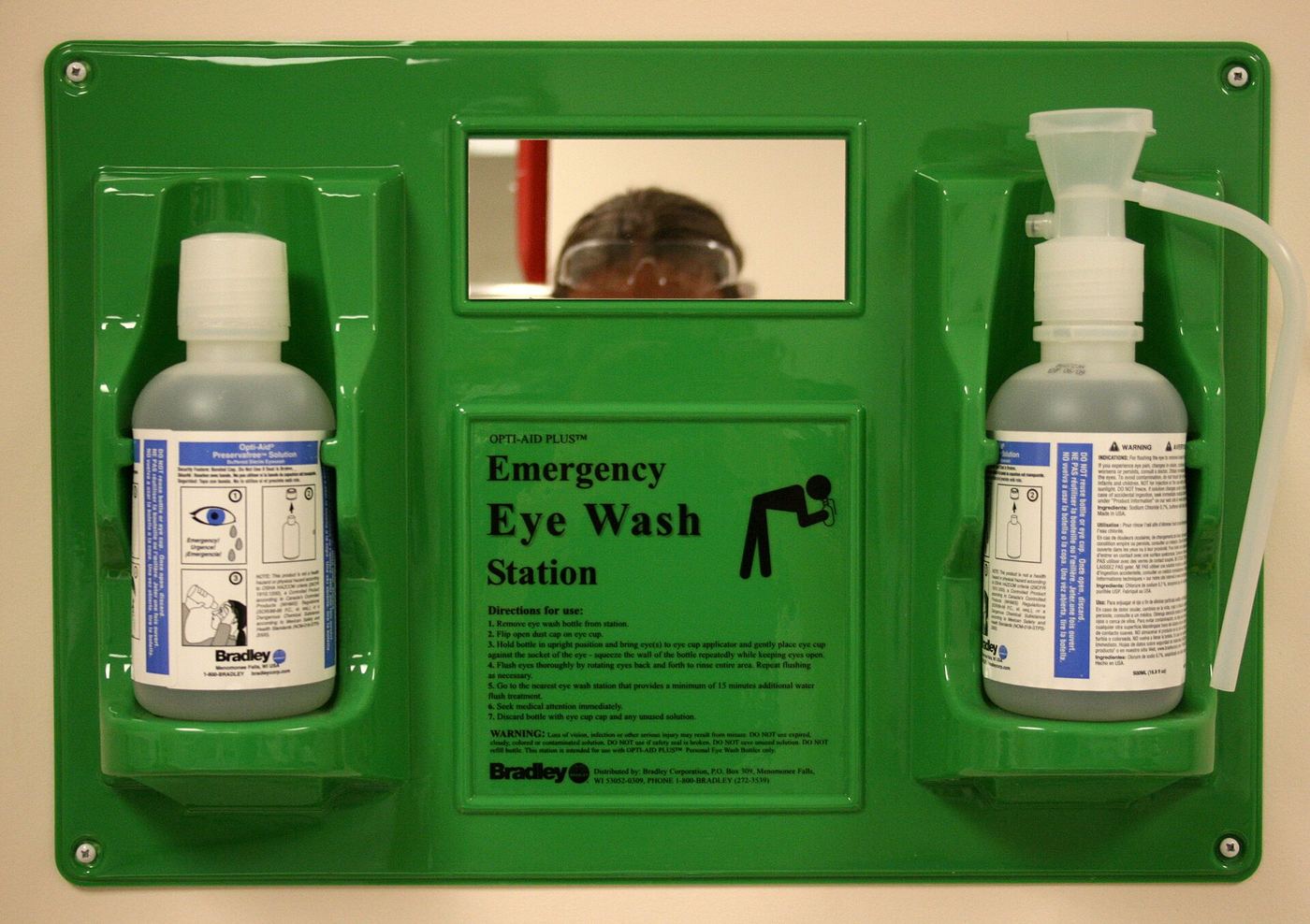
- Self-contained, gravity-fed: holds bacteriostatic water or sterile saline; one university discourages them in place of plumbed units.
- Personal wash units such as squeeze bottles: they do not meet the criteria of a plumbed or self-contained eyewash, and a vendor states the standard treats them as supplemental only.
- Drench hoses: activated weekly; one state requires two or more trained people where a hose replaces an eyewash. Flow is not specified after the 2004 edition, but a 1998-era state guide gives 3 gpm.
Equipvia may earn a commission from qualifying purchases through this link. The link resolved to Product ID 2022898090 during review. CPS resolution does not verify the seller's technical claims, the flow rate, affiliate eligibility, or commission attribution. Check the actual selected variant and current terms before ordering.
A plumbed unit is the only type that can deliver 15 minutes without someone refilling it, and it brings three requirements the listing does not address: 0.4 gpm at the building's actual pressure, a thermostatic mixing valve to hold 60 to 100 °F, and a drain for 300 gallons if a shower is part of the unit. Ask for the flow at a stated inlet pressure, whether a mixing valve is included, and for the Z358.1 listing — the standard has not been incorporated by reference into the CFR, so a supplier claim of "ANSI compliant" is worth checking against a test report.
Equipvia may earn a commission from qualifying purchases through this link. The link resolved to Product ID 1601562265606 during review. CPS resolution does not verify the seller's technical claims, the fluid, affiliate eligibility, or commission attribution. Check the actual selected variant and current terms before ordering.
A 30 L tank is 7.9 gallons, which is enough for one 15-minute flush at 1.5 L/min (22.5 L) with little margin — so the fill line matters, and so does what is in the tank. Plain water in an open unit needs changing about every six months; water with preservative every one to four months; sealed cartridges up to two years. Ask which of those the unit is designed for, because the maintenance interval follows the fluid, not the tank.
Where the sources disagree
- Ten seconds is about 55 feet to one state authority citing Appendix B of the 2014 edition, and to one university sheet; a second page of the same university says about 75 feet.
- An OSHA letter of 20 July 1992 says no more than 100 feet.
- A letter of 17 February 1995, on ethylene oxide, says within 10 feet of unimpeded travel, or the ANSI distance.
Implied walking speeds: 55 ft in 10 s is 5.5 ft/s, 1.7 m/s; 75 ft is 7.5 ft/s, 2.3 m/s; 100 ft is 10 ft/s, 3.0 m/s. The 100-foot figure is 1.8 times the 55-foot figure, and the three differ by 20 and 45 feet — 6.1 and 13.7 m.
Flow peak: 33 to 53 inches in one summary against 33 to 45 inches in a 1998-era state guide; the cause of the difference was not found.
Tepid water: one university requires 60 to 100 °F, another recommends tepid and accepts cold-only where tepid is not feasible, a third allows cold or tepid below 100 °F, and a fourth describes tempered units near 80 °F, which is 26.7 °C.
Weekly flush: a state guide and a 1986 OSHA bulletin say 3 minutes or more; one university says 1 to 3 minutes; another says until clear; a trade magazine, quoting an OSHA information sheet, says 15 minutes; and another trade piece says follow the manufacturer. That range is not resolvable from the sources read.
Testing frequency: weekly per the standard as most universities read it; monthly at minimum, weekly recommended, at one; monthly under a state code. Fluid change: weekly for plain water, every 1 to 4 months with preservative, up to 2 years for sealed cartridges, about six months for open units, at expiry or yearly if none is given, and weekly per the 1986 OSHA bulletin.
Shower flow: 20 gpm in current summaries, against 30 gpm in the 1981 edition.
Weekly flush arithmetic
For a 0.4 gpm eyewash:
| Flush | Water per week | Water per year | Staff time per year |
|---|---|---|---|
| 1 minute | 0.4 gal | 21 gal | 52 min |
| 3 minutes | 1.2 gal | 62 gal | 156 min (2.6 h) |
| 15 minutes | 6 gal | 312 gal | 780 min (13 h) |
A monthly 3-minute flush instead is 12 flushes, 14 gallons and 36 minutes a year.
Container checks from a state guide: one gallon in 2.5 minutes or less for an eyewash, which is 1 / 0.4; 20 seconds or less for an eye/face wash, which is 1 / 3; and 3 gallons in 9 seconds or less for a shower, which is 20 gpm — a test the guide says is not in ANSI.
Scaling to a building
Ten plumbed eyewashes flushed weekly: 208 gallons a year at 1 minute, 624 at 3 minutes, 3,120 at 15 minutes; staff time 26 hours a year at 3 minutes and 130 hours at 15. Flushed monthly at 3 minutes instead, it is 360 minutes, or 6 hours, and 144 gallons.
Five plumbed showers flushed 3 minutes weekly at 20 gpm use 60 gallons per flush, 300 gallons a week and 15,600 gallons a year — 59,052 L — which is 25 times the eyewash water in the same building.
Water quality
The temperature band is agreed across sources, and one state guide notes that temperatures above 38 °C have proven harmful.
Stagnant water is named as a hazard for Acanthamoeba, Pseudomonas and Legionella by a state guide and by an OSHA publication; a 2014 NIH bulletin advises a backflow preventer, mixing valves and no dead ends in piping, and notes that weekly 3-minute flushes may temporarily lower amoebic and bacterial concentrations.
A peer-reviewed study of water age found contamination rising significantly past one day of water age. A weekly flush implies about 7 days — seven times that mark — and a monthly flush about 720 hours, or 30 times it. One trade report gives 50 stations measuring 10² to 10⁶ CFU/mL, and a German accident-insurance study found running the water a few minutes improved quality.
What a weekly check covers
A university's weekly routine: unobstructed station, one-handed activation, covers removed by the flow, water running clear. For self-contained units: weekly visual inspection of the fluid and replacement at expiry. For portable units: the tank filled to the line, and opening the tank to look for growth or debris where no preservative is used.
An annual test from a state guide: eyewash at 0.4 gpm, or 1 gallon in 2.5 minutes, with the valve opening in 1 second and staying on; shower spray at least 20 inches across at 60 inches, which is 51 cm at 152 cm; shower head 82 to 96 inches.
What OSHA says
29 CFR 1910.151(c) requires suitable facilities for quick drenching or flushing of the eyes and body where a person may be exposed to injurious corrosive materials. A state instruction of June 2020 notes that neither the general industry nor the construction standards give specifications for design, water temperature or travel distance; that eyewashes and showers should be within 10 seconds and on the same level; that for strong acids or bases they should be adjacent to the hazard; and that drench hose pressure should not exceed 25 psi.
The interpretation letters run: within 100 feet (1992); within 10 feet for ethylene oxide liquid or the ANSI distance (1995); and ANSI Z358.1 used as guidance to comply with the rule (2004).
Edition history
1981 brought 30 gpm for plumbed showers; 1998 brought 20 gpm, a shower valve at most 69 inches high and activation within 1 second; 2004 removed the drench hose flow requirement; 2009 set tepid water at 60 to 100 °F for the full 15 minutes; and 2014 is the current text, approved in early 2015 and listed by ANSI as reaffirmed in 2020. One distributor page dated May 2026 says no newer revision has been published, which was not confirmed with ISEA. The standard has not been incorporated by reference into the CFR.
Gaps between editions: 17 years to 1998, then 6, 5 and 5 years, and 12 years from 2014 to now with the 2020 reaffirmation in between. The 1992 OSHA letter is 34 years old and the 1995 letter 31.
Reading the numbers when choosing
Before buying: plumbed or self-contained; a drain for the flush water; 6 gallons and a fill line if self-contained; 0.4 gpm at 30 psi stated against the building's pressure; dust covers; a hands-free valve; a mixing valve or tepid stored fluid; and a location within 55 feet, closer for strong acids and bases.
Maintenance per year: a weekly 3-minute flush is 156 minutes of staff time; an open self-contained unit changed every six months is two fluid changes; sealed cartridges at two years are half a change.
What this article could not check
The full text of ANSI/ISEA Z358.1-2014 (R2020) was not read, nor the full text of the OSHA publication on contaminated eyewash water. No source explains the 33-to-45 against 33-to-53 inch discrepancy, no test links flush length to microbial count, and no neutral price comparison of plumbed and self-contained units was found.
Share this article