Conductivity Standards: 84, 147, 1413 or 12,880 µS/cm, and Bottle Life
A bottle reading 80.7 in a 23 °C room is not broken. It is 3.9 % under its label, because the label belongs to 25 °C.
Disclosure: We may earn a commission if you purchase through links on this page, at no additional cost to you. Our selection criteria do not depend on commission; see our affiliate disclosure.
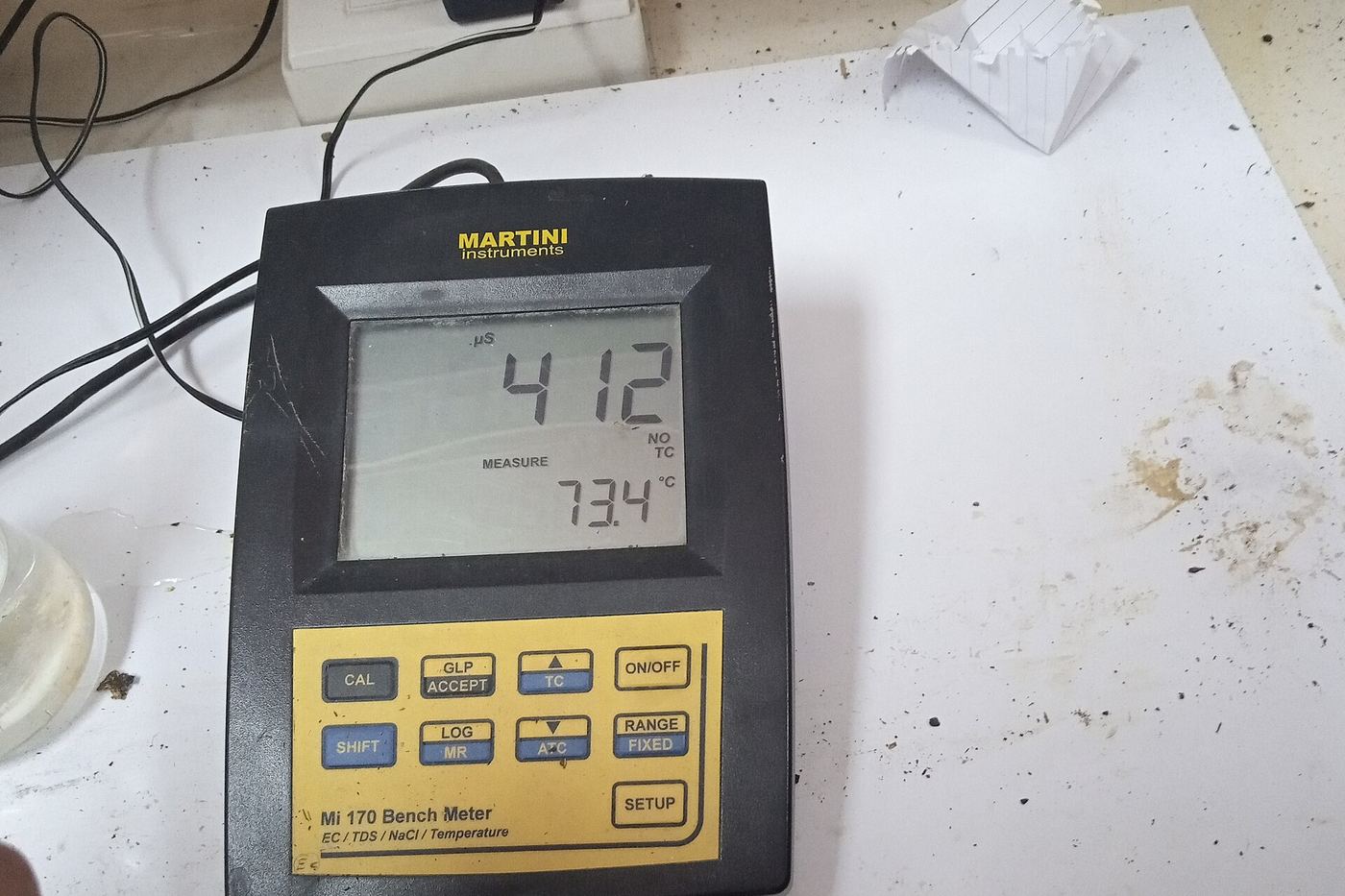
Pick up a bottle of 1413 µS/cm standard and read the label: ±1 % at 25 °C. Now look at the thermometer in your beaker. Potassium chloride solutions drift about 2 % for every degree, so a bottle sitting at 23 °C on a cool bench is already roughly 4 % away from the number printed on it. The tolerance on the label was never the biggest error in the room.
That is the odd thing about conductivity standards. They look like the simplest reagent in the lab, a salt in water, yet three separate decisions hide behind every reorder: which values to stock, which reference those values were pinned to, and what you do with the bottle once the cap is off. This guide takes them in that order. The anchor documents are the IUPAC report by Pratt, Koch, Wu and Berezansky, OIML Recommendation R 56, the ASTM D1125 reference table and the USP chapter on water conductivity. Most handling advice comes from the companies that sell the bottles, so they are named here and allowed to disagree.
Where 1413 comes from
Almost every standard on the shelf is KCl in water, and almost every one traces back to a handful of documents. They do not quite agree, for a dull but useful reason: each counts concentration differently.
IUPAC counts by molality. At 25 °C its 0.01 mol/kg solution is 1408.23 µS/cm, the 0.1 mol/kg solution is 12,824.6 and the 1.0 mol/kg solution is 108,620, each after the water's own conductivity has been subtracted. The report puts CO₂-saturated water at about 1.10 µS/cm.
OIML R 56, dated 1981, counts in demals, meaning grams of KCl per 1000 g of solution. Its 0.745263 g solution comes out at 1408.3 µS/cm, the 7.41913 g solution at 12,852, and the 71.1352 g solution at 111,310. A secondary standard of 0.07466 g per kilogram lands at 146.9.
ASTM D1125 weighs the salt and makes it up to a litre. In the 2014 table read for this article, 0.7440 g made up to 1 L at 20 °C gives 1408.8 µS/cm at 25 °C. The tenfold stronger solution gives 12,856, and a tenfold dilution of the weaker one gives 146.93. A footnote says to multiply by 0.999505 if your instrument is calibrated in absolute units.
Now look at the shelf. Hach sells a 0.01 M standard as 1413 ±12 µS/cm, one distributor lists a 12,880 and a 147, and Hamilton lists an 84. So the 0.01 solution is 1408 in three standards documents and 1413 in the catalogue, a gap of about 0.3 %. The strong solution is 12,825, 12,852, 12,856 or 12,880 depending on whom you ask. A guess, and only a guess, is that the shelf values come from molar preparation. Nothing found says so.
Does it matter? If your tolerance is 2 %, no. If you are comparing two labs, or two cells calibrated against standards from different families, yes. The practical rule is simple: write down the value on the certificate, not the value in your head.
Which values to buy
ASTM D1125 gives you a way to choose. Its Table 2 pairs ranges with cell constants: 0.01 to 0.1 cm⁻¹ for the lowest range, up to 10 µS/cm, then 0.1 to 1 up to 200, 1 to 10 up to 5000, and 10 to 100 beyond. The message is to calibrate near what you measure. One bottle will not cover a lab that runs deionised water in the morning and brine in the afternoon.
Most labs end up with three: a 1413 as the workhorse, something near 12,880 for brackish or process samples, and a low one for pure water. For that low bottle, Mettler Toledo's advice is to calibrate on 84 µS/cm and check on 10, even for very pure media, because its meters stay linear down there and the 10 µS/cm standard is too fragile to calibrate with. Optek, which makes process sensors, warns that low standards such as 147 or 25 µS/cm can carry tolerances up to 5 %, and that you can never measure a sample better than the bottle you calibrated against.
Tolerances really do vary. In the sources reviewed, Oakton quotes ±0.25 % on its traceable standards, or ±0.25 µS/cm for the lowest values, whichever is greater. A WTW traceable 1413 set claims ±0.5 %, plenty of others say ±1 %, and a WTW 100 µS/cm bottle allows ±3 %. Hach's ±12 µS/cm on 1413 works out to about 0.85 %.
Pharmaceutical water adds a rule book. USP <645>, in the USP 35 text, says the cell constant must be known within ±2 % and checked against a solution of known conductivity or against a sensor of known constant. The meter electronics are checked separately with precision resistors good to ±0.1 %, and the instrument has to be accurate to ±0.1 µS/cm apart from the cell. If you release water against the 1.3 µS/cm limit at 25 °C, buy a traceable low standard and file its certificate.
Temperature is the error you can control
From the IUPAC tables comes roughly 2 % per kelvin at all three concentrations: about 28 µS/cm per degree at 0.01 mol/kg, 247 at 0.1 and 1920 at 1.0. That is an estimate from the tabulated values, not a figure the report prints. Hamilton's table for its 84 µS/cm standard shows what it means at the bench. The bottle reads 77.5 at 21 °C, 80.7 at 23 °C, 84 at 25 °C and 104.4 at 37 °C. A meter showing 80.7 in a 23 °C room is not broken. It is 3.9 % under the label, which is arithmetic from that table.
Two rules follow, both judgment and neither published. Read the temperature table on the bottle, and use a thermometer you trust, before you blame the cell. And treat the ±1 % on the label as the best case, because a single degree of slip costs twice that.
What the standard actually calibrates, and whether to make your own
The bottle exists to find the cell constant. OIML R 56 writes it as the standard's conductivity multiplied by the measured resistance, and ASTM D1125 follows the same logic: the meter reads the cell, and the bottle says what the cell should have read. Section 9.1 of D1125 adds that a checked constant far from its nominal value means the electrodes need cleaning or replatinising, or the cell needs replacing. So when a calibration suddenly jumps by several percent, suspect the cell before the bottle.
ASTM also tells you how to make your own, which tempts any lab that pours litres of 1413. The recipe calls for KCl dried at 150 °C for two hours and kept in a desiccator, and water with a conductivity of no more than 1.5 µS/cm. The table values exclude the water's own conductivity, so you subtract a blank. Here the arithmetic bites, and it is arithmetic. A 1.5 µS/cm blank is about 0.1 % of the 1408.8 µS/cm solution but about 1 % of the 146.93 µS/cm dilution. ASTM wants that dilute solution made shortly before use and kept in its own glass-stoppered bottle. For the 0.01 N level, making your own is realistic with a good balance and clean water. Below about 150 µS/cm, buying a certified bottle beats fighting the blank.
One more point from the same standard. Section 6.1.2 warns that temperature compensation errors can be large below 5 µS/cm unless the algorithm uses a variable coefficient. That is a pure-water problem, separate from the KCl standards here, but it is a reminder to check which coefficient your meter has set before you calibrate.
How long an opened bottle lasts
Why would a salt solution misbehave once the cap is off? Because a low-conductivity standard has few ions and no buffering, so anything that dissolves in it shows. ASTM D1125 Section 5.1 says exposure to air can change conductivity, and that CO₂ can add roughly 1 µS/cm to pure water. Optek reports that ultrapure water at 0.05 µS/cm climbed to 1 µS/cm within seconds of being poured into a beaker, and advises sealed cells below 50 µS/cm and a nitrogen purge below 10.
The bottle makers give answers that do not reconcile. Mettler Toledo says standards at 10 µS/cm and below are for one use, right after opening, and that the 84 µS/cm standard should be used within a day. Another Mettler page says the 10 and 84 can be used through their shelf life if handled properly, while warning that CO₂ may alter them quickly, so even one company is not uniform. Hamilton says its 84 can be reused provided the bottle is never left open for more than an hour in total, within an 18-month life. Reagecon, as described on a Fisher Scientific page, says its 84 is guaranteed through expiry even after opening, and one distributor's product text claims a year after opening for 20 to 147 µS/cm and 18 months for the higher values.
All of those could be true of different products, packaging and handling, and there is no independent test of any of them here. Still, a little arithmetic shows why the caution is not silly. If an 84 µS/cm standard picked up even 1 µS/cm, the pure-water figure from ASTM, that is a 1.2 % shift, more than a ±1 % label allows. At 147 µS/cm the same pickup is 0.7 %, at 1413 about 0.07 %, and at 12,880 it vanishes. A salt solution may not absorb as much as pure water, so read this as an upper bound.
Equipvia may earn a commission from qualifying purchases through this link. The link resolved to Product ID 1601515421755 during review. CPS resolution does not verify the seller's technical claims, the value of the conductivity bottle, affiliate eligibility, or commission attribution. Check the actual selected variant and current terms before ordering.
The kit format is the thing to read twice. The only conductivity value in the title is 12.88 mS/cm, alongside three pH buffers and an ORP solution, and the quoted accuracy of 0.01 pH belongs to the pH buffers. That says nothing about the conductivity bottle's tolerance, which is the number this page is about. A mixed kit is a convenient way to buy a working set of pH buffers, but for the conductivity standard the questions are the same as for any single bottle: what value at what temperature, what tolerance, what uncertainty on the certificate, and whether the certificate is traceable to a national standard.
What a certificate can and cannot tell you
Two words appear on almost every bottle: traceable and certified. They are not the same promise. Oakton ships its traceable standards with a calibration report from a laboratory accredited to ISO Guide 34 and ISO 17025, and prints the tested uncertainty on the certificate. Hamilton goes a step further for its 1.3 and 5 µS/cm bottles and says they are certified under ISO 17034, which it describes as covering stability, homogeneity and uncertainty over the stated shelf life. The first tells you that someone measured a bottle from your lot. The second tells you that someone also showed the value would still hold at the end of the bottle's life.
When the certificate arrives, look for four things: the value and the temperature it belongs to, the uncertainty and whether it is quoted at k = 2, the expiry date, and whatever the maker says about opening the bottle. A Chimia article describing Hamilton's range states the relative expanded uncertainty as ±1 % at k = 2. That reads as a statistical statement and not a promise that every bottle sits within a percent, but that reading is an interpretation, so check the wording on your own paperwork.
A short reorder and handling routine
This is a routine, not a published procedure.
- Choose standards that bracket your samples, and keep a 1413 µS/cm bottle as the workhorse.
- Buy the tolerance you can use. If your sample specification is ±2 %, a ±3 % standard is not enough, and a ±0.25 % one is more than you need.
- Pour what you need into a clean beaker, never back into the bottle, and recap at once.
- Calibrate at the temperature the label states, or use the table printed on it.
- For 84 µS/cm and below, assume the vendor's shortest guidance applies until you have check data of your own, for example a fresh bottle measured against a day-old one.
What this article could not check
The IUPAC report was read through an automated extraction of its PDF, not a clean page-by-page reading, so the 2 % per kelvin figure is an estimate from the extracted tables. OIML R 56 was read in the 1981 edition only, and the ASTM D1125 table came from the 2014 sample, not the current 2023 text. The USP wording is the older USP 35 version, so check the current chapter before applying the numbers. Vendor stability claims come from sellers, and none of the bottles could be tested.
Share this article