Biosafety Cabinet Types: A2, B2 and C1 at 75 or 100 fpm Inflow, 358 against 734 cfm Exhaust, and the Five Field Tests
Two inflow minimums, one recirculation percentage printed in opposite directions by different universities, and a 2.05-times exhaust ratio that decides whether the building can take the cabinet at all.
Disclosure: We may earn a commission if you purchase through links on this page, at no additional cost to you. Our selection criteria do not depend on commission; see our affiliate disclosure.
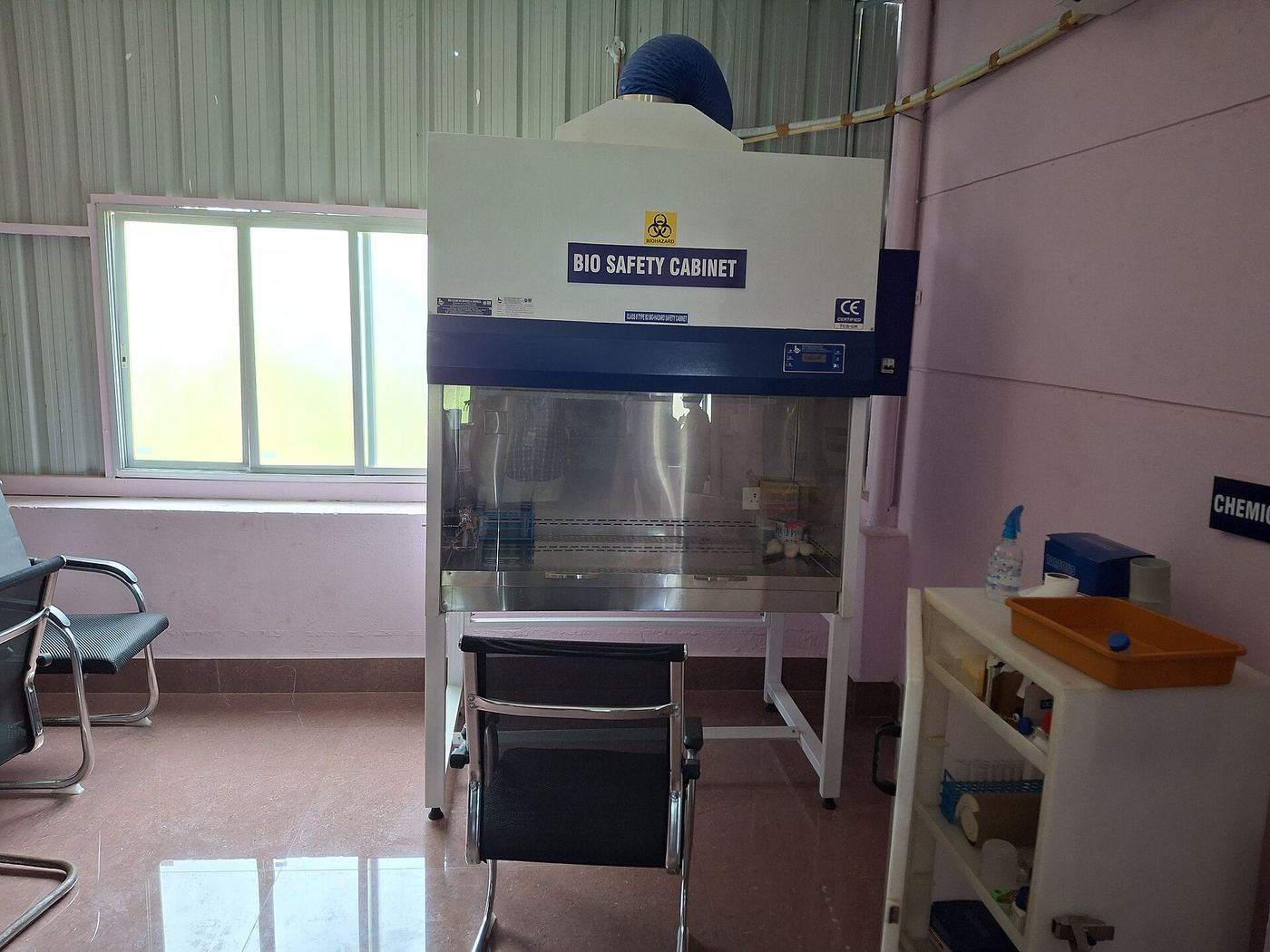
Published Class II biosafety cabinet figures: Type A1 at 75 fpm minimum inflow, Types A2, B1, B2 and C1 at 100 fpm, from University of Texas Health guidance of August 2023. Exhaust in one vendor's worked example runs 358 cfm for an A2 on a thimble and 734 cfm for a B2 — a ratio of 2.05, although the same document also says "about 2.5 times". Recirculation shares are printed in opposite directions by different university pages. The sections below line those numbers up and set out what the five field tests do and do not give you.
Inflow minimums by type
- Class I: 75 ft/min.
- Class II A1: 75 ft/min, 0.38 m/s.
- Class II A2, B1, B2 and C1: 100 ft/min each, 0.5 m/s.
- Class III: no face velocity at all; the cabinet is held at negative pressure of at least 0.50 in. w.g., or 120 Pa.
Other sources on the same numbers: a standards summary of NSF/ANSI 49-2024 gives Type A2 and C1 at 100 ft/min, written as 0.51 m/s; a university SOP gives A1 at 75 lfpm and A2 "between 100-110 lfpm"; a certification summary says the minimum is "commonly cited around 0.38 m/s / 75 fpm at the sash", depending on cabinet type and edition; two cabinet makers state direct inflow measurement with a minimum of 100 fpm, 0.51 m/s; and a manufacturer application note says EN 12469 requires at least 0.40 m/s for an A2, which is 79 fpm, and does not recognise the B2 at all.
The conversion is 100 fpm = 0.508 m/s, so 0.51 and 0.5 are the same number rounded two ways. The 100 to 110 fpm band appears in one source and is not repeated by any other read here.
Recirculation and exhaust percentages
| Source | A2 or A1 recirculated | Exhausted |
|---|---|---|
| University page quoting CDC BMBL 6th edition | 70 % | 30 % |
| University SOP, first statement | "about 30 %" recirculated | 70 % |
| University SOP, second statement (A1) | 70 % | 30 % |
| US Army public health fact sheet (A2) | 30 % | 70 % |
| Cabinet maker, as quoted by a trade site | 70 % | 30 % |
| Manufacturer application note | 60–70 % | 30–40 % |
| University health guidance (A1) | 70 % | 30 % |
Four of these say 70 percent recirculated. Two printed pages say 70 percent exhausted. That contradiction is not resolved by any source read here; the two 70-percent-exhausted pages disagree with every other entry, so they read as typing slips — a judgement, not a published correction.
For the other types the picture is consistent: B1 recirculates 40 percent and exhausts the rest, and B2 recirculates none. C1 is not given a percentage in the sources read.
Exhaust volume, and why it decides the purchase
A manufacturer application note gives two worked cabinets:
- A2 on a thimble: 358 cfm total, made of 275 cfm base plus 30 percent, at about 0.25 in. w.c. static pressure.
- B2: 734 cfm at about 1.7 in. w.c.
- Thimble flow is typically set 5 to 30 percent above cabinet exhaust, and the duct measurement point is 7.5 duct diameters downstream.
- Static allowance for filter loading: 0.7 in. w.g. for B2 and 0.3 in. w.g. for B1.
A second maker's white paper gives a 4 ft B2 at 1,200 to 2,000 m³/h continuous, and an A2 on a canopy at 400 to 800 m³/h. Converting at 0.589 cfm per m³/h: 400 m³/h is 235 cfm, 800 is 471, 1,200 is 706, 1,250 is 736 and 2,000 is 1,177 cfm. One 4 ft B2 at 1,250 m³/h is quoted at 18,000 to 30,000 kWh a year of HVAC energy in a temperate climate.
The two makers agree closely on the B2 figure — 734 cfm in the worked example against 736 cfm at 1,250 m³/h — and the A2 example of 358 cfm sits inside the 235 to 471 cfm canopy range. The ratio 734 / 358 is 2.05; the application note's own text says "about 2.5 times" in one place and "more than twice" in another.
Inflow volume from sash opening
At 100 fpm the inflow volume depends only on the opening:
| Cabinet width | Sash height | Open area | Inflow at 100 fpm |
|---|---|---|---|
| 4 ft | 8 in | 2.67 ft² | 267 cfm |
| 4 ft | 10 in | 3.33 ft² | 333 cfm |
| 6 ft | 8 in | 4.00 ft² | 400 cfm |
| 6 ft | 10 in | 5.00 ft² | 500 cfm |
Trade purchasing guides list 8, 10 and 12 in sash heights. An A2 on a thimble also draws room air for the 30 percent surplus, which the application note puts at about 30 percent beyond the recirculated flow.
Annual cost arithmetic
Two sources quote the same fume hood study for external exhaust: $4.50 per cfm per year, with a 3 ft by 18 in hood at about 450 cfm costing over $2,000 a year. Applied to the cabinet examples:
- A2 on a thimble, 358 cfm: $1,611 a year.
- B2, 734 cfm: $3,303 a year.
- Difference: $1,692 a year, or $25,380 over a 15-year life at a constant rate.
- The fume hood example, 450 cfm: $2,025 a year, which fits "over $2,000".
The $4.50 figure comes from a fume hood study rather than a cabinet measurement, it is old, and local energy prices and climate move it widely.
Plug load is a separate and much smaller line. A cabinet maker's comparison for a 4 ft A2 with the sash at 8 in gives 115 V, 3.6 A and 0.414 kW in normal mode, against 1.6 A and 0.184 kW in low-flow mode — a 56 percent saving. The same table gives the B2 1.0 A normal and 0.3 A low-flow, a 70 percent saving, at $0.13 per kWh. At 24 hours a day, 0.414 kW is 3,627 kWh and $472 a year, while 0.184 kW is 1,612 kWh and $210. The B2 at 1.0 A is 115 W, or 1,007 kWh and $131 a year, and at 0.3 A it is 34.5 W, 302 kWh and $39.
That makes the B2 plug load 28 percent of the A2 figure — but the B2 needs a dedicated external exhaust fan that the table does not include, so 115 W is not the B2's whole electrical cost. That is an inference from the table's scope, not a published statement.
The five field certification tests
A certification summary based on NSF/ANSI 49 Annex N-5 lists:
- Downflow velocity on a multi-point grid.
- Inflow velocity across a grid at the sash.
- Airflow smoke pattern — qualitative, not a number.
- HEPA or ULPA filter leak test with a photometer using DOP or PAO.
- Site installation assessment.
Type B and positive-plenum cabinets add a sixth: exhaust or plenum pressure. That summary gives no pass numbers; the figures below come from a vendor poster.
| Item | AS 2252.2 | NSF/ANSI 49-2018, A2 | EN 12469 |
|---|---|---|---|
| Downflow velocity | 0.40–0.45 m/s | set by biological testing | 0.25–0.50 m/s |
| Downflow point deviation | ±20 % | ±20 % or 0.081 m/s | ±20 % |
| Inflow | no limit | 0.51 m/s | at least 0.4 m/s |
| Inflow acceptance | none | ±0.025 m/s | ±20 % |
| HEPA leak, photometer | 0.01 % | 0.01 % | 0.01 % |
EN 12469 also lists 0.05 percent for particle-counter scans. The poster labels its inflow row as NSF/ANSI 49-2002 while other rows are 2018, so check the edition before using that line.
In fpm the acceptance windows are: NSF inflow 95.5 to 105.3 fpm; EN 12469 inflow 63 to 94 fpm; downflow point deviation ±16 fpm; and a common balance tolerance of ±3 fpm, which is 1.6 times tighter than the NSF half-window of 4.9 fpm. EN 12469's ±20 percent at 0.40 m/s is 0.32 to 0.48 m/s.
Downflow converts to 49 fpm at the EN 12469 floor of 0.25 m/s and 98 fpm at its ceiling of 0.50 m/s; the AS 2252.2 range of 0.40 to 0.45 m/s is 79 to 89 fpm.
Air changes and annual volume
Take a room of 20 by 15 by 9 ft, which is 2,700 ft³. The A2 thimble at 358 cfm moves 21,480 ft³ an hour, or 8.0 room volumes; the B2 at 734 cfm moves 44,040 ft³ an hour, or 16.3 room volumes. Per year that is 188 million ft³ against 386 million, or about 5.3 against 10.9 million m³ — a replacement-air ratio of 2.05.
Ten A2 thimble cabinets at 358 cfm each cost $16,110 a year at $4.50 per cfm, and ten B2 cabinets at 734 cfm cost $33,030 — a difference of $16,920 a year. The white paper's 18,000 to 30,000 kWh a year for one B2 becomes 180,000 to 300,000 kWh for ten. That kWh figure and the $4.50 figure are not the same measure and are not converted into each other here: one is a maker's HVAC energy estimate for a temperate climate, the other a fume hood cost per cfm.
Fan power behind the difference
At the two worked examples, the A2 thimble moves 358 cfm at 0.25 in. w.c., which is 62 Pa, and 10.5 W of air power. The B2 moves 734 cfm at 1.7 in. w.c., or 423 Pa, and 146 W. The pressure ratio is 6.8, the flow ratio 2.05, and the air-power ratio 13.9 with fan efficiency ignored. That ratio is why a B2 is a ductwork decision as much as a cabinet decision.
Equipvia may earn a commission from qualifying purchases through this link. The link resolved to Product ID 1601910717694 during review. CPS resolution does not verify the seller's technical claims, the NSF listing, affiliate eligibility, or commission attribution. Check the actual selected variant and current terms before ordering.
An A2 is the cabinet about 90 percent of laboratories buy, and buying a B2 "just to be safe" is described in the trade press as a common purchasing error when the building's HVAC cannot support 734 cfm per cabinet. What to ask for on an A2: the full NSF rating string with its AM, AI or AU condition, the inflow at a stated sash height, whether it is set up for a thimble or hard duct, and the alarm setpoint. An A2 that will see volatile chemicals needs a thimble or direct duct regardless of its certification, and neither type accepts flammable, corrosive or explosive materials.
Chemical use by type
An A2 handles volatile chemicals only with a thimble or direct duct; a recirculating A2 needs external exhaust for them. A B2 is designed for volatile toxic chemicals and radionuclides and allows larger quantities than an A2 because of dilution, with restrictions. Flammable, corrosive and explosive materials are excluded from both. One university allows small quantities of volatile toxic chemicals in an A2 only if it exhausts outside through a canopy or thimble with an exhaust alarm; another confines B1 work with volatile chemicals to the rear 50 percent of the cabinet; and a third sets no numeric limits at all, requiring only that concentrations never approach the lower explosion limit.
When to certify
Annual certification at minimum, per NSF/ANSI 49 and the BMBL. Certification is also required before first use, after relocation — including a short move within the same room — after repairs or filter changes, and after room HVAC changes. Run the blower about five minutes before work. A C1's internal exhaust motor may run up to five minutes during an exhaust failure. Certification should be done by NSF-certified technicians.
What this article could not check
The full text of NSF/ANSI 49-2024 and EN 12469 was not available, nor the BMBL 6th edition table, the KI-Discus pass limit, the microbiological challenge counts, or independent B2 operating-cost data. The KI-Discus potassium iodide method is described by one vendor as an accepted alternative to the microbiological challenge for aperture protection, with no numeric factor given.
Share this article