Why Do Fertigation Systems Use A and B Tanks?
A and B are not marketing labels. This guide maps which concentrates must stay apart, how the two liquid paths should meet, when a third tank is justified and what a dosing quote must document.
Disclosure: We may earn a commission if you purchase through links on this page, at no additional cost to you.
How to separate concentrated nutrients, sequence injection and specify a multi-tank dosing system
A and B are not marketing labels. They are a way to keep incompatible fertilizer salts apart while they are still concentrated. Calcium, phosphate and sulfate combinations that are manageable after dilution can form insoluble precipitates in a stock tank. The two-tank arrangement moves the meeting point into flowing irrigation water, where the concentration is lower and the system can be checked before the solution reaches the emitters.
This guide owns the A/B system-design decision: what belongs in separate tanks, when a third acid or base tank is justified, how the two liquid paths should be identified and monitored, and what to ask for in a dosing-system quote.
The decision is chemical first, hardware second
| Question | If the answer is yes | Design consequence |
|---|---|---|
| Will two concentrates form a precipitate at stock concentration? | Calcium with phosphate or sulfate is a common risk; the exact formulation and water quality still matter | Keep the salts in separate stock tanks and inject them independently |
| Does the crop recipe need pH correction? | Alkalinity or a target pH may require acid or base dosing | Use a separately identified acid or base tank and a compatible metering path; do not quietly add acid to A or B |
| Do different zones use different recipes? | One crop block may need a different nutrient balance or concentration | Use independent channels, valves or recipes; a single shared tank can become the wrong compromise |
| Is the formulation fully soluble and stable as one stock? | A single-tank arrangement may be workable for a simple, verified recipe | Keep the simpler design only if the formulation, hold time and cleaning procedure are documented |
Greenhouse guidance commonly states that stock-solution systems need at least two tanks because some fertilizer sources produce insoluble precipitates when concentrated together, and that an acid tank may be separate depending on the water and crop program. That is a design basis, not a universal recipe for every crop or fertilizer brand.
Do not copy a universal A/B recipe
A frequently used starting pattern places calcium-containing material in one tank and phosphate or sulfate material in the other, but the correct assignment depends on the complete formulation, chelation, source-water analysis and target concentration. The tank letter itself has no chemical meaning. A supplier's "Tank A = calcium" graphic should be treated as a starting convention, not a substitute for the buyer's recipe review.
| What to map before assigning a tank | Why it matters | Evidence to keep |
|---|---|---|
| Every fertilizer product and guaranteed analysis | The product name alone does not reveal all counter-ions, additives or solubility limits | Current label, technical data sheet, batch or lot information and target stock concentration |
| Source-water pH, alkalinity and relevant ions | The same A/B recipe can behave differently in different water | Recent laboratory water report and the date and sample point |
| Order of dilution and injection | Precipitation can occur in a concentrate, a suction line, a mixing chamber or the mainline | Piping diagram, injection sequence, residence time and jar-test record |
| Cleaning and residue history | A clear stock tank can still leave sludge or scale that changes the next batch | Tank inspection, drain record, filter residue and cleaning chemical log |
How the two liquid paths should meet
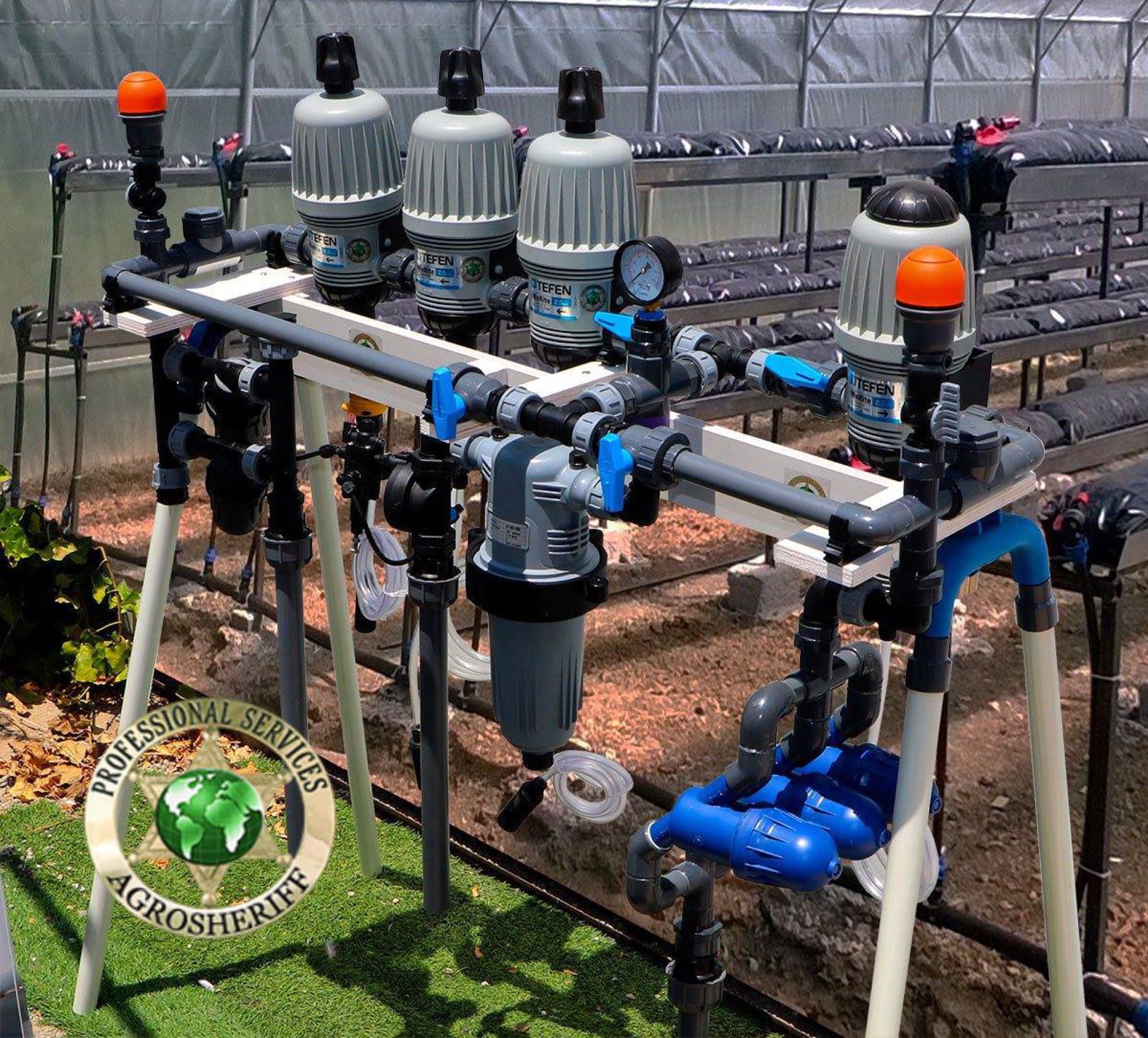
The two concentrates should remain separate until each has been metered into a moving water stream or a mixing point designed for the combined solution. The practical architecture is usually two labelled tanks, two pickup lines, two injection channels or pumps, non-return protection, and a downstream mixing and measurement point. The exact hydraulic arrangement depends on the dosing unit; a catalogue picture is not enough to prove that the two channels are independently controlled.
| System boundary | Minimum buyer requirement | Failure if omitted |
|---|---|---|
| Tank A and Tank B | Separate lids, labels, pickup lines, valves and chemical-compatible wetted parts | A cross-connection or wrong pickup can put incompatible salts in one tank |
| Each dosing channel | A defined flow or rate range, check valve and isolation point | A blocked or leaking channel can change the nutrient recipe without an obvious alarm |
| Dilution / mixing point | Enough water movement and residence time to mix before the zone | Local concentration spikes or precipitate can form downstream of the injection point |
| Monitoring point | EC, pH or another recipe-specific measurement after mixing, with a repeatable sample location | The controller may report a value that does not represent what reaches the zone |
| Flush and drain path | A way to rinse channels and remove residue without sending a concentrated slug to the crop | The next batch can inherit residue from the previous formulation |
A/B separation does not remove the need for clean-water flushing, filtration or backflow protection. It only controls one precipitation risk: the interaction of concentrated stock solutions. The downstream system still needs its own filter, flush and protection decisions.
When a third tank is worth specifying
- Acid or base correction. If the water requires pH correction, a third channel can keep the acid or base separate from the nutrient concentrates. The material, dosing range and interlock must be specified for the named chemical.
- A crop-specific additive. A micronutrient, biological product or treatment may need independent dosing because its concentration, timing or compatibility is not shared by A or B.
- A source-water treatment. An acid or oxidant used to manage alkalinity, iron or biological load belongs in a separately controlled treatment decision; do not hide it inside a fertilizer tank.
- Recipe flexibility. If different zones need different nutrient ratios, separate channels can reduce the temptation to over-concentrate a shared stock or accept a recipe that fits no zone well.
More tanks are not automatically better. Each added channel creates another pump, sensor, calibration record, chemical-compatibility question and failure mode. Specify a third tank only when it owns a distinct chemical or recipe task.
A/B operating checks that catch errors early
| Check | What to record | What it can reveal |
|---|---|---|
| Identity check | Tank label, product name, batch or lot, operator and date | Wrong product, wrong tank or an unrecorded reformulation |
| Stock appearance | Clarity, sediment, color, temperature and hold time | Settling, crystallization, sludge or a formulation outside its stable window |
| Channel draw | Volume removed from A and B over the same irrigation interval | A blocked pickup, air leak, worn pump head, wrong ratio or unbalanced recipe |
| Post-mixing sample | EC, pH or a formulation-specific measurement at the same point each time | A change after mixing that does not match the recipe or source-water baseline |
| End-of-zone check | Pressure, emitter output and visible residue after the event | A dosing or mixing issue that is not visible at the controller |
EC and pH are control signals, not a complete nutrient assay. A stable EC can coexist with the wrong ion balance, and a pH reading cannot identify which salt precipitated. Use them to detect change and then investigate with the recipe, water analysis and supplier documentation.
What the quote must say about cleaning and interlocks
A/B systems are often sold as a controller, pumps and sensors, while the tanks, pickup assemblies, valves and drains are treated as accessories. That is where a quote can look complete but remain impossible to commission. Ask the supplier to show every wetted component and every state that can stop injection.
| Quote item | Buyer question |
|---|---|
| Tank and pickup hardware | Are the tanks, lids, low-level pickup height, strainers and drain valves included? What is the residual heel? |
| Pump and channel identity | Which pump serves A, B and any acid channel? Can the controller prevent two incompatible channels from being routed to the same tank? |
| Low-level protection | Does the system stop or alarm before a pump draws air? Is the low-level switch part of the delivered system? |
| Backflow and cross-connection protection | What check valves, air gaps or isolation points prevent irrigation water from entering a stock tank, or A from entering B? |
| Cleaning mode | Can each line be flushed independently with clean water, and where does the flush discharge go? |
| Data and records | Can the controller export channel flow, EC, pH, alarms and recipe changes with timestamps? |
Sourcing candidates for an A/B or multi-channel system
These offers are system-level inquiry leads, not approved products, because marketplace listings rarely expose a complete A/B piping specification in the public snapshot. All observed fields are seller or platform statements. Confirm the delivered channel count, tank inclusion, routing isolation and sensor package before a system is approved.
Acceptance sequence before loading the crop recipe
- Dry-run the identity logic. With water only, verify that the controller, channel labels, valves, sensors and alarm states agree with the piping diagram.
- Run each channel separately. Measure A and B draw independently at a known operating point. Confirm that closing one channel does not change the other channel's identity or route.
- Run a water-only mixing test. Check the mixing point, sample location, flow measurement and clean-water flush before introducing fertilizer salts.
- Run the recipe at reduced risk. Use the validated formulation and a small batch, inspect stock tanks and downstream filters, and compare post-mixing EC and pH with the expected range.
- Record a stop condition. Confirm low-level, sensor-fault, pump-fault and communication-fault responses before production dosing.
Bottom line
Approve an A/B fertigation system only when the chemistry map, tank identity, channel routing, mixing point, sensor location, low-level protection, cleaning path and failure response are documented. Separate tanks reduce concentrated precipitation risk; they do not prove that the final recipe is agronomically correct, that the sensors are calibrated, or that the delivered system matches the sales diagram.
Share this article