V6 vs Volcano Nozzles and How to Choose the Right Replacement
Both families use an M6 thread, so the wrong part can screw in and still be wrong. This guide separates the dimensions, the sealing geometry and the flow evidence that justify a replacement or a conversion.
Disclosure: We may earn a commission if you purchase through links on this page, at no additional cost to you.
A Volcano nozzle is not a routine substitute for a V6 nozzle just because both have an M6 thread. Start with the hotend already fitted to the printer. For maintenance, buy the matching nozzle family, filament bore and outlet diameter. Consider a Volcano conversion only when the current hotend limits the flow your actual jobs require and a compatible conversion is available.
That distinction matters when ordering consumables for several printers. A bag labelled "V6 Volcano 0.4 mm" can describe a family of selectable products rather than one interchangeable part. The wrong variant may screw into a block yet leave an unsuitable seal, heating arrangement or tip position. This guide covers conventional separate nozzles and heater blocks; integrated nozzle assemblies need their own compatibility checks.
The dimensions that separate V6 and Volcano
"0.4 mm" normally identifies the outlet diameter. It does not identify the thread length or the filament bore. A nozzle for 1.75 mm filament and one for 2.85 mm filament can share an outlet size while serving different feed systems. E3D lists those filament sizes separately in its V6 and Volcano documentation.
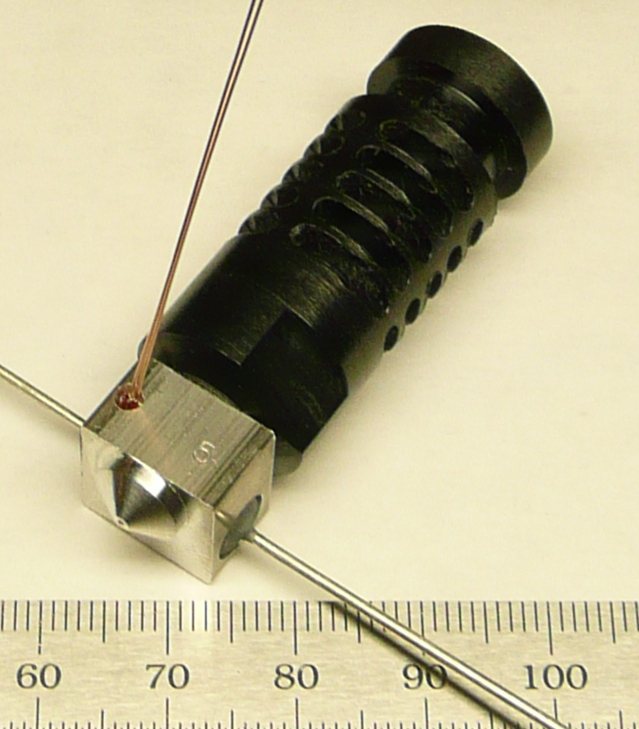
The following comparison uses published Bondtech dimensions for its V6 compatible RepRap nozzle and Volcano standard. These are useful reference geometries, not measurements of every aftermarket nozzle sold under those names. Require a drawing for the actual replacement.
| Dimension | V6 compatible RepRap reference | Volcano reference |
|---|---|---|
| Thread | M6 × 1 | M6 × 1 |
| Thread length | 7.5 mm | 14.5 mm |
| Overall length | 12.5 mm | 21 mm |
| Intended heater arrangement | Compatible V6 style block | Compatible Volcano style block |
The overall length difference here is 8.5 mm; the thread length difference is 7 mm. Mixing those measurements can lead to an incorrect purchase even when a supplier provides a number. Ask where each length starts and ends. An annotated drawing is more useful than a photograph beside a ruler.
Also compare the inlet sealing face, tip shape and wrench size. If the old part has an unusual extension or the printer has already been modified, identify the installed hotend rather than relying on the printer model printed on its frame. Keep a known correct spare with the maintenance record.
Why screwing into the block does not establish compatibility
In the conventional V6 arrangement, the nozzle seals against the heatbreak inside the heater block. The threaded connection brings those parts together. A nozzle shoulder touching the outside of the block does not establish that the internal faces have met.
Prusa's replacement instructions for the MK2.5/S, MK3/S/+ and MK3.5/S explicitly require the heated nozzle to lock against the heatbreak, with approximately 0.5 mm clearance between the nozzle hex and heater block. That clearance belongs to the documented assembly; it is not a universal setting for every hotend.
A replacement that bottoms against the block before forming the intended internal seal needs investigation. Do not compensate by applying more torque. Conversely, a long exposed threaded section is not evidence that the correct heated length and sealing position have been achieved. Check the assembled geometry against the hotend instructions before loading filament.
Plastic emerging above the heater block after a change points to an assembly or sealing problem that needs inspection. Under-extrusion at the outlet alone has several possible causes. Treating both symptoms as a worn nozzle can leave the real fault in place and consume another replacement.
Check the job before paying for more melt capacity
For an existing V6 installation printing acceptable parts, matching the original nozzle is usually the practical maintenance purchase. A high flow conversion becomes relevant when extrusion demand exceeds demonstrated capacity during useful portions of the print.
Use volumetric flow, measured in mm³/s, to frame that decision. A simple rectangular approximation is extrusion width multiplied by layer height multiplied by printing speed. For example, 0.45 × 0.20 × 100 gives about 9 mm³/s. Increasing width to 0.72 mm and height to 0.30 mm at the same speed gives about 21.6 mm³/s. These are calculated examples, not nozzle ratings.
The approximation helps compare jobs, but slicers can use a more accurate cross-section model. PrusaSlicer, for example, uses a stadium shaped extrusion cross-section. Consult the sliced flow preview for the actual toolpath rather than treating the rough calculation as its exact output.
Now inspect where time is spent. A large enclosure with long infill paths may sustain high extrusion demand. Small brackets with short moves may spend much of their time accelerating or slowing for cooling. A higher melt capacity cannot remove every limit. Record the current profile, actual print time and recurring defect before deciding which component needs changing.
Use the filament and temperature intended for production when evaluating flow. A capacity figure obtained with one PLA blend is not automatically valid for PETG, flexible filament or a filled polymer. Keep the printer within the operating limits of the complete hotend, including its heater and temperature sensor.
What the comparison tests actually establish
Volcano extends the heated filament path in its intended assembly, which can support greater melt throughput. It does not assign a fixed speed to the printer. E3D's original Volcano launch discusses larger extrusion widths and layer heights as part of the intended use.
CNC Kitchen's 2022 investigation is useful because it compared defined configurations rather than relying on nozzle names. Using a Hemera, 0.4 mm nozzles and Polylite PLA at 210 °C, the author reported roughly 13 mm³/s for the standard setup and 19 mm³/s for the genuine Volcano configuration. Those results describe that experiment. They are not guaranteed limits for another printer or an anonymous aftermarket nozzle.
The accompanying YouTube description and chapters separate tests without a fan, tests with cooling, insulation tests and temperature variations. That is a useful reminder to examine conditions behind a headline claiming a flow improvement. This article uses the author's published investigation; Equipvia has not performed those tests.
The same investigation explored conversion arrangements using nuts. Such experiments do not make a long nozzle a generally approved replacement for a short one. If a conversion is worthwhile, use an engineered combination with documented assembly instructions and clearances. Include the block, compatible heating components and any required mounting or cooling changes in the purchasing decision.
Choose outlet size and material after identifying the family
A Volcano nozzle can have a 0.4 mm outlet. Buying Volcano does not require choosing a larger hole, and choosing a larger hole does not by itself convert a V6 hotend into a Volcano. Keep family, outlet diameter and filament bore as separate fields on the order.
For plain, non-abrasive filament, brass is a reasonable baseline where the hotend manufacturer specifies it. For abrasive feedstock, select a nozzle explicitly documented for that material. E3D's support tables distinguish brass and plated copper from its abrasion resistant options. "Stainless steel" and "hardened steel" are different descriptions; do not accept one as evidence for the other.
An aftermarket listing saying "hardened tool steel" still leaves questions about the steel grade, heat treatment and actual wear performance. Obtain the relevant specification when those properties drive the purchase. A dark surface or a coating name alone cannot establish the substrate or its service life.
Choose the outlet for the part and filament requirements, then build the corresponding profile. Moving to a larger outlet changes the printable detail and available extrusion widths. Filled materials may also have supplier specified minimum nozzle diameters. Check the exact filament's instructions instead of assigning every carbon filled blend the same nozzle requirement.
For repeat orders, avoid mixed size packs unless each compartment is labelled. A farm standardising on one approved geometry gains little from cheaper spares that technicians must identify again at every change. Put the supplier's part number on the bin as well as the nominal diameter.
Installation details that belong to the exact nozzle
Use the replacement procedure for the installed printer and the instructions for the selected nozzle. Hot tightening temperature and torque depend on the assembly and material. Resolve conflicting instructions with the manufacturer before proceeding.
For example, E3D's current V6 nozzle support specifies 2 Nm for its listed installation procedures, while Bondtech's CHT VOL coated brass datasheet specifies 1.5 Nm. These figures refer to different products. Neither should be copied onto an unspecified third party hardened steel nozzle.
Support the heater block as instructed and protect the heater and thermistor wiring while working. Hot components can burn, and a wrench can damage wiring. If the nozzle does not seat as the documentation shows, stop and inspect the part identity, threads and sealing surfaces.
After a nozzle change, recheck the first layer according to the printer procedure. For a conversion, establish tip position and bed clearance before normal homing or printing. Inspect the cooling duct and probe relationship as well; a longer assembly changes more than the distance from the nozzle to the bed.
Validate with a short representative print before returning to an unattended production job. Check for leakage and consistent extrusion, then compare part dimensions and finish with the previous accepted result. Change one profile variable at a time so the result remains interpretable.
Turn a successful sample into a repeatable spare
The repeat purchase should reproduce an accepted specification. Send the supplier the hotend model, nozzle drawing, filament bore, outlet diameter and required material. Ask for a photograph of the actual variant and written confirmation that the quoted price and minimum quantity apply to it.
Check several sample pieces before approving a larger lot. Compare dimensions with the agreed drawing, inspect the inlet and sealing face, and look for damaged threads or an obviously irregular outlet under magnification. A visual check can reject visible defects; it cannot certify internal concentricity or bore tolerance. Require measurement evidence if those features matter to the application.
Run the sample on one designated printer with recorded filament, temperature and profile. A short job can reveal immediate assembly problems, but it does not establish abrasive wear life. Define the acceptance period around the failure you are trying to prevent, and retain an unused reference sample.
When reordering, reference the accepted part number and drawing revision. Request notification before changes to geometry, material or manufacturing source. Store replacement nozzles separately by approved variant. If a new lot behaves differently, quarantine it for comparison instead of quietly compensating across every printer's profile.
Make the purchase unit explicit. "Ten sets" may mean ten assortments, while "ten pieces" may allow only one selected size. Confirm the contents, labelling and quantity of each variant in writing. Compare the delivered cost of usable, accepted spares, including freight and any import charges, rather than the lowest price displayed beside a mixed listing.
For example, a workshop using both V6 and Volcano machines could order two separately identified lines of 0.4 mm nozzles. Record which printers each line serves and keep the accepted samples beside their drawings. Receiving staff can then check the delivery without dismantling a machine to identify the part. If only one printer uses the longer nozzle, buying a large mixed pack may create more obsolete stock than useful backup. Base replenishment on recorded consumption and supplier lead time, with extra allowance for the jobs that cannot wait for another shipment.
A supplier lead for a small trial order
An Alibaba listing from Shenzhen YouQi Technology Co., Ltd describes a 0.4 mm M6 hardened steel nozzle for a Volcano hotend and 1.75 mm filament. On 22 October 2026, it displayed a minimum order of 10 pieces and a price range of CNY 2–3.99 per piece. The displayed range is not a confirmed quote for a selected variant.
This is an inquiry candidate, not an approved interchangeable spare. The reviewed text did not establish the exact thread length, overall length, steel grade, hardness or installation torque. No shipping solution was shown for the displayed selection. Request those details and sample acceptance before ordering production stock.
The platform showed seven years of membership and a manufacturer/trading company description. Those signals do not independently establish manufacturing capability or nozzle quality. The supplier's profile also contains staffing figures that need clarification before relying on factory capacity claims.
Equipvia may earn a commission from qualifying purchases through this link. The product destination was checked on 22 October 2026; affiliate report attribution and commission settlement remain unverified.
For a machine that already prints the required parts reliably, replenish the approved nozzle. Pursue a Volcano conversion when measured demand justifies it, then qualify the complete assembly. That keeps routine consumable purchasing from becoming an undocumented equipment modification.
Share this article