Rotary Evaporator Size Guide: How to Choose 1L, 2L, 5L, 10L, 20L, or 50L
Choose rotary evaporator size from routine batch volume, daily throughput, and the vacuum, cooling, condenser, and installation requirements of the complete system.
Share this article
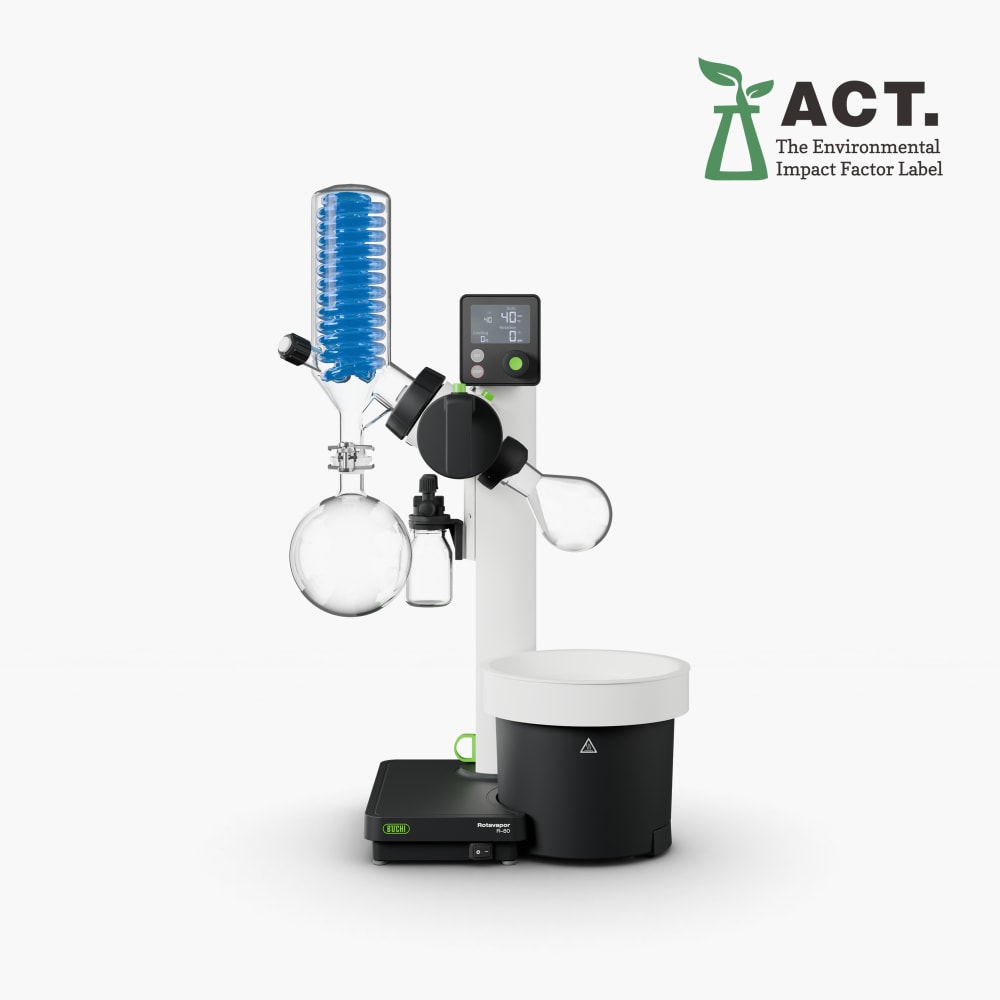
Rotary evaporator size should be chosen around the routine process, not the largest flask you can afford.
Start with the volume you normally process, how many batches you need to complete per day, and how much space and supporting equipment your lab can provide. Then check whether the vacuum pump, cooling system, condenser, receiving flask, bath, lift, and utilities are appropriately matched to that scale.
The key distinction is simple:
Nominal flask capacity is not the same as practical working volume or daily throughput.
A 5 L rotary evaporator is not automatically better than a 2 L system, and a 20 L unit is not automatically more efficient than a 10 L one. The right size is the one that fits your normal batch and workflow without forcing the rest of the system to become unnecessarily large or difficult to operate.
Quick Answer: What Size Rotary Evaporator Do You Need?
| Nominal size | Where it often fits | Main question before choosing |
|---|---|---|
| 1 L | Small-volume research, teaching, and method development | Are routine samples genuinely small enough to justify a compact system? |
| 2 L | General laboratory work and small-batch R&D | Will 2 L reduce complexity without creating too many repeated batches? |
| 3–5 L | Higher-volume laboratory work and repeated daily processing | Do you need more capacity without moving into pilot-scale handling? |
| 10 L | Scale-up work, preparative processing, and small pilot workflows | Can cooling, vacuum, space, and operators support the larger load? |
| 20 L | Pilot-scale concentration and repeated solvent recovery | Is throughput high enough to justify the larger footprint and support equipment? |
| 50 L | High-volume pilot or production-style solvent recovery | Are utilities, cooling, handling, and safety infrastructure ready? |
These are selection categories, not universal batch-volume limits. Actual working volume depends on flask design, sample behavior, solvent, foaming tendency, operating method, and manufacturer guidance.
1. Start With Routine Batch Volume, Not Maximum Flask Capacity
The first question should be:
How much liquid do you normally put through the process at one time?
Not:
What is the biggest flask available?
Yamato's current rotary evaporator selection guidance uses the same logic: once expected throughput is understood, flask size and bath capacity can be selected. Yamato also notes that many R&D samples are suited to rotary evaporator flasks in roughly the 100 mL to 2 L range. That is a market reference, not a universal rule.
Record three different volumes
- Typical batch volume — what you process most of the time.
- Largest routine batch — the upper end you expect to run regularly.
- Occasional maximum batch — a rare large job.
The first two should drive the purchase.
2. Nominal Flask Capacity Is Not Working Volume
A “2 L rotary evaporator” normally refers to the nominal evaporation-flask capacity supported by the system or supplied in a particular configuration.
That number is not permission to fill the flask to 2 L under every condition.
Practical fill level depends on solvent behavior, foaming, bumping tendency, viscosity, rotation, flask geometry, application, and manufacturer instructions. Equipvia does not recommend a universal percentage such as “always fill the flask to 50%.” A single percentage should not be applied to every solvent, flask, or manufacturer without supporting documentation.
3. Throughput Can Matter More Than Flask Size
Two labs can use the same batch volume and still need different equipment. Consider runs per day, acceptable cycle time, cleaning and changeover time, operator availability, heating time, condenser recovery, cooling recovery between batches, and whether the process is repeated or highly variable.
If you double flask size but the vacuum system, chiller, condenser, or workflow cannot support the higher vapor load, the larger flask may not deliver the expected productivity gain. Rotary evaporator sizing is therefore a system-sizing problem.
Related guide: How to Choose a Rotary Evaporator: A Practical Selection Guide.
4. When a 1 L Rotary Evaporator Makes Sense
A 1 L-class system is most attractive when compactness and small sample handling matter more than maximum throughput. Typical environments may include teaching laboratories, method development, small synthesis work, early-stage research, and labs with limited bench or hood space.
BUCHI's current R-80 system is specified for a maximum evaporation flask size of 1 L. That demonstrates that major manufacturers treat 1 L as a distinct compact product class.
A smaller system may offer a smaller footprint, easier glassware handling, simpler installation, and less unnecessary capacity for small samples. It becomes less attractive if the same process must be repeated many times per day simply because the equipment is too small for the workload.
5. When a 2 L Rotary Evaporator Makes Sense
The 2 L class is common in general laboratory work because it provides more batch flexibility than a compact 1 L unit without immediately moving into larger pilot-style hardware.
A 2 L system may be a good starting point when routine work is laboratory scale, space remains limited, operators need manageable glassware, process changes are frequent, and daily throughput is moderate.
Current marketplace example: 2 L full system
One current Alibaba listing is advertised as a 2 L rotary evaporator full set with water chiller, vacuum pump, and vacuum controller. When reviewed on September 18, 2026, the listing showed product ID 1600522495792, model RE-2010-2L, a displayed price of about US$889, MOQ 1 set, and Shanghai Yuhua Instrument Equipment Co., Ltd. as supplier.
The listing title advertises a full system, but the detailed listing does not clearly identify the exact pump, chiller, and vacuum-controller models. Confirm those components before ordering.
View current 2 L full-system listing.
6. When a 3 L or 5 L Rotary Evaporator Makes Sense
The 3–5 L range is useful when a laboratory needs more capacity while retaining a laboratory-style workflow.
BUCHI's current product range provides a useful example: the R-80 system supports a maximum 1 L evaporation flask, the R-180 supports 3 L, and the R-300 supports 5 L. That progression illustrates that moving from 1 L to 3 L to 5 L is not simply a matter of attaching a larger round-bottom flask. The instrument platform, bath, lifting arrangement, glassware, and system configuration also change.
2 L vs 5 L: how to decide
| Question | Favors smaller 2 L class | Favors larger 5 L class |
|---|---|---|
| Typical batch | Smaller | Consistently larger |
| Runs per day | Low to moderate | Repeated processing |
| Bench or hood space | Tight | More space available |
| Glassware handling | Easy handling is a priority | Larger glassware is acceptable |
| Cooling and vacuum infrastructure | Modest | Can support more vapor load |
| Future workload | Stable | Expected to increase |
The question is not “Which is better?” It is:
Will moving to 5 L reduce total process time enough to justify the larger supporting system?
Related comparison: 2 L vs 5 L rotary evaporator.
7. When a 10 L Rotary Evaporator Makes Sense
A 10 L system moves the buying decision toward scale-up and pilot-style processing. Pay much more attention to condenser capacity, chiller performance at operating temperature, vacuum pumping capacity, bath heating power, receiving-flask capacity, overall height, operator handling, facility power, and service access.
A 10 L system can be the wrong choice if the process is still poorly defined, batch size changes constantly, the lab cannot support the required chiller or power, or large glassware handling would become awkward.
8. When a 20 L Rotary Evaporator Makes Sense
The 20 L class is primarily a throughput decision. It becomes relevant when the process has moved beyond ordinary small-lab batching and repeated solvent removal is becoming a bottleneck.
Examples may include pilot workflows, preparative laboratories, repeated solvent recovery, and scale-up from a validated smaller process. At this scale, the equipment should be reviewed as part of the facility rather than as a stand-alone benchtop instrument.
Manufacturer-specific product tables show that larger systems commonly increase several related specifications together. One current Scitek range, for example, lists 10 L, 20 L, and 50 L systems with progressively larger receiving flasks and condenser areas. That is a manufacturer example, not an industry-wide sizing rule.
9. When a 50 L Rotary Evaporator Makes Sense
A 50 L rotary evaporator should be treated as a high-volume process system. Before selecting one, buyers should know their normal solvent load, throughput target, evaporation duty, vacuum range, cooling load, installation footprint, utility availability, operator handling requirements, and service strategy.
A 50 L unit is a poor way to “future-proof” a small process if the infrastructure and workflow do not justify it.
10. A Multi-Capacity Marketplace Example
One current LAB1ST Alibaba listing advertises rotary evaporator systems across multiple capacities and is marketed with a vacuum pump and chiller. When checked on September 18, 2026, the visible technical table provided detailed information through 50 L, while the product title also mentioned 100 L.
That difference matters. Equipvia treats the 100 L configuration as supplier-confirmation required rather than assuming that the same visible specification table applies to it.
View current multi-capacity listing.
11. Larger Size Means More Than a Larger Flask
Heating bath
Larger systems often require more bath power and a physically larger bath.
Vacuum system
The pump must maintain process pressure under the expected vapor load. Do not choose only from ultimate-vacuum specifications.
Condenser and cooling system
More evaporation potential creates more vapor that must be condensed. Evaluate a chiller by cooling capacity at the intended operating temperature, not only its minimum advertised temperature.
Receiving flask
The receiving vessel must fit the expected solvent-recovery workflow.
Physical handling
Larger glassware becomes heavier and more awkward. Lift type, flask mounting, drain design, and operator ergonomics become increasingly important.
Installation
Measure width, depth, total height, lift travel, condenser clearance, pump footprint, chiller footprint, tubing clearance, and service access.
12. Do Not Oversize Just for Future Growth
“Buy the largest system now so we can grow into it” is not always the lowest-risk choice.
Oversizing can create unnecessary capital cost, larger replacement-glass costs, higher heating and cooling requirements, more difficult handling, wasted floor or hood space, longer setup time, and more complex utilities.
A better approach is to size around the current validated process plus realistic near-term growth.
13. Build a Size Specification Before Requesting Quotes
| Requirement | Your process |
|---|---|
| Typical batch volume | |
| Largest routine batch | |
| Occasional maximum batch | |
| Batches per day | |
| Total solvent processed per shift/day | |
| Main solvents | |
| Heat-sensitive sample? | |
| Foaming tendency | |
| Required process pressure | |
| Current vacuum source | |
| Current cooling source | |
| Available bench/floor width | |
| Maximum installation height | |
| Facility voltage/frequency | |
| Desired receiving-flask workflow | |
| Operator handling limits | |
| Growth expected in next 12–24 months | |
| Target system budget |
Then compare every supplier quotation against the same requirement set.
14. Size-Selection Decision Path
- Define the routine batch.
- Define batches per day and throughput target.
- Shortlist the smallest size class that comfortably supports that workload.
- Check manufacturer guidance for practical flask usage.
- Match the vacuum pump.
- Match condenser and cooling capacity.
- Confirm receiving-flask workflow.
- Verify installation dimensions and utilities.
- Compare complete-system cost.
- Add realistic growth margin, but do not oversize without a process reason.
Common Sizing Mistakes
- Buying from nominal flask capacity alone: flask size is only one component of the process.
- Treating maximum capacity as normal operating volume: nominal size does not equal universal working volume.
- Ignoring daily batch count: a smaller system can become inefficient if it forces too many repeated cycles.
- Jumping from 2 L directly to 20 L: scaling changes vacuum, cooling, heating, glassware, installation, and handling.
- Assuming a bigger rotary evaporator is automatically faster: throughput depends on the whole system.
- Ignoring receiving-flask capacity: solvent collection and draining can become the bottleneck.
- Forgetting installation height: large condensers and lifted flasks can make vertical clearance more important than footprint.
Frequently Asked Questions
What size rotary evaporator is best for a research lab?
There is no single best size. Small research workflows may fit 1–2 L systems, while laboratories with larger or repeated batches may benefit from 3–5 L systems. Use routine batch volume, daily throughput, and available infrastructure to decide.
Is a 2 L rotary evaporator big enough?
It can be, especially for small laboratory batches and moderate throughput. If your process repeatedly requires splitting one batch into several cycles, evaluate a larger system.
Should I buy a 2 L or 5 L rotary evaporator?
Choose 2 L when compactness, smaller glassware, and moderate throughput matter more. Evaluate 5 L when routine batches and daily processing justify the larger supporting system.
When should I move to a 10 L rotary evaporator?
Consider 10 L when moving from ordinary lab-scale processing toward repeated preparative or scale-up work and when cooling, vacuum, space, power, and handling capability are adequate.
Is 20 L a pilot-scale rotary evaporator?
It is commonly sold into pilot and scale-up workflows, but “pilot scale” is application dependent. Define throughput and process requirements rather than relying on the label alone.
Is a 50 L rotary evaporator suitable for production?
A 50 L system can support higher-volume processing, but suitability depends on process duty, utilities, cooling, vacuum, operator handling, and whether rotary evaporation remains the right technology at that scale.
How full should I fill a rotary evaporator flask?
Do not use a universal fill percentage without checking the exact flask, process, and manufacturer guidance. Leave enough operating margin for rotation, boiling behavior, foaming, and bumping risk.
Final Takeaway
Choose rotary evaporator size from the routine process outward.
Start with normal batch volume and required daily throughput. Then confirm that the chosen size can be supported by the vacuum system, condenser, chiller, bath, receiving flask, installation space, utilities, and operator workflow.
For many laboratories, the real question is not simply “2 L or 5 L.” It is:
What is the smallest complete system that can handle our routine workload efficiently, repeatably, and with realistic growth margin?