KF (NW) Centering Ring O-Rings: Viton, Buna-N, Silicone or FFKM
A Viton ring rated to 260 °C in one catalogue is rated to 150 °C for bakeout in another. The gap is not a printing error, and it decides whether your line can be baked.
Disclosure: We may earn a commission if you purchase through links on this page, at no additional cost to you. Our selection criteria do not depend on commission; see our affiliate disclosure.
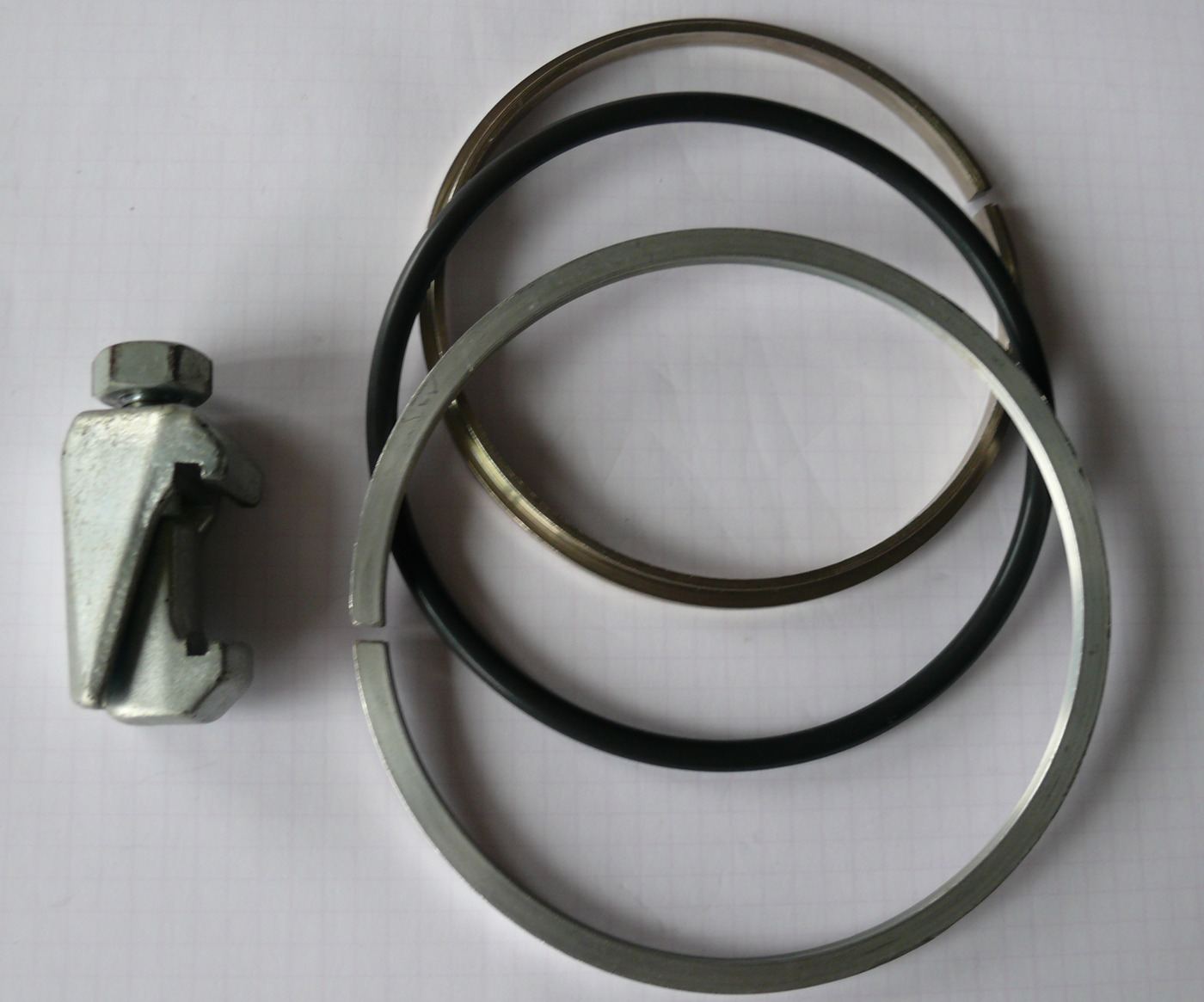
Unclamp a KF joint and a thin rubber ring falls out of a stainless carrier. Small thing. It still sets how low a bench line pumps, whether a helium leak test lies to you, and how the joint copes with its first acetone wipe. Nobody puts it in a purchase spec.
This guide runs through what ISO 2861 pins down, how nitrile, Viton, silicone and FFKM compare, where published numbers contradict each other, and when a ring is done.
What the standard fixes, and what it does not
ISO 2861:2020 gives dimensions for clamped quick-release couplings plus the O-rings and carriers used in them. Clamps are not covered, and the coupling diameters were chosen to line up with flanges in ISO 1609. Hence the interchangeability: a KF16 ring from one catalogue sits in a KF16 flange from another. The usual sizes are NW10, 16, 25, 40 and 50, with some suppliers also listing 20 and 32 mm. Clamps are shared across sizes in places; one wing-nut clamp is sold for both KF10 and KF16.
The standard is silent on the rubber. You pick it.
Inside the ring, a stainless carrier holds the O-ring. MKS says the clamp squeezes the O-ring until flange faces and carrier meet metal to metal, which is why KF joints need no torque wrench and why a damaged O-ring cannot be rescued by pulling the clamp tighter.
Spare O-rings come in inch sizes. MKS uses 2-320 for NW25 and 2-326 for NW40. Ted Pella lists a B dimension of 18.54 mm for its NW16 silicone ring and 53.34 mm for NW50. Marco Rubber adds that US or metric sizes can both work depending on the groove. Measure an unfamiliar ring before you order a spare.
The four materials, in plain terms
Buna-N (nitrile). The cheap default and the springy one. A vacuum-technology instructor's rule of thumb, quoted on the Normandale College site, is that if it bounces it is Buna-N and if it goes thunk it is Viton. Buna-N seals easily, as MKS says, and costs least. Its drawback in vacuum is a high outgassing rate; Phil Danielson's R&D Magazine article gives nitrile an outgassing figure of 1 × 10⁻⁶ in the units he uses, against 3 × 10⁻⁸ for pre-baked fluoroelastomer.
Viton (FKM). The usual choice for anything that must pump down well. It outgasses less and, in Normandale's example, passes air at about a tenth the rate of Buna-N (2.5 × 10⁻⁸ against 2.5 × 10⁻⁷ torr·L/s per linear inch). It also costs more. One catch for buyers: Ted Pella notes that Viton O-rings may be black or brown and that the colour cannot be specified, so colour is no way to tell grades apart. Viton is a DuPont trade name, and Normandale's gas-load article points out that a ring sold as Viton may contain an equivalent compound such as Fluorel.
Silicone. Good at temperature and flexible, and the standard choice when someone wants a hot, dry bakeout without paying for FFKM. The trade-off, per Marco Rubber's permeation chart and MTM's selection guide, is high gas permeability even though outgassing is low. Marco lists silicone helium permeability at 250 in its table units, against 8 for Buna-N and 9–22 for Viton A.
FFKM (Kalrez, Chemraz and similar). Danielson gives perfluoroelastomers the highest cost and the best chemical resistance, with the temperature limit highest in his table at 200 °C. He adds that you should still check the maker's compatibility tables for your actual gases. For routine rough and medium vacuum it is hard to justify.
Two others turn up. EPDM is sold for KF rings by some suppliers, and one thin-film materials listing credits it with good resistance to ageing, ozone and oxidisers. PTFE is not a substitute: MTM states that Teflon does not compress enough to form a reliable vacuum seal.
The numbers, and where they disagree
Published figures differ more than most buyers expect. Part of the spread comes from compounding. Normandale's gas-load article notes that "Viton" from a distributor may be a different formulation, and Paolo Chiggiato's CERN Accelerator School paper (2017) says reported polymer outgassing rates vary widely even for nominally identical materials. Treat every table below as indicative.
Temperature limits. Here the vendor claims scatter:
| Source | Viton | Buna-N | Silicone |
|---|---|---|---|
| MKS, bakeout rating (Series 31 rings) | 150 °C (assembly rated 180 °C) | 80 °C | 185 °C |
| Ted Pella, maximum | 250 °C | not listed | 220 °C |
| One supplier comparison table | 260 °C | 150 °C | 232 °C |
| Danielson (R&D Magazine) | 150 °C | 135 °C | not given |
The gap between a "maximum usable temperature" and a bakeout rating is not a contradiction; they are different tests. But it is a trap for buyers. Danielson says fluoroelastomers are often rated at 200 °C yet begin to break down slowly at 150 °C, with brief excursions causing little damage. Chiggiato likewise puts the bakeout limit for Viton at about 150 °C. If your line will be baked, plan around 150 °C for Viton unless your supplier's data sheet says otherwise for the specific compound.
Base pressure. MKS states that with the large number of elastomer seals in a system, the typical limit without baking is around 10⁻⁷ Torr, and that baked Viton systems can go two decades lower. MPF Products puts KF at roughly 10⁻⁸ Torr. Accu-Glass rates its ISO quick flange for 1 × 10⁻⁹ Torr. These are not the same claim, and all three come from companies selling the hardware. For a bench pumping with a rotary-vane or diaphragm pump, none of this matters. For turbo-pumped high vacuum, it does.
Helium permeation. This one matters for leak testing, and the sources split. Danielson's table puts nitrile helium permeation (9 × 10⁻⁸) above Viton (5 × 10⁻⁸). Marco's coefficients put Viton A (9–22) above Buna-N (8), and one materials supplier says Viton's helium permeability is about double Buna-N's. Those cannot be reconciled from catalogues alone; the likeliest explanation is different compounds and test conditions. The practical message is consistent across all of them: helium goes through elastomers.
Outgassing, permeation and why a new ring misbehaves
A ring adds gas to your system in two ways, and people often lump them together as "outgassing." Normandale's explanation separates them: gas coming out of the rubber itself, and gas from the room permeating through it.
Outgassing is front-loaded. According to the Normandale article, the rate is high at the start of the pumpdown, when surface water desorbs, then declines. Chiggiato explains why polymers behave differently from metals: Viton and PEEK hold roughly 0.2 wt.% water at equilibrium with 50% humidity air at 20 °C, and elastomers take water back up whenever they sit in air. So a ring you vent and reopen every day never fully dries.
Permeation is slower and steadier. Chiggiato's worked figure for a Viton O-ring with a 5 mm cross-section and 6 cm torus diameter is a permeation flow of about 10⁻⁷ mbar·L/s, with steady state taking about two months. Normandale's own example shows what that looks like in a small system: a single KF16 Viton O-ring on a one-litre chamber with the pump valve closed rises from 10⁻⁶ to 10⁻³ torr in 222 minutes through air permeation alone.
Two practical consequences.
First, a freshly installed ring, or one that has been in a humid cupboard, will gas heavily for the first hours. Pump time cures it. Baking helps, within the limits above.
Second, helium leak checking with a spray gun can mislead. Chiggiato warns that helium can permeate through the gaskets and be detected even with no real leak. Normandale describes the pattern: a slow, steady climb of the signal while helium sits on a flange, as opposed to the sharp rise of a true leak. If your signal creeps up over a minute while you are spraying a KF joint, suspect permeation before you suspect the clamp.
Chemistry: the part vendors tell you to check
Solvent vapour is where rubber choices go wrong on bench lines. No neutral chemical-compatibility source turned up in the research for this article, so the guidance here is limited to what the vacuum sources say.
Danielson warns against cleaning O-rings with solvents at all: the ring absorbs them, swells, and permeation rises. He also advises against ultrasonic cleaning because it causes water absorption, and recommends wiping with lint-free tissue. Marco Rubber and Danielson both tell the reader to check the manufacturer's chemical-resistance table before committing to a compound. Supplier charts generally rate standard FKM poorly for ketones such as acetone, a solvent that tends to end up in cold-trap lines. If your process pulls strong solvents through the joint, ask the supplier for the compatibility rating of the specific compound, not just "Viton."
Handling and installation
The handling rules in the sources are brief.
- Gloves. Danielson says to use lint-free gloves. Bare fingers leave skin oil, and plastic gloves can transfer plasticisers.
- Grease. Avoid it. Danielson reserves grease for an unavoidable situation such as a scratched sealing surface, and prefers dressing the scratch.
- Cleaning. Wipe with lint-free tissue; a damp tissue is enough if mould-release powder is present.
- Seating. Make sure the O-ring sits in its carrier and is not pinched between the flange faces. If the ring is out of its groove the clamp can close and still leak.
A double-O-ring arrangement with a guard vacuum can cut permeation. Normandale and MTM both say that a rough vacuum of 1–10 torr in the space between two rings reduces permeation across the inner seal to a negligible amount, and a small diaphragm pump is enough. One materials supplier adds the caution that a double seal is pointless unless the space between is pumped. This is a specialist fix, not something a bench line needs.
When to replace the ring
No source found for this article gives a replacement interval, and any that does should be treated with suspicion. Ted Pella's O-ring page says only that rings need renewing depending on pressure, environment and service temperature. What follows is a set of triggers, offered as suggestions rather than a published standard:
- Visible damage. Flats, nicks, cracks, or a ring that has taken a permanent oval set. Danielson's concern about surface scratches applies to the ring's mating faces too.
- Swelling or stickiness after solvent exposure. A swollen ring will not recover.
- A base pressure that drifts upward with the same pump and no new leak. Replace the rings in the suspect joints one at a time and watch the gauge.
- Repeated bakeouts above the compound's rating. Danielson's remark about slow breakdown above 150 °C is the guide.
- Contamination. Oil, dust or hairs on the sealing surface that wiping does not remove.
If you keep a log of base pressure after each service, the trend will tell you more than any calendar interval.
What it costs, and what that tells you
Prices move, so treat these as a snapshot. MKS lists its stainless Viton centering ring assemblies at roughly $8 to $9 for NW10 to NW25 and $14 for NW40, in the listing viewed for this article. One supplier's October 2025 list for packs of ten replacement O-rings shows Viton at about AUD 64 for NW25 against AUD 20 for nitrile and AUD 33 for silicone. A Viton ring is a few times the price of nitrile and still trivial next to a pump service or a ruined batch.
So the economics point one way. A reasonable rule, though not a published one: stock Viton for any line that pumps below about 10⁻³ torr or that gets baked, stock nitrile for roughing lines you open daily where the cost of a seal and the ease of seating matter more, and do not pay for FFKM unless a compatibility chart makes you.
A short selection guide
| Your line | Reasonable ring | Why |
|---|---|---|
| Roughing line, opened often, no bake | Buna-N | Seals easily, cheapest |
| High vacuum, turbo pump, occasional bake to 150 °C | Viton (FKM) | Lower outgassing and air permeation |
| Hot, dry, baked above 150 °C | Silicone or FFKM per supplier rating | Higher rated temperature, but check permeation |
| Strong solvent vapour | Compound chosen from a compatibility chart | "Viton" alone is not enough |
| Helium leak testing | Any, but expect permeation drift | Helium passes through all elastomers |
Equipvia may earn a commission from qualifying purchases through this link. The link resolved to Product ID 1600791488140 during review. CPS resolution does not verify the seller's technical claims, the elastomer used, affiliate eligibility, or commission attribution. Check the actual selected variant and current terms before ordering.
The listing does name the compound, which is more than most: the title specifies an FKM O-ring in a stainless centering ring, across KF16, KF25, KF40 and KF50, at $0.90 from ten pieces. What it does not give is the hardness, the compound's rated temperature, or whether the O-ring can be bought separately from the carrier. Those are the numbers that set the bakeout limit, so ask for them per size, since one family listing can hide more than one grade.
Practical sequence for a first pumpdown
Fit the ring dry, with lint-free gloves and no grease. Clamp until the metal faces meet, then stop. Pump, watch the gauge, and note where it settles after an hour and after a day; the first hour is dominated by surface water, so the day-one figure is the useful baseline. If the joint will be baked, take it to the compound's bakeout rating, not its headline maximum, and expect a rise in pressure while the ring warms before it falls.
Record the base pressure, the date and the ring's compound in the pump log. Three services later that log will tell you whether a ring is failing or whether you changed something else in the line.
Share this article