Replacing PTFE Tape on an Eight Inch Impulse Sealer
A worn brown strip on an impulse sealer can mean two different parts. The cover above the element releases hot film; the adhesive strip below it insulates the wire from the frame.
Disclosure: We may earn a commission if you purchase through links on this page, at no additional cost to you.
A worn brown strip on an impulse sealer can mean two different parts. The PTFE cover above the heating element keeps hot packaging film from sticking. The adhesive-backed PTFE strip below the element insulates the wire from the metal body. They may look alike in a shopping photo, but they are not interchangeable. On Uline's eight-inch H-163 tabletop sealer, the maker lists the cover and tape separately and sells an H-164 service kit containing both, along with replacement elements.
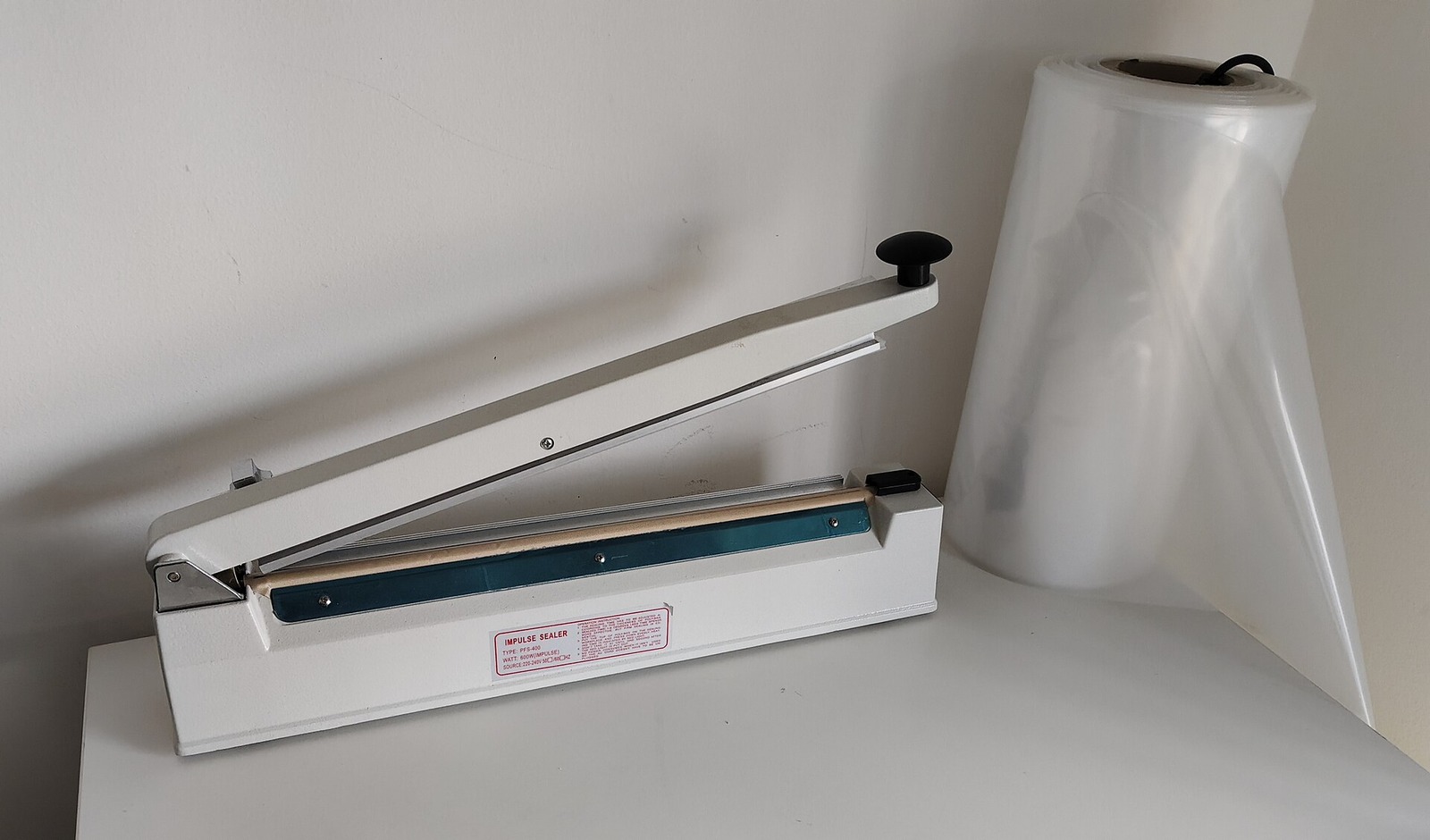
This is a practical replacement guide for a small packing bench with an eight-inch sealer. It uses the H-163 as a documented example, then shows what to confirm on another machine before ordering. The goal is to restore repeatable seals without guessing from a generic "200 mm Teflon tape" listing. A weak seal may involve film, dwell, pressure, a damaged element or other faults; the tape is only one part of that diagnosis.
Identify the layer before ordering anything
Unplug the unit and let the jaw cool before inspecting it. On the Uline assembly drawing, the layers from the sealing surface downward are the top PTFE cover, heating element and bottom adhesive PTFE tape. The top cover is held by cover plates; the lower strip adheres to the sealer body under the element. The latter is an electrical insulator. Uline warns that if the element touches the housing, the sealer will short out.
The visible cover takes rubbing from bags and heat cycles. A dark track, tear or exposed element is a reason to inspect it. The lower tape is less obvious until the cover and element have been removed. Uline says to replace that strip if it is worn, burned or ripped. Sealer Sales, which sells its own hand-sealer parts, explicitly requires new lower PTFE adhesive whenever one of its heating elements is changed. Apply the machine maker's procedure to the actual model rather than merging these instructions into a universal interval.
The jaw's silicone rubber pressure pad is another separate component. A depressed, cut or dirty pad can affect contact even when both PTFE layers are sound. Uline lists a pad as an H-163 part. The timer, microswitch, element and spring also have distinct roles. If the sealer has no heating indication at all, buying a wider cover will not necessarily solve it.
Use the exact model as the purchase key
"Eight inch" describes nominal seal length, not the dimensions of every replacement piece. Uline's H-163 page gives an eight-inch by one-sixteenth-inch seal, calls the adhesive tape S-5331 and the covers S-6783, and identifies H-164 as its service kit. The H-161 is also an eight-inch model, but Uline maps it to H-495, not H-164. This is an easy way to order a superficially plausible wrong kit. Record the nameplate model and read the parts diagram before choosing a strip.
A different manufacturer may use a roll of PTFE cloth retained by clips instead of Uline's pre-cut cover under plates. An Interplas impulse-sealer manual describes pulling fresh cloth from a roll, cutting away a burned section, and retightening its clips; it separately calls out the PTFE strip below the wire. That design should be serviced by its own instructions. Do not assume that a peel-and-stick strip replaces a tensioned roll cover, or that the lower adhesive on one brand can be omitted because another machine has a different cover arrangement.
If the machine has a cutter, a round cutting wire or a wider flat sealing element, identify that variant too. The width of the seal is not automatically the width of the top cover or lower insulation. Compare a photographed exploded view and part number with what is physically installed. For a generic machine without a reliable model number, measure the retained cover width and length, the lower rail and required end coverage, and the element width and terminal layout. Those observations form a sample request, not proof that any stock roll will work.
Buy a cover for the top and insulation for the bottom
Sealer Sales describes its adhesive PTFE as a cover-like material with a silicone adhesive backing and says it goes under the heating element. Its catalogue offers several widths and 3, 6 or 10 mil constructions; a listed half-inch by eight-inch, 6 mil piece belongs to its hand-sealer range. Those figures show why "PTFE tape" alone is not a complete specification. They are Sealer Sales product choices, not permission to retrofit a Uline H-163 with an arbitrary thickness.
The top layer has to release the intended film and remain secure in the machine's cover hardware. The lower layer must insulate the entire metal path where the live element could contact the body. Width, length, adhesive placement, thickness, backing construction and terminal coverage all matter. Order the OEM kit when model identification is clear and the cost of a failed seal or electrical fault is significant. If sourcing rolls for a fleet, first obtain maker approval or validate a sample against the exact machine assembly; document the successful cut length and installation method for repeat orders.
PTFE-coated glass-fabric products, skived PTFE films, plumbing thread-seal tape and general heat-resistant tapes can all appear under "Teflon tape". Their names do not establish the same electrical insulation, adhesive, release surface or mechanical behaviour. A seller's claimed temperature rating by itself cannot answer where the tape belongs. For a lower strip, ask for its construction, adhesive side, total thickness, dielectric or insulation data relevant to the assembly, and the width and length of the supplied unit. For a cover, ask whether it is adhesive-backed, a loose pre-cut piece, or roll cloth retained by the machine.
Remove and refit the layers in the right order
Uline's H-163 family service sheet begins with disconnecting power. It calls for removing the cover plates and top cover, then removing the element from the terminal posts. Only then is the lower tape assessed. If that tape needs replacement, clean the exposed sealing surface of glue and debris; the sheet recommends an adhesive remover. The new adhesive tape goes down evenly, with excess extending to the terminal posts so the element cannot touch metal. The element is then attached and the top cover refitted flush before the plates go back.
Treat the rail as an electrical assembly, not a craft surface. Do not stretch a narrow strip across a metal edge and assume it will stay insulated; do not overlap arbitrary scraps under the element to use up leftover tape. Keep cleaner and loose adhesive off terminals, and allow the surface to be clean and dry as the machine instructions require. If a terminal, spring or mounting post is damaged, stop the tape change and repair the defective part according to the maker's service procedure. A new cover cannot correct a shorted element or damaged wiring.
An Interplas roll-cloth machine has a different sequence: its manual says to loosen the fixed plate and press clip, advance the cloth, cut off the burned area, pull the roll tight and secure the clips. For element replacement it warns not to bend or crimp the wire, and to change the lower PTFE strip when worn because the element may short. This is the reason a generic video can help an operator visualise the layers but cannot replace the manual for their specific machine.
After reassembly, verify that the cover lies flat across the sealing path and the pressure arm closes without snagging. Inspect the entire length, including the ends near the terminals, before reconnecting power. Test on a clean sample of the actual packaging material at the maker's recommended starting setting, then check the seal after it cools. Keep the first accepted sample and note its film type and setting. If the application has a validated seal specification, follow that inspection and documentation procedure instead of adopting an informal hand pull as a substitute.
Diagnose the seal before turning the timer higher
A seal that peels open can be underheated, insufficiently pressed or disturbed before it cools. A burned, narrowed or cut-through seal may reflect excessive heat or dwell, a damaged cover or a pressure problem. Neither pattern proves the adhesive under the wire is at fault. Start with a clean film and an intact cover, inspect the silicone pad and element, and compare the setting to the equipment instructions. Uline's H-163 instructions say the timer setting depends on bag thickness; the H-163 page describes an adjustable timer.
On the manufacturer side, Sealer Sales names the element, PTFE cover and adhesive, microswitch, mounting spring and timer as common troubleshooting points. It warns that raising heat unnecessarily can damage the element and lower adhesive. That is a better diagnostic frame than turning the dial to its maximum after every poor seal. If the indicator does not come on, or the element is broken or bent, check the machine's troubleshooting section and arrange competent electrical service where appropriate.
The packing material matters as much as the tool. Uline publishes model-specific limits and supported materials for H-163; an unrelated multilayer pouch may require a different sealer and validation method. Do not infer a universal maximum bag thickness from the H-163's published eight-mil figure. For food, medical or other controlled packaging, a line operator must use the approved film, equipment and quality procedure; a repair alone does not validate package integrity.
A manufacturing discussion describes partial weak seals appearing after element and PTFE wear, with a buyer discovering failures only after shipment. That is useful evidence of the problem operators notice, not a measured wear-life study. A Sealer Sales maintenance video demonstrates changing an element and both PTFE pieces; use it for visual orientation, while following your model's service instructions for exact fasteners and end coverage.
Make replacement a repeatable stock item
For a named H-163, the simplest requisition is H-164 when both PTFE pieces and elements are needed. Uline says it includes two heating elements, two PTFE strips and two covers. If only a layer is needed, its H-163 page separately lists S-5331 tape and S-6783 covers. Check present stock and pack contents when ordering; the number of strips in a kit is not the number of machines in service.
For an unidentified eight-inch machine, write down the brand and model if visible, nominal sealing length, measured cover and lower-tape dimensions, heating-element type and width, fastening method, and whether the lower strip is adhesive backed. Record a photograph of the original stack before removal. Buy one sample, install it by the correct manual, run the actual film, inspect the finished seal, and then set the reorder code. That short record prevents the next buyer from repeating a search for "universal 200 mm tape".
Equipvia may earn a commission from qualifying purchases through this link. The link resolved to Product ID 1601271281062 during review. CPS resolution does not verify the seller's technical claims, the cloth construction, affiliate eligibility, or commission attribution. Check the actual selected variant and current terms before ordering.
Ask for the selected variant's actual element end geometry, cloth construction and dimensions, number of pieces, and supported machine models before comparing a quote. Because the listing mixes sizes and generic machine attributes, it is not an OEM equivalent for a specific sealer without those answers.
The decision is about two surfaces
Replace the worn upper cover for release and protection; replace damaged lower adhesive insulation when the service procedure calls for it, especially while changing an element. Match the part number and stack to the machine, then prove the repair with the actual film. That is more useful than a generic temperature rating or an eight-inch label.
Share this article