Choosing Replacement Burrs for a Eureka Mignon 50 mm Grinder
Diameter is the easiest number to match and the least useful one. Model generation, espresso or filter profile and the Eureka part reference decide whether a replacement burr set will actually grind the way the machine should.
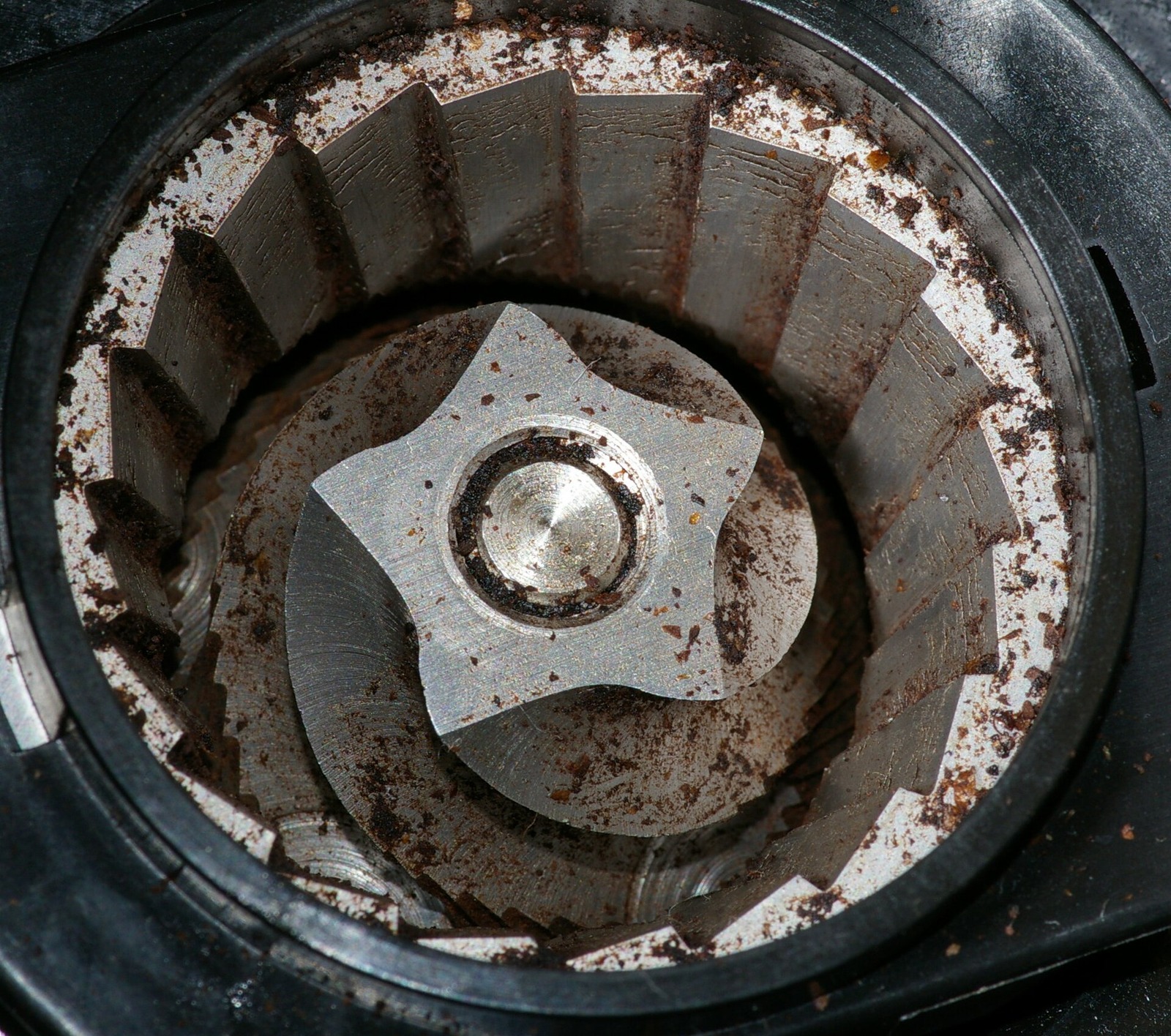
If a Eureka Mignon has stopped producing the grind range you need, a new burr set may be the answer, but "50 mm" by itself is not a safe part specification. First separate burr wear from a dirty chamber, a blocked chute, a shifted adjustment point, or a mechanical fault. Then identify the grinder's exact model and production version, and match the replacement by its Eureka part reference and mounting geometry. For many Mignon models, the relevant espresso burr set is MAC50CP; other 50 mm Mignons use a different burr profile for filter coffee, and newer models also use 55 mm or 65 mm sets.
This guide is for owners, repair shops, and buyers ordering a repeat replacement for a 50 mm Eureka Mignon. It explains when replacement is justified, how to avoid buying a same-diameter but wrong-profile set, what to verify before checkout, and what to ask a supplier if an exact OEM part is unavailable. It does not treat every Mignon generation as interchangeable.
When should you replace the burrs?
Eureka lists a 250 kg burr lifespan for certain current Mignon models, including the Manuale and Classico product pages checked for this guide. Treat that as the manufacturer's stated service-life reference for those named models, not a universal countdown for every Mignon or an automatic requirement to replace a set at exactly 250 kg. Eureka's official product material also identifies different burr diameters across the range. The model page and manual for the grinder in front of you take priority.
Most home users do not record cumulative kilograms. A practical decision therefore combines service history with a controlled diagnosis. Replacement becomes more plausible when the grinder has processed substantial volume, the burr edges are chipped or damaged, and cleaning plus a known-good adjustment no longer restores the required grind range. If the grinder is second-hand and its use history is unknown, inspect and document the burrs before ordering instead of assuming that age alone means they are worn.
A shot that runs too quickly is not proof of dull burrs. Bean age, roast, dose, basket, tamp, humidity, and adjustment can all change extraction. A Mignon can also fail to grind fine enough because the burr carrier or adjustment mechanism is out of position, the chamber is packed with old grounds, a foreign object has jammed the burrs, or the chute is blocked. Clive Coffee's Mignon inspection guidance recommends checking whether the burr gap remains even as the lower burr is rotated and the setting is moved finer; this is a diagnostic clue, not a home-user substitute for safe servicing.
Before buying, remove old coffee from the chamber using the procedure approved for your grinder, then test again with beans and a dose you know. Keep the grinder unplugged for cleaning or inspection. If the motor hums, stalls, smells hot, or makes a new scraping noise, stop using it. Those symptoms can indicate a mechanical or electrical problem that a burr set will not fix.
Is every 50 mm Mignon burr set interchangeable?
No. Diameter is only one dimension, and Eureka's Mignon family includes distinct burr designs. Current product pages, for example, list 50 mm hardened-steel flat burrs for the Mignon Manuale and Classico, while other Mignon models use 55 mm or 65 mm burrs. In addition, some 50 mm models are configured for espresso and others for filter coffee.
For an espresso-oriented 50 mm replacement, MAC50CP is a common Eureka part reference. Eureka's parts listings for Mignon models identify MAC50 CP as a 50 mm flat burr set. Specialist parts listings describe this set as a pair with a 50 mm outside diameter, 30 mm inside diameter, 7.5 mm thickness, and three fixing holes. Treat the dimensions as a cross-check against the exact OEM part, not as permission to substitute any burr that happens to share those measurements.
Filter burrs are a frequent source of confusion. Some Mignon Filtro and Crono versions have used filter-oriented 50 mm burrs; later Crono parts listings distinguish the MAC50FPROCP reference from MAC50CP. The part number, machine generation, and intended brew use matter more than a marketplace title that simply says "50 mm Mignon burrs." A burr set that physically mounts may still have a different cutting geometry and produce a different grind distribution. Ask the seller to identify the exact part number and models supported, then compare that claim with Eureka's parts documentation or an authorized parts diagram.
Do not use MAC50CP as a shortcut for every Mignon. A Mignon Specialità or Silenzio from a different production version may use a 55 mm set; the XL uses a larger burr. Product naming and dimensions have changed over time. If your label says Specialità, Libra, XL, Zero, Oro, or another newer variant, stop and look up the parts diagram for that exact model and version. A 50 mm listing is not evidence of compatibility.
How do you identify the correct part before ordering?
Start with the rating plate and record the full model name, serial or production information shown, and any variant suffix. Photograph the label and the grinder from the front. "Eureka Mignon" is a product family, not a complete identification. Then find the model's parts diagram or manual and note the burr reference. If the grinder has already been serviced, compare the installed part number with the diagram; a previous owner may have fitted a different set.
For a MAC50CP order, verify all of the following against the product documentation:
- The listing identifies MAC50CP or the exact current OEM reference, not just "Eureka compatible."
- The product is a pair of flat burrs, not one disc or a carrier assembly.
- The listed outside and inside diameters, thickness, and three-hole pattern agree with the part you are replacing.
- The listing specifies the intended Mignon models and, where relevant, production range.
- The seller distinguishes espresso burrs from filter burrs rather than treating them as one generic 50 mm item.
A specialist distributor currently lists MAC50CP as a 50 × 30 × 7.5 mm pair with three fixing holes and publishes a model compatibility list. Eureka's own parts listings independently identify MAC50 CP as the 50 mm flat burr set. These sources make a useful cross-check, but a distributor's fit list is not a substitute for the diagram for your individual machine.
If the original burr has a readable stamp, photograph it beside a ruler and include the grinder label in the same request. Do not infer that "RH" means all right-hand rotation grinders take the part; it is a product descriptor that must agree with the manufacturer's part reference. Ask the supplier to confirm in writing: exact part number, burr set quantity, supported model and version, intended espresso or filter profile, and whether the supplied item is OEM or aftermarket. If an aftermarket listing gives only a diameter and a stock photo, it has not established fit.
What should you inspect before blaming burr wear?
Check one variable at a time. First, determine whether the grinder runs and feeds coffee. A motor that runs without producing grounds may have a blockage rather than worn burr edges. Clive Coffee's maintenance guide points to the grind chamber and chute as common places to check when a grinder is running but no coffee exits. Unplug before any access or cleaning, and follow the instructions for your exact model.
Second, look for obvious damage, contamination, or a visibly uneven gap. A chip caused by a stone or other foreign object can justify replacement even when the burrs have processed far less than the nominal life. Conversely, a shiny appearance alone does not give a reliable wear measurement. Coffee oils and cleaning residue can change how the surface looks. Do not run a fingertip across sharp cutting edges to judge them.
Third, check whether the adjustment range has shifted. Eureka's Mignon Evolution material describes a stepless micrometric system based on repositioning the lower burr, and says the design allows maintenance without losing the grind setting. That is a statement about the listed Evolution design; it does not mean every older Mignon will preserve its setting after disassembly, nor that a grinder with a shifted zero point needs new burrs. Record your starting adjustment and use the service procedure for the exact model.
If the burrs appear undamaged but touch at one point before they do around the full rotation, the problem may involve alignment, carrier seating, or the adjustment mechanism. Do not try to correct uneven contact by aggressively tightening screws or grinding with the burrs touching. Refer the grinder to a technician if the setting cannot be made repeatable, the spindle feels rough, a carrier is loose, or the grinder has electrical damage.
Is replacing the burrs a simple DIY repair?
It depends on the model, warranty, and your experience. Eureka's Mignon Silent maintenance video demonstrates cleaning and burr substitution for that range, while older Mignon user instructions describe removal of the upper burr holder and three screws from each burr. The manual also tells the authorized technician to switch off and unplug the grinder before maintenance. Follow the applicable manufacturer procedure; the fact that a video exists does not make the same steps valid for every Mignon.
At a high level, a service replacement involves disconnecting power, exposing the burrs according to the model-specific procedure, removing the old discs, cleaning their seats thoroughly, fitting the correct pair in the correct orientation, and reassembling to the specified fastener condition. Retained coffee particles under a burr can prevent it from seating flat, so cleanliness is part of fit, not cosmetic housekeeping. Do not improvise screw torque, lubrication, or alignment steps when the manual does not state them.
If the procedure requires opening electrical covers, moving wiring, removing a lower carrier, or working around a capacitor, use a qualified service technician. A grinder can retain mechanical hazards even when unplugged, and a poorly seated burr can cause contact, vibration, or damaged fasteners. If the grinder is under warranty, check with the seller or authorized service channel before opening it; a do-it-yourself repair may affect warranty coverage, depending on the terms in force where you bought it.
After assembly, do not assume the old dial mark is still a safe operating setting. Start coarser, run a small amount of coffee, and adjust in small steps while checking the output. If the burrs make contact, back away immediately and use the model's setting procedure. A new set may need adjustment for the coffee you use, but claims that every burr set requires a fixed "seasoning" quantity should not be treated as a Eureka specification unless the manufacturer documents it for that part.
What should a repeat-order request include?
For a repair shop or multi-unit site, a vague note such as "Mignon 50 mm burrs" creates avoidable back-and-forth. Keep a simple record with the full grinder model, serial or production range, old part number, new part number, espresso or filter use, pair quantity, and the source of the compatibility check. Save one clear photo of the rating plate and one of the removed burr stamp when available.
For a supplier inquiry, request a current drawing or dimensioned product sheet if the listing is not an OEM part. Ask for the exact outside diameter, inside diameter, thickness, hole count and spacing, rotation and profile designation, material and coating if claimed, pair count, and the models the supplier supports. Ask whether the quoted product is the manufacturer's original part, a compatible replacement, or an upgrade. Do not accept "fits Eureka Mignon" as a sufficient answer if the model, part number, and burr profile remain unspecified.
When placing a repeat order, retain the supplier's written confirmation with the invoice. On receipt, compare the part number and geometry before installation. If a lot or package arrives without identification, pause rather than mixing unverified parts into maintenance stock. The modest effort of recording a part number once is cheaper than diagnosing a wrong-profile replacement after the grinder has been reassembled.
The safest buying rule is simple: identify the exact grinder version, confirm the burr task (espresso or filter), then match the OEM reference and mounting details. "50 mm" narrows the search; it does not finish the specification.
Share this article