ER Collet Sizes Explained: What ER32 Means and Which Bore Fits
ER11, ER16, ER32 and ER40 describe geometry that must fit the holder. The bore that grips the cutter is a separate number, and it is the one that decides the purchase.
Disclosure: We may earn a commission if you purchase through links on this page, at no additional cost to you.
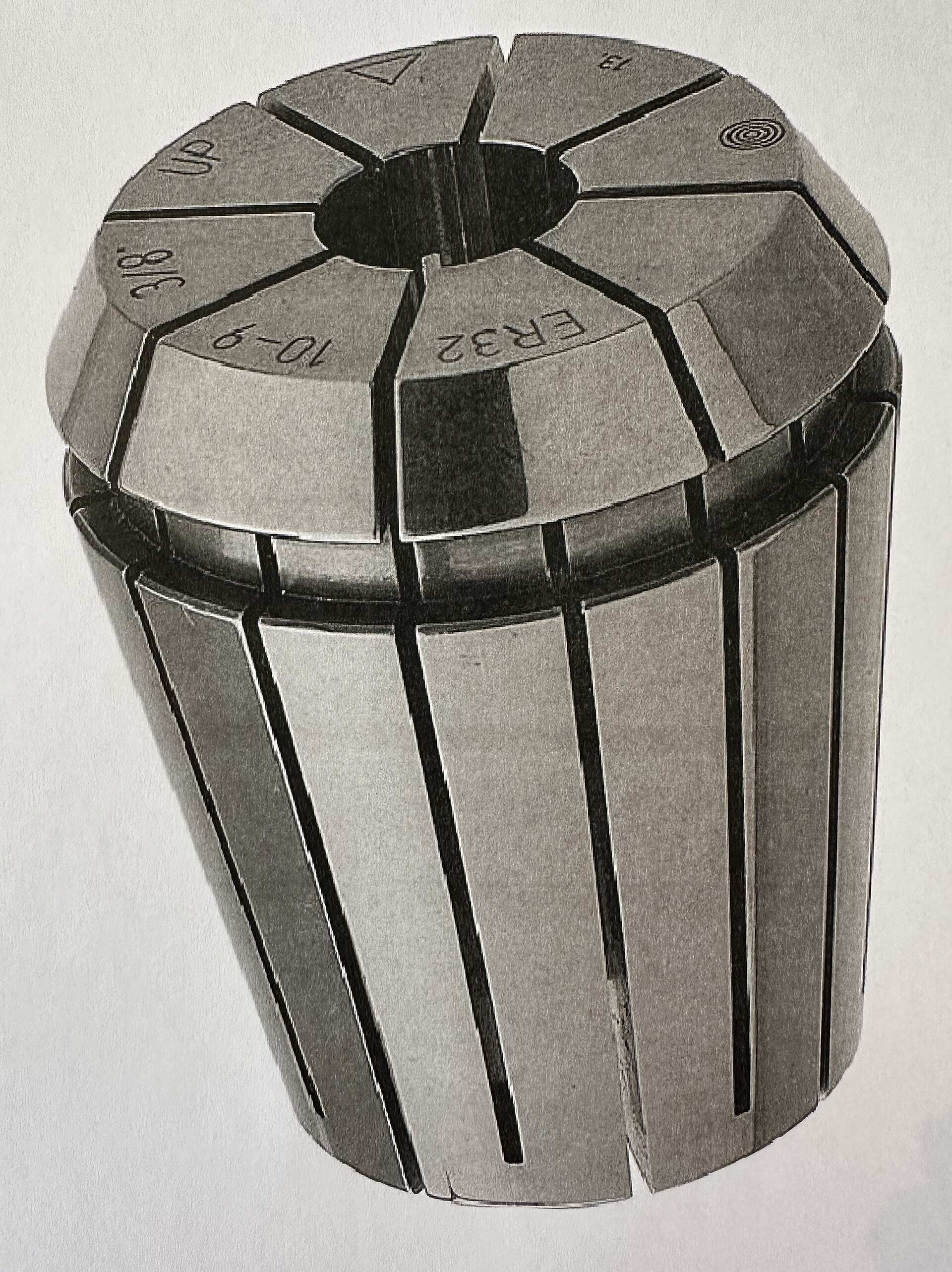
ER32 does not mean that the tool shank should be 32 mm. It identifies the ER collet system family. The hole through an individual collet is a different size, and that bore is what grips the cutter. A buyer who orders an "ER32 collet" without naming the shank diameter may receive the right family but the wrong part.
The same confusion appears with ER11, ER16 and other series. Those numbers describe the collet geometry that must fit the holder and nut; they do not tell you whether a 3 mm, 6 mm or 1/4-inch tool will fit. Choose in two stages: match the collet family to the holder, then match the individual collet's documented clamping range to the measured shank. This guide focuses on standard ER collets for CNC milling and engraving. Tapping collets, sealed coolant collets, collet reductions, and proprietary spindle systems have additional requirements.
Start with the holder, not the cutter
Read the marking on the existing collet, nut, holder or spindle manual. It may identify ER16, ER20, ER25 or ER32. If only a spindle taper is listed — such as BT30, BT40, CAT40 or HSK — that is not the ER size. A holder can be described as BT30–ER32: BT30 identifies its machine-side taper, while ER32 identifies the collet family at the tool end. Neither number gives the bore for your cutter.
A collet must seat in the holder's matching taper and engage its nut correctly. An ER32 collet cannot be substituted into an ER20 holder just because both have a 6 mm bore. Compare the family marking on the holder and collet, and confirm the nut is intended for that holder. If a machine uses a proprietary one-piece spindle collet, do not assume it follows ER dimensions because a listing uses similar wording.
REGO-FIX's standard ER product information identifies its collets with DIN 6499-B / ISO 15488 and lists ER sizes separately from the supported shank-diameter range. Those references describe the manufacturer's standard ER product family; they do not certify an unmarked aftermarket collet.
Then match the individual bore to the shank
Measure the straight gripping section of the tool, not its cutting diameter. A 6 mm end mill has a 6 mm shank only if the manufacturer specifies that dimension; a tool's flutes, neck and cutting head are not the gripping surface. Remove oil and chips, inspect for burrs, and measure the clean shank with a suitable micrometer or caliper. For a precision setup, use the measurement method and tolerance required by the tool and machine documentation. If readings vary around the shank, check for wear, damage or an out-of-round tool before ordering a collet.
Next, look up the exact collet's clamping range in its manufacturer's table. Do not rely only on a listing title, a colour, or a statement such as "one-millimeter range." In REGO-FIX's 2026 ER32 standard table, the 6.0 mm collet is listed for 5.0–6.0 mm shanks. Its 6.5 mm collet is listed for 5.5–6.5 mm. The catalog also lists a 1/4-inch ER32 collet with a 5.33–6.35 mm range. These are the published ranges for that product family; another maker or collet type may use different limits.
| Collet marking in the REGO-FIX ER32 chart | Published clamping range | Practical reading |
|---|---|---|
| 6.0 mm | 5.0–6.0 mm | Intended metric size; range includes a 6.0 mm shank |
| 6.5 mm | 5.5–6.5 mm | A separate metric collet with a different nominal bore |
| 1/4 in | 5.33–6.35 mm | Inch size; 6.0 mm falls inside this specific charted range |
The table settles an easy-to-miss question: 6 mm is not identical to 1/4 inch. One quarter inch is 6.35 mm, a difference of 0.35 mm. Yet in the cited ER32 chart, the 1/4-inch collet's stated range does include a 6 mm shank. That does not make inch and metric collets interchangeable in every brand, series or precision class. Check the actual range and the tool's required tolerance. If a matching 6 mm collet is available, it is the clearer choice for a 6 mm tool — especially when repeatability matters — because the order records the same nominal system as the tool.
A size chart often prints the nominal bore at the upper end of a clamping interval. The collet's slots allow it to contract around smaller shanks, but that does not mean any smaller tool is acceptable. The permitted range is the limit. Never exceed it by forcing an oversized shank into the collet, and do not assume that a collet compressed far beyond its listed range will hold concentrically or safely. Manufacturer guidance takes priority over rules of thumb.
Three checks before you add it to the order
1. Confirm the ER family
Record the exact holder or spindle designation, including the collet family and any special type. "ER32" alone may not identify whether the existing part is standard, ultra-precision, sealed, tapping, coolant-through or another specialized design. A replacement should match the holder's intended collet form, not just its outside appearance.
2. Confirm the tool shank size and units
Record the tool's specified shank diameter in millimetres or inches. Do not convert a rounded label into a different size without checking the actual value. A 1/4-inch shank is 6.35 mm; a nominal 6 mm shank is 6.00 mm. Use the supplier's exact inch or metric variant and ask for its clamping range. If your tool paperwork gives a tolerance, compare it with the collet specification instead of measuring only one sample tool.
3. Confirm the precision you need
A collet that closes on a shank is not automatically accurate enough for the cut. REGO-FIX lists 10 μm total indicated runout for its standard ER line, but that is a manufacturer-specific product specification, not a universal promise for every ER collet or a complete spindle assembly. A machine's measured runout also depends on the holder, nut, spindle condition, cleanliness, assembly and tool. If finish, small tools or tight tolerances matter, ask for the runout specification and test conditions for the exact collet, and measure the assembled setup as your machine manual directs.
For ordinary tool holding, a standard collet may suit the work. A higher-precision variant can cost more and still will not compensate for a dirty taper, damaged nut or worn spindle. Buy the grade your process needs, not just the most impressive number in a listing. If the supplier quotes an accuracy such as 0.005 mm, ask whether that is collet-only TIR, a measurement on a reference arbor, or the assembled toolholder result. The number is incomplete without the test setup and the exact selected size.
Fit and assemble it without damaging the collet
Inspect the collet slots, face and taper under good light. Chips, dried coolant, rust, a cracked segment or a polished groove from slipping can prevent even clamping. Clean the holder taper, nut and collet using the method in the machine or holder instructions. Keep abrasives and hard scraping tools away from precision surfaces; if the contact surface is damaged, replace or have it assessed rather than trying to reshape it by hand.
ER nuts have an eccentric ring that captures the collet. REGO-FIX's assembly directions say to engage the collet groove with the nut's ring before screwing the assembly onto the holder; it also recommends a torque wrench for its system. Follow the instructions supplied with your own holder and nut, including any required torque. Do not drop a loose collet into the taper and tighten the nut over it.
Insert the tool far enough for the collet to grip the straight shank, while respecting the toolholder manufacturer's minimum engagement and maximum stick-out guidance. REGO-FIX advises inserting the tool to the full collet length where possible and never less than two-thirds of that length for its ER system. Treat that as REGO-FIX guidance, not a substitute for instructions from a different holder maker. Keep the cutting flutes out of the gripping zone unless the toolmaker explicitly permits it.
Before running the spindle, confirm the tool is seated, the nut is secured to the specified torque, and no chips remain on the mating surfaces. Use the machine's prescribed runout check if the operation requires one. If a tool slips, chatters or shows unexpected runout, stop and inspect the shank, collet, nut and holder. Tightening harder is not a fix for the wrong bore, a damaged collet or poor seating.
Make the next replacement straightforward
When a collet works well, keep its packaging or record the manufacturer, series, exact marking, material or type, and date installed. Add the tool shank size, holder model, required precision grade and purchase source. A photograph of the stamped collet can help, but keep the written measurements; stamps are easy to misread after the part wears.
For an RFQ, send the seller the holder family, exact tool shank diameter and units, required collet type, expected runout or test method, quantity, and a photo of the original marking. Ask for a drawing or current datasheet that maps the selected option to its bore and clamping range. Confirm whether the displayed price is for one collet or a set, what the minimum order quantity covers, and whether the supplier can identify the size on each package. Do not accept "fits ER32" as proof that a particular bore, precision grade or runout is included.
For repeated jobs, keep only the sizes your cutters actually use and label the drawer by ER family and bore. A complete assortment is useful when the shop supports many shank diameters; it is wasteful if the machine uses only two. Buying one correct replacement size at a time also makes it easier to notice if a new batch has different markings or performance.
A sourcing candidate
Alibaba Product ID 1601405657635 is a multi-variant ER32 listing. The page displays a 6 mm option, a one-piece minimum order and a displayed price of ¥9.96; it shows no product reviews. The seller profile identifies Shangdong Carlson CNC Equipment Co., Ltd. as "Manufacturer, Trading Company," shows a 4.7/5 shop score from 45 ratings, and lists a three-year Alibaba tenure. These are platform statements, not independent factory, measurement or performance verification.
The page's attributes claim steel and "within 0.005 mm" accuracy, but do not establish the test method or prove that result for the 6 mm option. Treat this as an inquiry lead only, not a recommendation. Before ordering, ask for a drawing and the exact 6 mm variant's clamping range, material and heat-treatment information, runout test method, unit price, minimum order quantity, and confirmation that it is a single ER32 collet rather than a holder assembly. If those details are not confirmed, use a manufacturer or authorized distributor whose part number and specification match your holder.
Equipvia may earn a commission from qualifying purchases through this link. A tracked route being generated does not verify product performance, exact option fit, or commission settlement.
The practical answer
Read ER32 as the holder-family size, not the cutter diameter. Match the individual collet to the measured tool shank using the exact manufacturer's clamping-range table, then confirm the collet type, nut and holder all belong to the same system. For a 6 mm tool, a 6 mm collet is the clearest nominal match; a 1/4-inch collet may also include 6 mm within its stated range in a specific chart, but that is a product-specific fact, not a universal conversion rule. Keep the evidence and size marking with the spare so the next replacement is a repeatable purchase.
Common questions
Does ER32 mean a 32 mm tool shank?
No. ER32 identifies the ER collet family. The bore of the individual collet determines which tool shank it can clamp.
Can a 1/4-inch ER collet hold a 6 mm shank?
REGO-FIX lists 5.33–6.35 mm for its ER32 1/4-inch collet, so 6 mm is inside that particular published range. Check the actual collet manufacturer and required precision before using another product.
Is a 6 mm collet the same as a 1/4-inch collet?
No. 1/4 inch equals 6.35 mm. Their clamping ranges may overlap, but the nominal sizes are different. Use the exact tool marking and the selected collet's chart.
Can I clamp a smaller shank in a larger ER collet?
Only when the shank falls inside that exact collet's published clamping range and the tool and process allow it. Do not use a generic collapse rule in place of the manufacturer's table.
Does the ER number tell me which nut to order?
It points to the collet family, but verify the nut and holder model against the manufacturer's catalog. Mini, sealed, coolant and specialized nuts may have additional compatibility requirements.
Share this article