Choosing DBx1 or DPx5 Sewing Needles: System Before Size
A DBx1 needle and a DPx5 needle can both be marked Nm 80/12 and still not be interchangeable. The system code sets the geometry the machine was built around; the size is a separate decision.
Disclosure: We may earn a commission if you purchase through links on this page, at no additional cost to you.
DBx1 and DPx5 identify different industrial sewing-machine needle systems. They are not two sizes of the same needle, and the same size marking — such as Nm 80 or Singer 12 — does not make them interchangeable. Start with the needle system specified in the machine manual or parts book; then choose the needle size, point, and needle style for the material and thread. If the manual says DBx1, order DBx1. If it says DPx5, order DPx5, or a cross-reference explicitly approved for that machine.
Do not switch systems to solve thread breakage, skipped stitches, or a heavy-material problem. Those symptoms have other causes, and a needle with the wrong geometry can change needle-to-hook timing and stitch formation.
What DBx1 and DPx5 actually tell you
The system code describes the needle geometry that a machine was designed to accept: dimensions such as shank diameter and length, the relationship between the eye and scarf, and other features that determine how the needle meets the hook or looper. The size code describes a different property: blade thickness. A DBx1 needle marked Nm 80/12 and a DPx5 needle marked Nm 80/12 therefore have the same nominal blade-size designation, but they do not thereby become the same machine needle.
SCHMETZ identifies DBx1 among the round-shank systems used only where the machine instructions specify that family. Its product information gives a 1.62 mm round-shank diameter for the listed DBx1-family needle. Its 134 U product, which the company says fits machines whose manuals specify 134, 134 R, DPx5, 135x5, SY 1955, 135x7, or 797, has a 2 mm round shank. That is a clear practical reason not to treat DBx1 and DPx5 as interchangeable merely because a seller groups several codes together. Those values describe the cited SCHMETZ products; they are not a substitute for the drawing or specification of every needle variant.
You will often see DBx1 cross-listed with names such as 1738, 16x231, or 16x257, and DPx5 cross-listed with 134 or 135x5. Cross-reference lists are useful for finding a needle, but they can conceal variations in point style, eye, scarf, shank, or the machine application covered by the reference. Treat a second code as a cross-reference only when the machine manufacturer or needle maker documents it for the exact needle type and machine. "Fits industrial sewing machines" is not a sufficiently precise compatibility statement.
Find the system before choosing the size
Use this order when replacing a needle:
- Read the model and subclass on the machine's nameplate. A suffix can matter; two machines in the same model family may use different needle systems or have different applications.
- Check the operating manual, parts book, or manufacturer's product page for the needle-system code and permitted size range. Search the exact model plus "needle system" or "needle size" if the manual is not at hand.
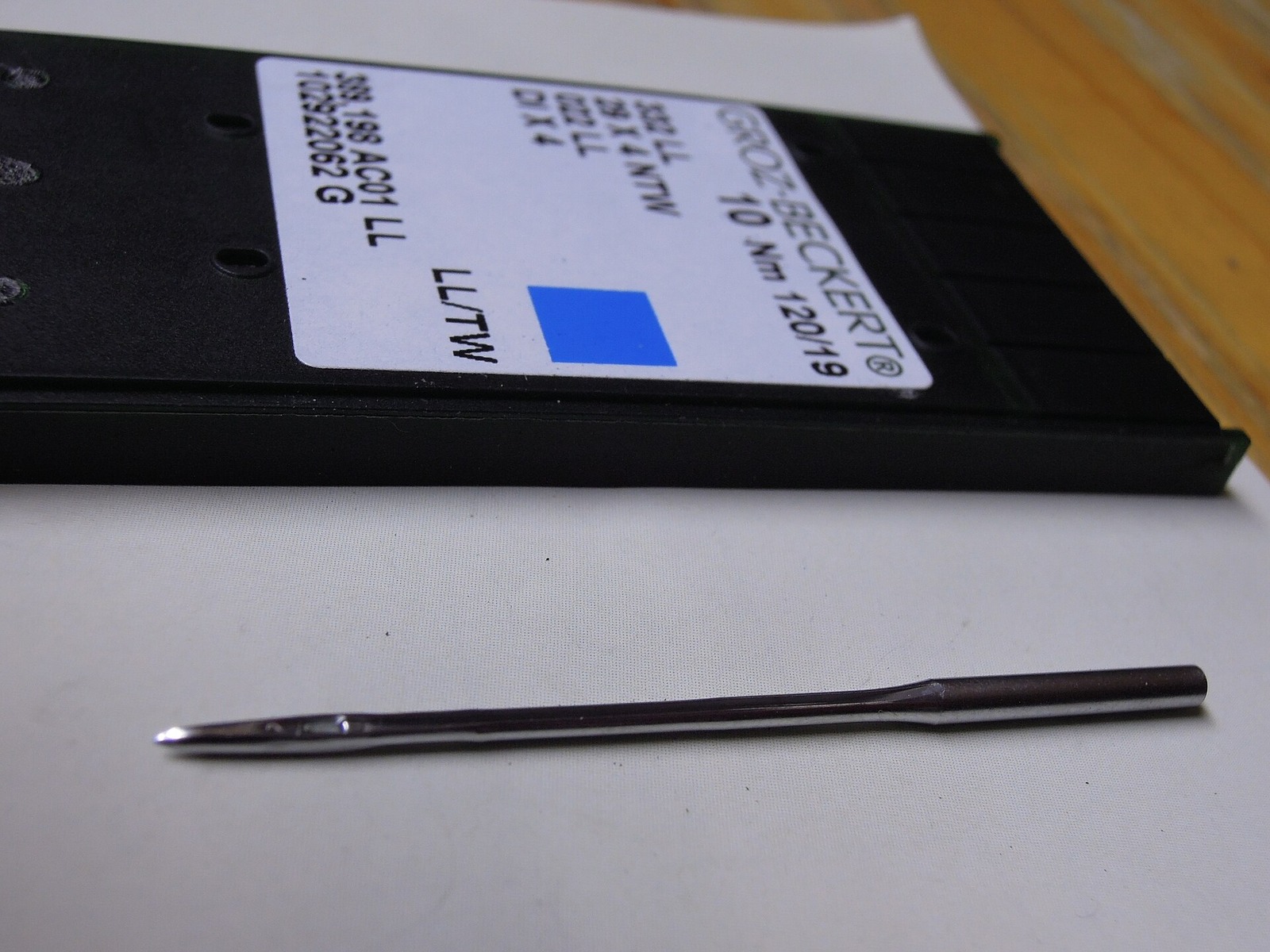
- Compare the old needle's packaging and markings. The system may be printed on the packet; the needle itself may carry only a size or maker mark, so absence of a code on the shaft proves nothing.
- If the machine is used, modified, or has an undocumented needle-bar conversion, verify the installed needle bar and hook arrangement with a qualified technician or the machine supplier before ordering by model name alone.
The manual outranks a marketplace title, a forum answer, or a visual guess. For example, Brother's DB2-B793 instruction manual directs the operator to use a DBx1 needle and gives a specific insertion orientation. Brother's BAS-341F manual specifies DPx5 options for different applications. Brother's industrial catalogue also lists different needle systems and size ranges against particular machine models. These examples show why one brand-wide rule is unsafe: check the actual model and subclass.
When the manual is missing, take clear photos of the machine nameplate, needle bar, needle clamp, old needle packet, and the needle beside a ruler. Send them to the machine maker or an industrial sewing-machine technician. Ask them to identify the complete system code, not just "a needle that looks the same." Needle length is difficult to judge by eye, and a small geometry difference can affect the hook relationship even when a needle can be clamped in place.
Needle system and needle size are separate decisions
After confirming the system, select size for the thread and material. SCHMETZ explains that Nm is the blade diameter in hundredths of a millimetre, measured at a specified part of the blade; its conversion table pairs Nm 80 with Singer size 12, Nm 90 with 14, and Nm 100 with 16. A size label is not the system code. "DBx1 Nm 80" tells you a system and a size; "80/12" by itself does not tell you whether the needle is DBx1, DPx5, or another system.
Choose the thinnest needle that reliably carries the selected thread and forms a clean stitch in the material. If the needle eye is too small for the thread, the thread can abrade or break; if the needle is unnecessarily large, the puncture can be conspicuous or damage delicate material. Coats' technical guidance treats needle and thread choice as a system and gives a useful starting point, but its tables are starting points — not universal machine settings. Follow the machine manual and test the real fabric, thread, seam construction, and speed.
Point style matters too. A regular point is commonly used for woven fabrics, while ball points are designed to move between knit loops rather than cut them. Leather points cut and form a slit; their orientation and stitch appearance matter. Labels such as SES, SUK, RG, or LR refer to point styles or needle variants, not to the DBx1/DPx5 system itself. Confirm the point code with the needle manufacturer's legend and the fabric supplier's recommendation. A seller's generic "universal" description does not establish that the point is correct for the material.
| What you are choosing | What it controls | Where to verify it |
|---|---|---|
| Needle system, such as DBx1 or DPx5 | Machine fit and stitch-forming geometry | Machine manual, parts book, manufacturer |
| Size, such as Nm 80/12 | Blade thickness relative to thread and material | Manual, needle-maker chart, sewing test |
| Point, such as SES or LR | How the point enters or displaces the material | Needle-maker point code and material guidance |
| Needle style or coating | Wear, heat, or application-specific behaviour | Exact manufacturer datasheet and machine guidance |
When a cross-reference is safe
A cross-reference is useful when it is specific. SCHMETZ, for example, states that its 134 U fits machines whose manuals specify DPx5 and several related systems; it also gives product-specific dimensions that distinguish that item from a standard 134 R needle. That is stronger evidence than a generic chart that prints "DPx5 = 134 = 135x5" without explaining the needle type or machine scope.
Use a substitute only when one of these sources confirms the exact match: the machine maker's manual or parts list; a current needle-maker cross-reference that names the machine or system and exact needle style; or written confirmation from a qualified machine supplier who has checked the model and application. If the substitute changes the needle's butt-to-eye length, shank, scarf, or eye geometry, ask whether hook timing or needle-bar adjustment is required. Do not make that adjustment by trial and error on a production machine.
Be especially careful with "DBx1" listings that advertise a very broad size range. The DBx1 name alone does not prove that every size in the listing has identical shank dimensions or that the same subclass supports it. The machine maker's size range and the needle maker's exact specification control. Where larger sizes or special needle styles are involved, obtain a dimensioned drawing or technical confirmation before ordering a case quantity.
Diagnose the stitch problem without changing systems
If the right system and size are already installed, a stitch problem is not proof that you need DPx5 instead of DBx1, or the reverse. Stop the machine and replace a bent, blunt, burred, or heat-damaged needle with the same specified system and a suitable size. Then check the following in sequence:
- Skipped stitches. Confirm that the needle is fully seated, installed in the prescribed direction, and not bent. Check needle size and point against the material. If skipping continues, inspect the hook or looper timing and clearance using the service manual or a technician; do not compensate by changing systems.
- Thread fraying or breaking at the eye. Check that the thread fits the needle eye, the thread path is smooth, and tension is appropriate. Verify that the needle is not damaged and that the size is not too small for the thread. Do not assume a bigger system is needed.
- Fabric damage or puckering. Review needle size and point, thread tension, presser-foot pressure, stitch length, and fabric support. A larger needle is not automatically better for thick material; the correct point and a compatible thread are also important.
- Needle strikes the plate, hook, or foot. Stop immediately. Confirm system, insertion depth, needle orientation, straightness, and machine setup. A strike can bend the needle or damage the hook; repeated handwheeling is not a safe diagnostic substitute for the service procedure.
Power off before changing a needle. Follow the model manual for insertion direction and seating depth, tighten the clamp as specified, and rotate the handwheel slowly through a full cycle before restarting. Brother's BAS-341F manual specifically warns operators to switch off power before installation and gives its own insertion orientation. That instruction is model-specific; use your manual rather than copying an orientation from another machine.
A repeat-order check that prevents the wrong box
Before you place a repeat order, record the full needle designation from the packet, not just "size 12." A useful line item includes machine model and subclass, system, size in both Nm and Singer notation where shown, point style, needle style or coating, quantity per pack, and the supplier's manufacturer part number.
For a new supplier, request a photo of the sealed original packet and its label, the manufacturer's full part number, exact system and size, point code, pack count, and a current datasheet or catalogue page. Ask whether the goods are the named brand or an equivalent, and request evidence of authorization if brand origin matters to your purchasing policy. A listing title, country-of-origin field, seller badge, and product review count are not independently verified proof of brand authenticity. Start with a small order and inspect the packet and needle markings before approving a larger reorder.
Equipvia may earn a commission from qualifying purchases through this link. The link resolved to Product ID 1600425129007 during review. CPS resolution does not verify the seller's technical claims, product identity, affiliate eligibility, or commission attribution. Confirm the selected variant against the machine manual before ordering.
Before ordering, request a current packet photo, the exact manufacturer part number for the selected DBx1 SES 80/12 variant, confirmation that one box contains the stated quantity, and traceability or authorization documents if the branded origin is important. Compare the answer with the machine manual. If the seller cannot establish product identity or the packet differs from the quote, do not substitute it on the machine.
The decision in one minute
Look up the exact machine model and subclass. Copy the needle system from its manual. Confirm that the packet's system matches; then select size for the thread and material, and select a point suited to woven, knit, or leather work. Use a cross-reference only when it is documented for that machine or exact needle style. Record the entire designation for repeat purchasing. If the system is uncertain, stop at identification and ask the machine maker or a technician; ordering by "same size" is not a safe shortcut.
Share this article