2L vs 5L Rotary Evaporator: Which Size Fits Your Lab?
A practical 2L vs 5L rotary evaporator comparison focused on batch volume, throughput, vacuum, cooling, footprint, handling, and complete-system cost.
Share this article
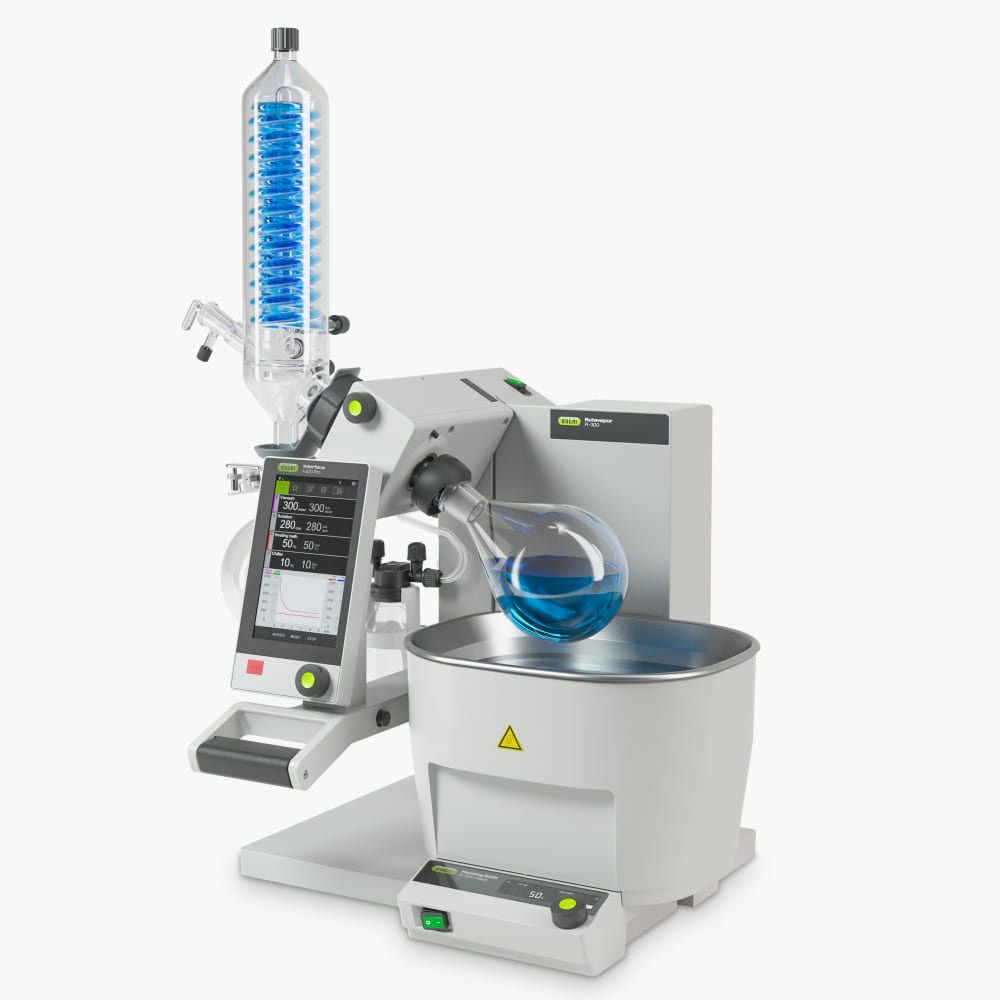
A 5 L rotary evaporator gives you more nominal flask capacity than a 2 L system, but that does not mean it is automatically the better or faster choice.
The real decision is whether the larger system reduces the number of batches and operator handling enough to justify its larger glassware, footprint, cooling demand, and complete-system cost.
For most buyers, the useful question is:
Will a 5 L system solve a real throughput problem that a 2 L system cannot solve efficiently?
If the answer is no, the smaller platform may be easier to install, easier to handle, and less expensive to support. If the answer is yes, moving to 5 L can reduce repeated batch handling—but only when the vacuum, condenser, chiller, receiving flask, and workflow are matched to the larger process.
Quick Decision Summary
| Decision factor | 2 L class | 5 L class |
|---|---|---|
| Routine batch size | Better fit for smaller laboratory batches | Better fit when routine batches consistently exceed a comfortable 2 L workflow |
| Repeated batches | Can become operator-intensive if many cycles are required | Can reduce batch count when the process justifies the larger flask |
| Glassware handling | Smaller and easier to handle | Larger and heavier |
| Footprint and height | Usually easier to fit into a crowded lab | More space and vertical clearance may be required |
| Condenser and cooling | Lower system load in many configurations | Cooling and condenser capacity deserve closer review |
| Best reason to choose | Your routine workload fits without excessive cycling | It materially reduces batch count or handling time |
This table is a decision framework, not an industry specification. Exact capabilities vary by manufacturer and configuration.
1. The Difference Is More Than “2 L vs 5 L”
Nominal flask capacity is the most visible difference, but it is not the only one. A larger rotary evaporator may also change receiving-flask capacity, condenser area, instrument height, total weight, bath geometry, lift travel, rotation-speed range, cooling requirement, vacuum-flow requirement, glassware replacement cost, and handling effort.
That is why a 5 L system should not be treated as a 2 L system with a bigger flask attached.
A concrete manufacturer example
Shanghai Linbel publishes separate specifications for its 2 L and 5 L rotary evaporators. The values below are useful because they come from the same manufacturer, reducing some of the noise that appears when unrelated brands are compared.
| Specification | Linbel 2 L example — ATR-001 | Linbel 5 L example — R1005 |
|---|---|---|
| Evaporation flask | 2 L | 5 L |
| Receiving flask | 2 L | 3 L |
| Condenser area | 0.15 m² | 0.27 m² |
| Rotation range | 35–200 rpm | 20–140 rpm |
| Maximum vacuum shown | 399.9 Pa | 399.9 Pa |
| Product size | 650 × 420 × 900 mm | 660 × 400 × 1020 mm |
| Product weight | 20 kg | 33 kg |
The 5 L evaporation flask is 2.5 times the nominal capacity of the 2 L flask, but the receiving flask, condenser area, dimensions, weight, and rotation range do not all increase by the same ratio. Both examples also publish the same maximum-vacuum value.
2. Choose 2 L When the Routine Process Is Actually Small
A 2 L rotary evaporator is often the more rational choice when normal work is laboratory scale and the system can complete the required workload without excessive repeat cycles.
A 2 L class is worth shortlisting when:
- routine samples are relatively small;
- the lab has limited bench or hood space;
- glassware is handled frequently;
- methods change often;
- throughput is moderate;
- one or a few batches per day are acceptable.
The main advantage is not simply a lower purchase price. It is lower operational burden. Smaller glassware is easier to mount, remove, clean, store, and replace, and a smaller platform is generally easier to fit around other laboratory equipment.
Current marketplace example: 2 L full-system listing
One current Alibaba listing is advertised as a 2 L rotary evaporator full set with water chiller, vacuum pump, and vacuum controller. When checked on September 18, 2026, the listing showed product ID 1600522495792, model RE-2010-2L, a displayed price of about US$889, MOQ 1 set, and Shanghai Yuhua Instrument Equipment Co., Ltd. as supplier.
The title advertises a full set, but the detailed page does not clearly identify the exact pump, chiller, and vacuum-controller models. Confirm those components before ordering.
View current 2 L full-system listing.
3. Choose 5 L When Repeated Batching Is the Bottleneck
Moving from 2 L to 5 L makes sense when the smaller platform forces unnecessary repetition. Examples include workflows where a routine feed has to be split across several runs, operator time is consumed by repeated loading and unloading, cleaning and changeover dominate the shift, or solvent recovery per day is increasing.
The key is routine throughput, not an occasional large batch. If you only need a larger flask once every few months, a permanently larger platform may create more daily inconvenience than value.
4. Do Not Convert Nominal Flask Size Directly Into Working Volume
A 2 L flask does not mean every process should be run at 2 L. A 5 L flask does not mean every process should be run at 5 L.
Practical fill level depends on solvent, sample composition, foaming, bumping tendency, viscosity, rotation, flask geometry, operating pressure, and manufacturer guidance. Equipvia does not use a universal rule such as “fill every rotary flask to 50%” because a single percentage cannot safely represent every solvent, flask, and process.
5. Throughput: Count Batches, Not Just Liters
Write down routine batch volume, batches per day, time per batch, loading time, evaporation time, unloading time, cleaning time, cooling recovery time, and operator time. Then ask:
Which of those steps would actually improve if we moved to 5 L?
If the bottleneck is repeatedly splitting feed between runs, 5 L may help. If the bottleneck is slow cooling, poor vacuum control, a small condenser, foaming, or operator technique, a bigger flask may not solve it.
This is why the comparison should be made in batches per shift, not only nominal liters.
6. A 5 L System Does Not Automatically Evaporate 2.5× Faster
Evaporation rate depends on heating, exposed liquid-film behavior, vacuum level and control, pump flow, condenser performance, cooling temperature and capacity, and solvent properties.
Linbel's published 2 L and 5 L examples are instructive: the two pages list different condenser areas and physical sizes, yet show the same published water and ethanol evaporation-rate figures. That is manufacturer-specific data, not a universal performance claim.
The correct buying principle is:
Larger flask capacity and higher evaporation throughput are not the same specification.
If throughput is the reason for choosing 5 L, ask the supplier for performance data relevant to your solvent and configuration rather than assuming performance from flask size.
7. Compare the Condenser and Cooling Path
The condenser has to recover the vapor the process generates. In the Linbel example, the published condenser area increases from 0.15 m² on the 2 L model to 0.27 m² on the 5 L model.
When comparing quotations, check condenser type, condenser area, cooling-fluid connections, recommended coolant temperature, cooling-flow requirements, whether the chiller is included, and chiller capacity at the intended operating temperature.
Do not compare chillers only by “minimum temperature: −20°C.” Ask for cooling capacity at your operating temperature, coolant-flow range, ambient-temperature limits, electrical requirements, and recommended connection size.
8. Do Not Select the Vacuum Pump From Flask Size Alone
Moving to 5 L can increase vapor load and system demand, but the correct pump is not simply “the bigger one.” Pump selection should consider solvent, required process pressure, chemical compatibility, flow rate, vapor load, and control strategy.
KNF's rotary-evaporator guidance warns that bigger is not always better: excessive flow can be difficult to regulate and unnecessarily expensive, while an undersized pump can slow evaporation.
9. Compare Footprint, Height, and Handling
In the Linbel example, the 2 L unit is listed at 650 × 420 × 900 mm and 20 kg, while the 5 L model is listed at 660 × 400 × 1020 mm and 33 kg. The footprint difference is modest, but the 5 L model is taller and substantially heavier.
Check total installed height, condenser clearance, lift travel, flask-removal clearance, access inside a fume hood, pump and chiller footprint, hose routing, and the ability to remove a filled receiving flask.
10. Receiving Flask Size Can Become a Workflow Constraint
A larger evaporation flask does not always come with a receiving flask of the same capacity. The Linbel example pairs a 2 L evaporation flask with a 2 L receiving flask and a 5 L evaporation flask with a 3 L receiving flask.
Ask how often the receiving flask will need to be drained, whether draining requires breaking vacuum, how easy the flask is to remove, and whether spare flasks are available.
11. Compare Complete-System Cost, Not Headline Equipment Price
Normalize every quotation for the evaporator, glassware, condenser, vacuum pump, vacuum controller, chiller, tubing, clamps and seals, spare glass, shipping, electrical requirements, installation, service, and warranty.
Marketplace example: a listing covering 2 L, 3 L, and 5 L
One current Alibaba listing from Shanghai Drawell Scientific Instrument covers 2 L, 3 L, and 5 L rotary evaporator variants on the same page. When checked on September 18, 2026, the listing showed product ID 1601236702574, models DW-ORE-2000A, DW-ORE-3000A, and DW-ORE-5000A, a displayed price range of US$1,760–2,150, and MOQ 1 piece.
The listing showed a 1 L receiving flask for the 2 L model and a 3 L receiving flask for the 5 L model. It listed product dimensions of 66 × 42 × 83 cm for 2 L and 74 × 44 × 96 cm for 5 L, with gross weights of 30 kg and 42 kg respectively. Vacuum control was listed as optional.
The page contains multiple variants and some fields are presented at listing level rather than variant level, so confirm the exact configuration before ordering.
View current 2 L / 3 L / 5 L listing.
12. A Practical 2 L vs 5 L Decision Checklist
Shortlist 2 L first if:
- your routine batches are small;
- one or a few runs complete the daily workload;
- bench or hood space is constrained;
- operators handle glassware frequently;
- process conditions change often;
- you do not yet have a validated need for larger throughput.
Shortlist 5 L first if:
- routine batches repeatedly exceed the comfortable 2 L workflow;
- multiple 2 L runs are creating measurable operator time;
- solvent recovery per shift is increasing;
- the process is stable enough to scale;
- the lab has suitable cooling and vacuum infrastructure;
- larger glassware handling is acceptable.
Reconsider both if:
- the real bottleneck is vacuum control;
- cooling recovery is slow;
- the condenser is undersized;
- the process foams or bumps badly;
- operator technique is inconsistent;
- continuous or semi-continuous evaporation would solve the workflow better than simply increasing flask size.
13. Questions to Ask Before Requesting a Quote
- What is the exact evaporation-flask capacity?
- What working range does the manufacturer recommend?
- What is the receiving-flask capacity?
- What condenser type and surface area are supplied?
- What vacuum pump model is included or recommended?
- What is the pump's flow rate and ultimate vacuum?
- What chiller model is included or recommended?
- What cooling capacity does the chiller provide at our operating temperature?
- What are the complete installed dimensions?
- What are the voltage and frequency requirements?
- Which glassware, seals, tubing, clamps, and adapters are included?
- What spare glassware is available?
- What is excluded from the quoted price?
- What warranty applies to the evaporator and auxiliary equipment?
Do not compare quotations until these fields are normalized.
Frequently Asked Questions
Is a 5 L rotary evaporator better than a 2 L?
Not inherently. A 5 L system is more suitable when larger routine batches or repeated processing justify the extra capacity. A 2 L system can be the more efficient purchase when the workload is genuinely small.
Is a 5 L rotary evaporator 2.5 times faster than a 2 L?
No universal relationship exists. Nominal flask capacity and evaporation rate are different specifications. Heating, vacuum, condenser, cooling, solvent, and control strategy all affect throughput.
Can I put a 5 L flask on a 2 L rotary evaporator?
Do not assume that flask sizes are interchangeable. Use only sizes, joints, load limits, and configurations supported by the specific manufacturer.
Does a 5 L rotary evaporator need a stronger vacuum pump?
It may require more pumping capacity depending on vapor load, but the correct pump must be selected from solvent, pressure, flow, compatibility, and control requirements. Bigger or deeper vacuum is not automatically better.
Does a 5 L rotovap need a larger chiller?
A larger process can create higher cooling demand, especially if the goal is higher throughput. Check chiller cooling capacity at the intended operating temperature rather than choosing from minimum temperature alone.
Is 2 L enough for a chemistry lab?
It can be enough for many small-batch laboratory workflows. The deciding factors are routine batch size and how many runs are required to complete the daily workload.
Final Takeaway
A 2 L rotary evaporator is a strong fit when the process is small, space matters, and the daily workload can be completed without excessive cycling.
A 5 L system becomes more attractive when repeated 2 L runs are a real bottleneck and the lab has the cooling, vacuum, space, and handling capability to support the larger process.
Which complete system handles our routine workload with fewer unnecessary batches and without adding avoidable infrastructure?